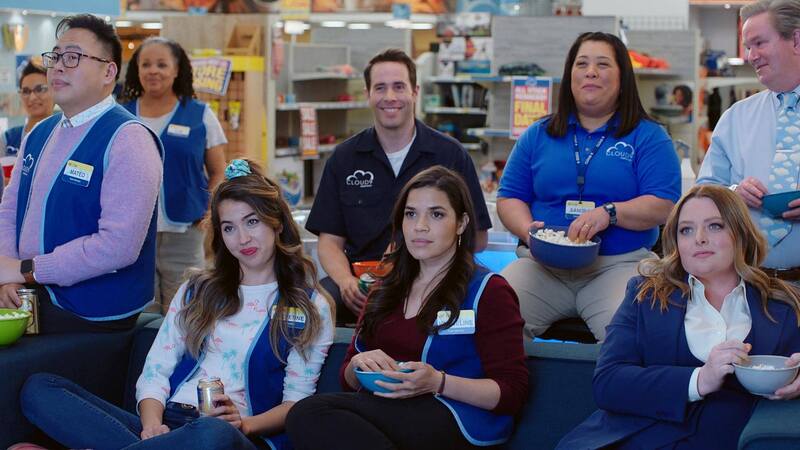
Corporate Wants Everyone to Smile
Read Time:8 Minute, 52 Second
TV SERIES REVIEW
Superstore: The Complete Series
TV-14 – 

Genre: Comedy
Year: 2015–2021, 2026 Blu-ray
Runtime: 39h 33m total / Approximately 22m per episode
Creator: Justin Spitzer
Directors: Various, including Ruben Fleischer, Victor Nelli Jr., and America Ferrera
Writers: Justin Spitzer, Jonathan Green, Gabe Miller, Jackie Clarke, and others
Cast: America Ferrera, Ben Feldman, Lauren Ash, Colton Dunn, Mark McKinney, Nichole Sakura, Nico Santos, Kaliko Kauahi
Where to Watch: available November 3, 2026; pre-order your copy here: www.moviezyng.com or www.amazon.com
RAVING REVIEW: The customers wandering through SUPERSTORE sometimes explain the entire show without saying a word. Between scenes, someone misuses merchandise, abandons an inappropriate item, or behaves as though entering a large retailer has suspended the rules of public life. These brief interruptions are some of the series’ most reliable jokes. They also establish a useful fact about Cloud 9, the fictional megastore where its employees spend their days. Whatever disagreement is consuming the break room, something worse is probably happening in the next aisle.
Created by Justin Spitzer, the series follows the staff of a Cloud 9 location in the St. Louis area across six seasons and 113 episodes. America Ferrera plays Amy, an experienced employee whose patience has worn thin with cheerful explanations of how things should work. Ben Feldman’s Jonah arrives with plenty of those explanations. He’s eager, educated, and determined to find meaning in a workplace where getting through the shift already takes a lot of effort.
Their initial difference gives the show an accessible entry point, but its ability to grow beyond them makes the complete series worth watching. Cloud 9 becomes a convincing collection of people who didn’t necessarily choose one another and can’t always choose to leave. Some want advancement, some need stability, and others simply try to minimize how much the job consumes them. That variety keeps the workplace from feeling like a temporary stop on everyone’s way to something better.
The physical environment does a surprising amount of comic work. Break rooms force incompatible personalities together, staff meetings turn private disputes into public arguments, and an announcement over the store’s speakers can expose something that should’ve stayed between two people. The aisles offer enough space to avoid each other without guaranteeing privacy. SUPERSTORE understands that a workplace can be enormous and still make it impossible to escape the coworker you don’t want to speak to.
Colton Dunn’s Garrett makes particularly good use of that arrangement. His dry delivery turns store announcements and passing observations into opportunities to amuse himself at someone else’s expense. Dunn rarely needs to push a joke when a slight pause or lack of enthusiasm will do. Garrett’s detachment is funny because it feels practiced, although the series also recognizes the selfishness that can hide inside a commitment to never taking anything seriously.
Lauren Ash moves in almost the opposite direction as Dina. Her attachment to rules, confidence in her own judgment, and indifference to ordinary social cushioning make her capable of derailing a conversation immediately. Ash commits to Dina’s intensity without asking the audience to approve of her behavior. The character becomes even more entertaining as her loyalties and unexpected vulnerabilities complicate that certainty. She’s difficult company, but rarely dull.
Mark McKinney’s Glenn supplies another kind of workplace hazard. He cares deeply about people while regularly misunderstanding what caring requires, especially when his religious beliefs or need for approval enter the conversation. McKinney’s anxious delivery makes Glenn’s attempts at reassurance wonderfully unreliable. His kindness matters, but the show doesn’t consistently let kindness excuse his intrusions or make him a competent manager.
The strongest ensemble pairings often come from shared habits rather than obvious opposites. Nichole Sakura’s Cheyenne and Nico Santos’ Mateo develop a friendship rooted partly in their willingness to judge everyone around them. Their conversations can be petty, quick, and sharply funny, with each encouraging the other’s worst instincts. Both performers also give their characters enough individuality that the friendship doesn’t swallow their separate lives.
Kaliko Kauahi’s Sandra becomes one of the show’s great assets by making quietness increasingly unpredictable. Her reluctance to assert herself creates one kind of joke, while the startling things she eventually contributes create another. The wider cast adds further possibilities, including Jon Barinholtz’s Marcus, Kelly Schumann’s Justine, and the late Linda Porter’s Myrtle. A familiar background employee can suddenly become the funniest person in an episode, which makes the store feel populated beyond its leading characters.
That depth is important because Amy and Jonah’s relationship doesn’t provide equally strong material throughout the run. Ferrera and Feldman have an appealing conversational rhythm, especially when irritation and attraction are pulling an exchange in different directions. Some complications, however, feel maintained because the series needs another complication. The workplace offers so many interesting relationships that the romantic uncertainty occasionally receives more attention than it earns.
Jonah’s self-image also becomes a recurring source of humor. His desire to be helpful often exposes how much he wants to be seen as the helpful one, and Feldman handles that embarrassment well. The show sometimes returns to the same lesson without finding a substantially different angle. Amy’s frustration has a similar limitation when the writing allows her impatience to become her main response rather than drawing on the intelligence and experience behind it.
SUPERSTORE distinguishes itself most clearly by treating employment as a practical condition of its characters’ lives. Money, scheduling, health coverage, childcare, and job security affect their choices. An argument about working conditions doesn’t arrive from outside the comedy as a separate educational assignment. It grows from what these people need and what their employer is willing to provide.
The union material benefits from that approach. Shared frustration doesn’t automatically produce agreement, particularly when workers have different levels of security and different reasons to fear retaliation. The series finds humor in misunderstandings and competing priorities without treating those fears as imaginary. Corporate language promises a shared identity, but it becomes less convincing when employees ask for something concrete in return.
Its treatment of immigration similarly gives employment consequences beyond the store’s immediate boundaries. The writing allows insecurity to affect someone who can also be vain, competitive, and unkind. That’s an important choice because a character shouldn’t have to become exceptionally agreeable before their circumstances deserve concern. SUPERSTORE can take a person’s vulnerability seriously while still letting that person be funny and flawed.
Occasionally, the social commentary becomes too neatly organized. A break-room conversation can start to resemble a sequence of positions arranged for the episode to address, with each employee supplying the next misunderstanding or objection. The best versions remain grounded in personality and personal interest. The weaker ones make the dialogue feel temporarily more concerned with covering the subject than with how these particular people talk.
Behavior also broadens as the seasons continue. Supporting characters sometimes become delivery systems for increasingly extreme remarks, and a few conflicts require someone to ignore experience they’ve already gained. The series is usually funny enough to recover, but the exaggeration makes certain episodes feel less connected to the recognizable workplace that gives the comedy its strength. This limitation is noticeable across a full-series viewing, even when individual jokes land.
The final season’s pandemic setting gives that workplace a different pressure. Customer entitlement and contradictory corporate expectations were already part of the show, and the adjustment feels connected to its existing concerns. Protective measures, public behavior, and the demands placed on retail workers provide material that belongs to these characters’ working lives. The season reflects a difficult period without suggesting that their earlier problems have conveniently disappeared.
Without revealing where everyone ends up, the finale gives the relationships the attention they deserve. It understands that the audience’s investment has expanded beyond the initial romance and the most prominent characters. The emotional payoff comes from recognizing how much time these people have spent together and how closely they’ve observed one another. That’s a fitting emphasis for a comedy built from conversations interrupted by announcements, customers, and the next task.
Universal’s November 3 Blu-ray collection includes all 113 episodes across six seasons on 11 discs, with a listed total runtime of 2,373 minutes. The announced specifications include a 1.78:1 presentation and DTS-HD Master Audio 5.1, with deleted scenes and a gag reel among the supplements. Those are the release specifications; judging the discs’ picture and sound requires examining the finished set.
SUPERSTORE earns its love through the number of people it makes worth following and the consistency with which their personalities generate comedy. Its romantic complications and occasional overstatement keep it from being equally strong every week, but Cloud 9 remains a remarkably useful setting for stories about compromise, resentment, affection, and getting paid. The employees don’t always like one another, and sharing a shift doesn’t magically resolve their differences. They do learn who’ll help when things go wrong, which counts for considerably more than another corporate speech about being a family.
Please visit https://linktr.ee/overlyhonestr for more reviews.
Follow me on Letterboxd, Instagram, Twitter, and YouTube. You can also find my social media accounts on most platforms by searching for 'Overly Honest Reviews'.
I’m always happy to hear from my readers; please don't hesitate to say hello or send me any movie questions.
[photo courtesy of MOVIE ZYNG, AV ENTERTAINMENT, UNIVERSAL]
DISCLAIMER:
At Overly Honest Movie Reviews, we value honesty and transparency. Occasionally, we receive complimentary items for review, including DVDs, Blu-rays, CDs, Vinyl Records, Books, and more. We assure you these arrangements do not influence our reviews, as we are committed to unbiased, sincere evaluations. We aim to help you make informed entertainment choices regardless of our relationship with distributors or producers.
Amazon Affiliate Links:
This site also contains Amazon affiliate links. If you purchase through these links, we may receive a commission. This affiliate arrangement does not affect our commitment to honest reviews and helps support our site. We appreciate your trust and support as you navigate these links.


Happy
0 %

Sad
0 %

Excited
0 %

Sleepy
0 %

Angry
0 %

Surprise
0 %
 0
 0


Average Rating