Sometimes the System Is Rotten
Read Time:9 Minute, 25 Second
MOVIE REVIEW
Bad Apples
 –


Genre: Dark Comedy, Thriller, Satire
Year: 2025, 2026
Runtime: 1h 40m
Director: Jonatan Etzler
Writer: Jess O’Kane (screenplay); Jonatan Etzler and Jess O’Kane (story); based on the novel DE OÖNSKADE by Rasmus Lindgren
Cast: Saoirse Ronan, Eddie Waller, Nia Brown, Jacob Anderson, Rakie Ayola, Robert Emms, Sean Gilder, Kerry Howard
Where to Watch: available to buy or rent on Digital November 3, 2026
RAVING REVIEW: Every teacher (at some point) has probably imagined what their classroom would be like without that one kid who makes everyone else’s life miserable. Most have the self-control not to act on it, but BAD APPLES isn’t particularly interested in that boring story, and thank goodness! Director Jonatan Etzler takes an outrageous premise and transforms it into a wonderfully entertaining dark comedy about education and the increasingly ridiculous consequences of refusing to confront a problem. Saoirse Ronan is fantastic as a teacher whose frustrations spiral into something far worse than just a bad day at work. It’s uncomfortable, ludicrous, occasionally horrifying, and somehow hilarious all at the same time. I had an absolute blast, which probably says something about my sense of humor…
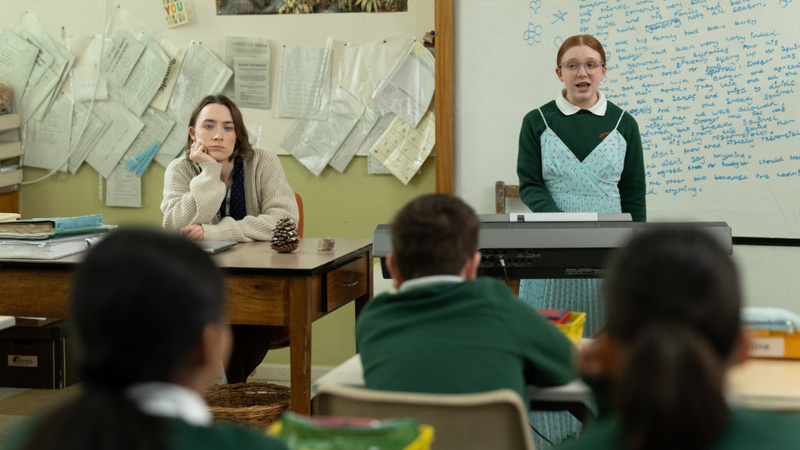
Maria (Ronan) is a primary school teacher who wants nothing more than to make a difference in her students’ lives. Unfortunately, wanting to be a good teacher and actually having the resources to manage a classroom are two very different things. Her class includes Danny (Eddie Waller), a ten-year-old whose behavior has progressed well beyond just playful mischief. He’s aggressive, disruptive, confrontational, and determined to make every school day as miserable as possible for everyone involved. The situation is particularly frustrating because Maria’s efforts to maintain order rarely make much difference. The administration and parents who should be supporting her seem more concerned with getting through the day than addressing the underlying problems.
Eventually, circumstances push Maria to realize that no amount of professional development could have prepared her for this. Without spoiling anything, chaos erupts and changes her world, and Danny’s, forever. His absence from school improves the classroom, and the same environment that had been falling apart begins functioning the way everyone always wanted. The students are happier, their performance improves, and the adults around Maria celebrate the transformation. The problem, of course, is that the solution involves something unacceptable (right?) and, realistically, should end her teaching career and send her to an entirely different kind of institution.
What makes this so entertaining is how easily the film encourages us to understand Maria before confronting us with the consequences of that sympathy. Danny is an absolute nightmare, and Eddie Waller commits to making him as infuriating as possible. He’s the sort of character who makes you wonder how anyone honestly lasts an entire school year dealing with him. That is essential to the comedy because the film wants its audience to recognize the temptation of the… absurd solution before considering the implications. BAD APPLES has a great deal of fun exploring the uncomfortable reality between those ideas.
Ronan has become one of those performers who draw me into any project, and BAD APPLES gives her a chance to demonstrate another side of her acting. She’s already established herself through dramatic performances in films such as LADY BIRD, BROOKLYN, and others, but her comedic timing deserves just as much appreciation. Maria isn’t a cartoonishly incompetent teacher or someone secretly waiting for an excuse. Her attempts to do the right thing become tangled with exhaustion, fear, frustration, and increasingly desperate efforts to protect herself. Ronan understands that the character’s sincerity is necessary for everything else to work.
The performance benefits from Ronan’s ability to communicate frustration without making everything an explosive confrontation. Maria spends much of her life trying to maintain a level of composure that her reality can justify. That restraint creates an interesting contradiction. She’s supposed to be the responsible adult in the room, yet her growing desperation makes her judgment questionable. Ronan can make disbelief feel like part of the joke without turning the character into a caricature.
Eddie Waller deserves credit for making Danny such an effective source of conflict. Playing an intentionally unpleasant child is tricky because the performance has to establish enough to justify everyone else’s frustration without losing sight of the fact that the character is still a child. Waller brings the aggression and defiance, creating a presence that changes the classroom atmosphere almost immediately. The interesting thing is the reality that children don’t develop in isolation, and the people responsible for their upbringing influence the behavior that eventually becomes everyone else’s problem.
Nia Brown delivers another standout performance as Pauline, a student who acts nothing like Danny. Where Danny challenges authority, Pauline embodies everything a teacher might want in a student. She’s attentive, ambitious, and eager to behave. The contrast between these two children becomes increasingly important to the film’s understanding of good and bad behavior. Brown brings a fascinating intensity to her role, showing how someone who understands authority figures’ expectations can use that knowledge to their advantage.
Waller and Brown aren’t simply there to give Ronan something to react to; their characters are essential to the story’s shifting power dynamics. Both bring distinctive personalities to their performances, and their interactions with the adults contribute to the film’s increasingly uncomfortable sense of humor. There’s something absurd about watching adults struggle to maintain control while children discover exactly how much influence they can exert over the people supposedly responsible for them. These performances hold their own alongside Ronan. While they both offer up somewhat stereotypical roles, the way they play them is why everything here works.
The British school setting works because the film’s craziness exists alongside problems that don’t need much exaggeration. Teachers are expected to educate children with different abilities, behavioral needs, home settings, and emotional difficulties while meeting academic targets and managing parents’ and administrators’ expectations. When those responsibilities become overwhelming, individual teachers often bear the burden, even when the problems are far more than one person can solve.
Everyone wants better outcomes, but what happens when those outcomes depend on excluding someone who was already struggling? It’s tempting to view Danny only through the inconvenience he causes, especially when his behavior disrupts an entire class. The film doesn’t excuse his actions, nor does it pretend teachers should tolerate them without resolve.
Parents aren’t immune to criticism either. The film presents a social environment where responsibility is often passed between people with different expectations of what everyone else should be doing. Schools are expected to correct behavior that originates outside the classroom, while parents can become defensive when confronted with the consequences of their children’s actions.
I also appreciate that the satire isn’t limited to the argument that children are terrible or teachers are overworked. The title gradually takes on more meaning as the story examines how damaging behavior can exist at every level of an institution. Sometimes the person causing the most disruption isn’t the only one contributing to the problem. That’s a strong foundation because it lets the film challenge the audience’s assumptions without abandoning the entertainment value of its premise.
The film’s humor is often uncomfortable, and that’s exactly what I wanted from something like this. BAD APPLES doesn’t ask us to approve of Maria’s decisions before we can find things about it funny. It recognizes that the contradiction between her intentions and her behavior is part of what makes it work. It’s a style of humor that rewards audiences willing to embrace the uncomfortable rather than expecting every joke to arrive with an obvious punchline.
The film’s willingness to let its characters behave unexpectedly, unreasonably, or in ways a responsible person shouldn’t is part of what makes it work. That doesn’t mean their actions are okay, but fictional characters don’t have to make the right decisions to be entertaining. In fact, this story would lose its personality if everyone responded with the maturity and professionalism we’d expect in real life. Etzler and O’Kane understand how people can convince themselves that their decisions are somehow manageable. Watching those rationalizations collide with reality is part of the fun.
BAD APPLES benefits from not needing to explain the satire to the audience. The implications surrounding educational inequality, institutional priorities, and parental responsibility are present without the characters constantly stopping to announce the film’s message. Its exaggerated circumstances invite us to consider what lies beyond the story, but the experience still feels like watching the outrageous. I appreciate that balance because social commentary can become exhausting when filmmakers seem more interested in lecturing than in entertaining.
Its mix of Scandinavian and British institutional satire, plus an internationally recognizable lead, gives it a distinctive identity. More importantly, Etzler shows confidence in a comedy that isn’t designed to make everyone comfortable. The audience has to be willing to find humor in increasingly unpleasant ethical implications, and I loved how enthusiastically the film commits to that.
Ronan may be the headline attraction, but I was just as impressed by the young performers and the filmmakers’ willingness to push their premise into such uncomfortable territory. BAD APPLES is the kind of film that makes you laugh, then makes you reconsider whether laughing was the right response. That’s part of its appeal, and the story’s interest in responsibility extends well beyond the original conflict. Teachers deserve support, children deserve an education, and institutions have an obligation to protect both. Unfortunately for everyone involved, Maria found a solution that wouldn’t make anyone happy if they knew the truth.
I love a movie that understands exactly how ridiculous it is and uses that to make its larger ideas more entertaining. BAD APPLES delivers a terrific performance from Saoirse Ronan, an unexpectedly formidable pair of young actors, and a wonderfully twisted examination of an education system that seems determined to make everyone’s problems worse. It’s funny, uncomfortable, and just mean enough to make its satire sting. And while I certainly wouldn’t recommend Maria’s approach to classroom management, I have to admit that watching her attempt to navigate the consequences makes for one hell of an entertaining film. Maybe the next time someone suggests that teachers should just try a little harder, they should watch this first.
Please visit https://linktr.ee/overlyhonestr for more reviews.
Follow me on Letterboxd, Instagram, Twitter, and YouTube. You can also find my social media accounts on most platforms by searching for ‘Overly Honest Reviews’.
I’m always happy to hear from my readers; please don’t hesitate to say hello or send me any movie questions.
[photo courtesy of REPUBLIC PICTURES, PARAMOUNT, VICE STUDIOS, HANWAY FILMS]
DISCLAIMER:
At Overly Honest Movie Reviews, we value honesty and transparency. Occasionally, we receive complimentary items for review, including DVDs, Blu-rays, CDs, Vinyl Records, Books, and more. We assure you these arrangements do not influence our reviews, as we are committed to unbiased, sincere evaluations. We aim to help you make informed entertainment choices regardless of our relationship with distributors or producers.
Amazon Affiliate Links:
This site also contains Amazon affiliate links. If you purchase through these links, we may receive a commission. This affiliate arrangement does not affect our commitment to honest reviews and helps support our site. We appreciate your trust and support as you navigate these links.


Happy
0 %

Sad
0 %

Excited
0 %

Sleepy
0 %

Angry
0 %

Surprise
0 %
 0
 0


Average Rating