A Devastating Portrait of Misplaced Affection
Read Time:15 Minute, 25 Second
MOVIE REVIEW
Scarlet Street
 –


Genre: Film Noir, Crime, Drama
Year Released: 1945, 2026 4K / Blu-ray
Runtime: 1h 41m
Director: Fritz Lang
Writer: Dudley Nichols, based on La Chienne by Georges de La Fouchardière and André Mouëzy-Éon
Cast: Edward G. Robinson, Joan Bennett, Dan Duryea, Margaret Lindsay, Rosalind Ivan, Jess Barker, Charles Kemper
Where to Watch: available November 23, 2026; Pre-order your copy here: www.eurekavideo.co.uk
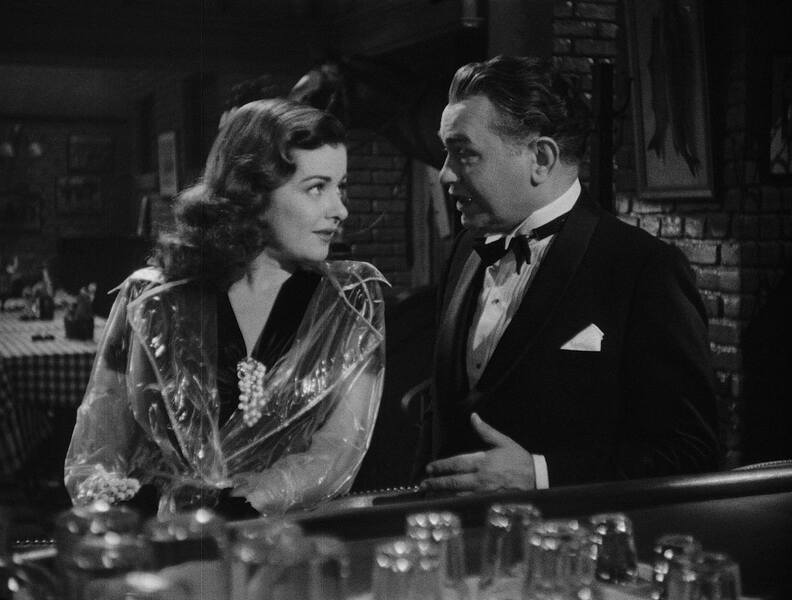
RAVING REVIEW: Christopher Cross has spent twenty-five years being a dependable employee, and the reward for all that loyalty is a watch and another evening heading home to a marriage that makes him miserable. That's the kind of cruel joke Fritz Lang understands better than almost anyone. SCARLET STREET takes an ordinary man who desperately wants something better from life and places him in a situation where his loneliness makes him an easy target. Edward G. Robinson, an actor so closely associated with tough guys and gangsters, becomes a man whose greatest weakness is his willingness to believe that someone might genuinely care about him. What follows is a remarkably unpleasant examination of how badly people can treat one another, made all the more uncomfortable because nobody involved is entirely innocent of the circumstances that develop.
Lang's 1945 film occupies an important place in American noir, but its reputation as a classic can sometimes obscure just how mean its story actually is. The characters aren't especially interested in doing the right thing, and even their occasional moments of apparent decency tend to come with expectations attached. Dudley Nichols' screenplay understands how easily desperation can be mistaken for affection and how people convince themselves that their dishonest behavior is justified. The resulting drama is filled with manipulation, though the characters' motivations are familiar enough to make their behavior more disturbing than a collection of elaborate criminal schemes.
Robinson's Christopher works as a cashier and spends his free time painting, one of his few opportunities for personal satisfaction. His marriage to Adele, played by Rosalind Ivan, offers very little encouragement. She has little appreciation for his artistic interests, and their domestic relationship is defined by resentment that has clearly existed for years. Christopher isn't a traditionally appealing romantic protagonist, but his dissatisfaction is understandable. He's approaching a point in life when the opportunities he imagined having seem increasingly distant, and his paintings represent an ambition that hasn't disappeared, even though everything around him suggests it should.
An unexpected encounter with Kitty March, played by Joan Bennett, introduces the possibility of something different. Christopher intervenes when he witnesses her being attacked by Johnny Prince, played by Dan Duryea, without realizing that Johnny is also Kitty's boyfriend. Kitty mistakes Christopher for a wealthy artist, and he does very little to correct that impression. Their relationship begins with misunderstandings that quickly become useful to people who recognize how easily he can be exploited. Christopher wants to believe he's finally met someone who appreciates him, while Kitty and Johnny see a potential source of money. The arrangement is unlikely to end well, but Lang cares far more about the personal weaknesses that sustain it than about rushing toward the inevitable consequences.
Robinson's performance is essential to understanding why Christopher works as something more complicated than an unfortunate fool. The actor's familiar screen authority is replaced by an uncomfortable eagerness to please, making his character's emotional vulnerability central to the story. Christopher isn't unaware that his life has become disappointing. His mistake is believing that an unexpected romance can somehow repair years of dissatisfaction without requiring him to examine his own behavior. Robinson gives the character enough humanity that his predicament invites sympathy, even when his decisions become increasingly frustrating. The film doesn't require the audience to approve of Christopher to recognize that he's being treated terribly.
That distinction becomes important because Christopher's willingness to deceive is part of the problem. He lets Kitty maintain her mistaken assumptions about his financial circumstances and artistic reputation, creating an identity that becomes harder to sustain. He isn't simply an innocent man whose kindness is exploited without his participation. His desire to be admired encourages him to maintain an illusion, and his dishonesty makes it easier for others to construct increasingly elaborate schemes around him. The tragedy develops from choices that initially seem minor, making the consequences more convincing than a story that depends on one spectacularly foolish decision.
Bennett's Kitty is similarly complicated, although her behavior is considerably harder to defend. She's willing to encourage Christopher's romantic interest because she believes she can gain something from it, but her attachment to Johnny adds another layer of exploitation. Kitty isn't operating independently as a criminal mastermind. She's involved with someone who treats her badly and encourages her to manipulate another person, creating a relationship in which affection and personal advantage have become difficult to separate. Bennett's performance benefits from that contradiction. Kitty can be calculating without becoming an abstract embodiment of evil, and her behavior reflects a woman whose priorities have been shaped by the people she chooses to keep around her.
Duryea's Johnny brings a nastier personality to the arrangement. He's openly unpleasant, casually abusive, and convinced that he's clever enough to profit from Christopher's infatuation. Unlike the cashier, Johnny doesn't need to construct a respectable identity to feel comfortable with himself. His confidence comes from believing other people exist to be used, and Duryea makes that attitude central to the character. Johnny's relationship with Kitty is particularly revealing because his treatment of her establishes the cruelty that the couple eventually directs toward Christopher. Their scheme isn't a harmless deception that spirals beyond their control. The exploitation was present before Christopher ever entered their lives.
The connections between these characters allow Lang to examine several different kinds of dependency. Christopher needs Kitty to validate an identity he's never managed to establish for himself. Kitty remains attached to Johnny despite the obvious problems in their relationship, and Johnny depends on others to finance the lifestyle he believes he deserves. None of these relationships offers genuine equality. Everyone wants something from someone else, and the difference between emotional attachment and personal exploitation becomes increasingly difficult to identify. The film's understanding of those unhealthy arrangements gives its familiar noir premise much of its psychological interest.
Christopher's paintings introduce another fascinating element because they carry meaning that the people around him don't necessarily understand. To Adele, his artistic interests are another reason to criticize him. For Kitty and Johnny, the paintings eventually become objects with potential financial value. Christopher approaches them differently, using art to express something that his ordinary existence doesn't accommodate. His creative work becomes another possession that other people believe they're entitled to control. This allows the film to explore the difference between an artist's personal attachment to their work and the commercial value someone else assigns to it.
There's additional irony in how Christopher's artistic identity develops. The paintings that seem incapable of earning his wife's respect become potentially valuable once they're associated with another person. Recognition depends on circumstances that have little to do with the intentions behind the artwork. That makes the deception surrounding the paintings more than a convenient plot development. It exposes the uncomfortable relationship between talent and reputation, particularly when financial success becomes the primary measure of artistic achievement. Lang doesn't turn this into a separate lecture about the art world. He makes it part of Christopher's personal humiliation, allowing a professional disappointment to become inseparable from his romantic vulnerability.
The paintings themselves were created by artist John Decker, a detail that adds another interesting connection between the film's production and its story. The artwork needed to function convincingly as the product of a person who paints for personal satisfaction rather than public recognition. Its role in the narrative also required it to be desirable to people who evaluate art by different standards. It's a useful example of how much thought can exist behind an apparently ordinary production detail. The paintings aren't decorative objects included simply to establish that Christopher has a hobby. They play a meaningful role in the relationships that define the film.
SCARLET STREET also reunites Robinson, Bennett, and Duryea following their appearance in Lang's THE WOMAN IN THE WINDOW. Released the previous year, that film similarly explores the consequences of a respectable man becoming involved with a woman whose presence disrupts his ordinary existence. The similarities make the two productions natural companions, but SCARLET STREET is considerably more cynical about its characters' motivations. Nichols and Lang approach the material without requiring the audience to maintain unwavering sympathy for the protagonist. Christopher's problems are recognizable, yet his response to them becomes increasingly difficult to excuse. The result is a story that permits moral discomfort rather than providing an obvious person to defend.
The film's origins extend beyond that earlier collaboration. SCARLET STREET adapts Georges de La Fouchardière's novel LA CHIENNE, which Jean Renoir had previously brought to the screen in 1931. André Mouëzy-Éon also contributed to the source's theatrical history, giving Lang and Nichols material that had already been interpreted in multiple ways. The American adaptation relocates the circumstances to a different social environment without abandoning the central relationships. That history helps explain why the story combines recognizable noir conventions with an unusually bitter understanding of romantic humiliation. Its concerns weren't invented specifically for the American crime-film boom, even though Lang's direction makes them feel perfectly suited to it.
Lang's background in German cinema is another important consideration. His work on films such as M demonstrated an interest in criminal psychology and the relationship between individual wrongdoing and social judgment long before his American noir productions. SCARLET STREET brings those concerns into a smaller domestic setting, making ordinary rooms and familiar relationships sources of anxiety. Cinematographer Milton Krasner helps establish the visual environment through compositions that emphasize the distance between the characters and the identities they want to project. The film's expressionist inheritance isn't simply about making everything darker. Visual choices support a story about people whose understanding of their circumstances is increasingly unreliable.
The screenplay's occasionally cruel humor deserves recognition, too. Christopher's situation is often so humiliating that the behavior of people around him approaches absurdity. At times, the audience recognizes the deception so easily that his continued acceptance becomes almost unbearable. Those moments aren't necessarily evidence that the story has lost control of its characters. They're part of its willingness to examine the ridiculous behavior people accept when they're desperate to preserve a comforting belief. Lang allows that discomfort to exist alongside the serious consequences of the characters' actions, creating a film that doesn't always invite an easy emotional response.
It's possible to criticize Christopher's gullibility as excessive, especially as the warning signs around Kitty and Johnny become harder to ignore. His behavior requires patience because so much of the drama depends on his refusal to acknowledge what the audience can recognize. His inability to confront reality also forms the film's central psychological argument. Christopher isn't merely confused about Kitty's intentions. He's invested in maintaining a version of his life that makes him feel worthwhile. Accepting the truth would mean admitting how much of that imagined happiness he constructed himself, and that's a considerably more painful prospect than continuing to believe someone else's lies.
The film was controversial during its original release, with censorship disputes arising in several American jurisdictions. New York initially banned it before approving a modified version, and restrictions also emerged in Atlanta and Milwaukee. These objections reflected contemporary concerns about depicting criminal behavior and the consequences assigned to characters whose actions violated accepted moral standards. Lang's film arrived during an era when Hollywood productions were expected to satisfy strict expectations about punishment and social responsibility. Its treatment of guilt and accountability demonstrates how filmmakers could operate within those restrictions while producing material that remained disturbing.
The historical circumstances make Eureka Entertainment's new Masters of Cinema edition particularly worthwhile. SCARLET STREET has a complicated home-video history, including years of widely circulated presentations that haven't always represented the film well. Eureka's limited edition offers a 4K restoration sourced from a 35mm nitrate composite fine grain, with the feature presented in its original 1.37:1 aspect ratio. The two-disc package includes a 2160p UHD presentation and a 1080p Blu-ray, along with the original mono soundtrack and optional English subtitles. It represents an important opportunity to revisit a significant work of American noir through a dedicated archival presentation.
The UHD disc is region-free, although the accompanying Blu-ray is locked to Region B. That's an important distinction for collectors outside the UK, especially those accustomed to buying boutique releases without checking compatibility. The limited edition includes an O-card slipcase designed by Nick Wrigley and a collector's booklet featuring a new essay by Barry Nevin examining the relationship between SCARLET STREET, its French literary origins, and Renoir's LA CHIENNE. That comparative approach is a sensible addition, because the film's history offers more to discuss than its place in Lang's American career.
Eureka has also assembled an impressive selection of supplementary material. Noir historian Imogen Sara Smith contributes an audio commentary. At the same time, David Cairns examines Lang and SCARLET STREET in the video essay ALL YOUR FEARS ARE FOOLISH FANCY MAYBE, featuring director Alexander Payne voicing Darryl F. Zanuck. Film historian Sheldon Hall provides the appreciation HELLO, LAZY LEGS, and Pamela Hutchinson discusses Joan Bennett's career in FEMME FATALE. The release also includes three episodes of the radio anthology SUSPENSE featuring Edward G. Robinson. These additions extend the discussion beyond the feature itself, particularly through material devoted to its performers and place in film history.
The connection between Bennett and Lang especially deserves that attention. Their collaboration extended across several films, and Bennett's association with the director became an important period in her career. It's easy to discuss SCARLET STREET primarily as a showcase for Robinson because Christopher's personal disaster drives so much of the story. Bennett's contribution is just as essential to the film's character relationships. Kitty needs to be convincing as the object of Christopher's affection and as someone capable of participating in the deception that exploits him. Reducing her to a generic femme fatale overlooks the difficult relationship that informs many of her choices.
SCARLET STREET remains compelling because its characters create much of their own suffering without necessarily understanding the damage they're causing. Christopher wants affection and recognition, but those desires don't excuse his dishonesty. Kitty sees an opportunity to improve her circumstances and accepts increasingly unpleasant methods of doing so. Johnny is comfortable exploiting practically anyone who might benefit him. Lang brings these people together in a story that understands how selfishness can become destructive without requiring its participants to begin with elaborate criminal ambitions. Their weaknesses are recognizable long before the consequences become severe.
There's something especially disturbing about a noir that doesn't depend on an extraordinary criminal world. Christopher has a conventional job, an unhappy marriage, and an artistic interest that should satisfy him. His circumstances aren't glamorous, but they're familiar. The people who take advantage of him don't possess unusual intelligence or sophisticated resources. Their success depends on his willingness to believe what he wants to hear. That's the source of the film's enduring cruelty. The danger isn't confined to people living outside respectable society. It exists in the ordinary desire to be loved, admired, and treated as someone whose life matters.
Eureka's edition gives this uncomfortable story an appropriate place within a collection devoted to preserving important cinema. Lang's direction, Robinson's vulnerable performance, and the destructive relationships Bennett and Duryea develop make SCARLET STREET an enduring example of how deeply noir can examine human behavior. The film doesn't need likable characters or consistently sensible decisions to make their predicament worth following. Its bitterness comes from understanding that people can recognize the source of their unhappiness and still choose the actions that make everything worse. Christopher Cross desperately wants his life to become something different, and Lang understands just how dangerous that desire can become when someone else realizes what he's willing to sacrifice for it.
Please visit https://linktr.ee/overlyhonestr for more reviews.
Follow me on Letterboxd, Instagram, Twitter, and YouTube. You can also find my social media accounts on most platforms by searching for 'Overly Honest Reviews'.
I’m always happy to hear from my readers; please don't hesitate to say hello or send me any movie questions.
[photo courtesy of EUREKA ENTERTAINMENT]
DISCLAIMER:
At Overly Honest Movie Reviews, we value honesty and transparency. Occasionally, we receive complimentary items for review, including DVDs, Blu-rays, CDs, Vinyl Records, Books, and more. We assure you these arrangements do not influence our reviews, as we are committed to unbiased, sincere evaluations. We aim to help you make informed entertainment choices regardless of our relationship with distributors or producers.
Amazon Affiliate Links:
This site also contains Amazon affiliate links. If you purchase through these links, we may receive a commission. This affiliate arrangement does not affect our commitment to honest reviews and helps support our site. We appreciate your trust and support as you navigate these links.


Happy
0 %

Sad
0 %

Excited
0 %

Sleepy
0 %

Angry
0 %

Surprise
0 %
 0
 0


Average Rating