A Pilgrimage Through Love, Fear, and Obligation
Read Time:5 Minute, 51 Second
MOVIE REVIEW
9 Temples to Heaven (9 วัด สู่สวรรค์)
 –
– 


Genre: Drama
Year Released: 2026
Runtime: 2h 20m
Director(s): Sompot Chidgasornpongse
Writer(s): Sompot Chidgasornpongse
Cast: Amara Ramnarong, Surachai Ningsanond, Jirawut Chiwaruck, Yaneenan Jiraphatjittrin, Klaichan Phunman
Where to Watch: shown at the 2026 Cannes Film Festival
RAVING REVIEW: There’s a precise kind of exhaustion that only comes from family. Not hatred, not resentment, not even conflict in the conventional sense. Just the emotional fatigue of people who’ve known each other too long, understand each other too well, and still fail to communicate in ways that matter. 9 TEMPLES TO HEAVEN understands that feeling. Instead of trying to dramatize it into explosive confrontations or sentimental breakthroughs, the film lets it settle naturally. Conversations trail off. Small disagreements continue. Silence becomes its own language. By the time this family reaches the later stages of their pilgrimage, the emotional weariness hanging over them feels almost physical.
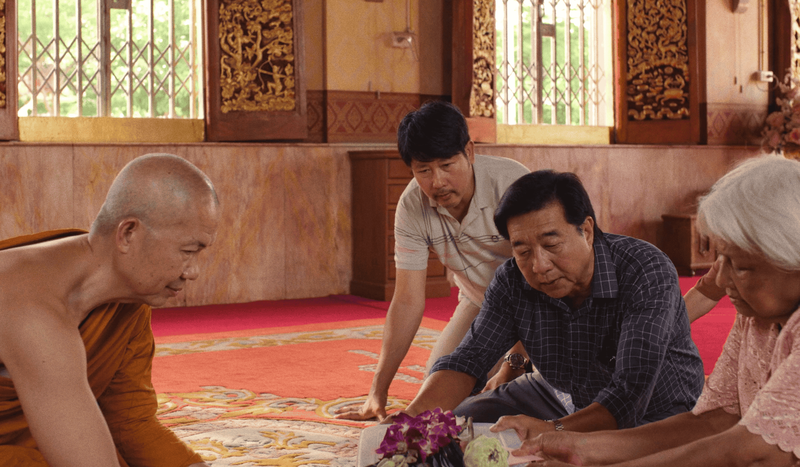
Sompot Chidgasornpongse builds the film around a deceptively simple premise. After hearing that his elderly mother may die soon, Sakol organizes a one-day trip across nine temples with multiple generations of his family in hopes that ritual and merit-making might somehow delay the inevitable. What initially sounds like a spiritual journey slowly reveals itself as something far more complicated. This isn’t really a film about fixing fate. It’s about the desperate human need to feel useful as mortality becomes unavoidable.
One of the smartest things the film does is resist turning Sakol into either a noble patriarch. Surachai Ningsanond plays him with a heaviness that feels deeply internalized. He carries himself like a man trying to maintain order because he’s terrified of what happens if he stops moving. The pilgrimage becomes less about faith and more about impetus. If the family keeps driving, keeps praying, keeps arriving at the next temple, maybe they can avoid sitting still long enough to confront what’s actually happening to the grandmother at the center of everything.
Amara Ramnarong gives the film its emotional pull without demanding attention. Her performance is remarkably restrained, especially considering how easy it would’ve been for the role to lean into overt fragility. Instead, she often exists slightly outside the chaos surrounding her. There’s a sadness in the way others project meaning onto her condition while she drifts further inward physically and mentally. Some of the film’s strongest moments come from watching family members speak around her rather than directly to her, almost treating her as both participant and symbol at once.
The structure naturally invites repetition. Nine temples, repeated rituals, repeated stops, repeated prayers. That repetition is clearly intentional, and it ties directly into the film’s larger ideas about routine, tradition, and cycles that families inherit without fully questioning. Chidgasornpongse’s director’s statement openly connects the film to modern Thailand’s political and spiritual tensions, particularly the ways ritual can become intertwined with nationalism, superstition, social expectations, and emotional survival. Those ideas sit underneath nearly every interaction in the film, even when characters aren’t discussing them directly.
A lesser version of this story might’ve reduced religious practice into either comforting wisdom or meaningless performance. 9 TEMPLES TO HEAVEN lives in a murkier space. The family members clearly don’t agree on what any of this actually means. Some appear invested. Others seem emotionally detached. The journey itself still creates moments of connection that probably wouldn’t exist otherwise.
Jonathan Ricquebourg’s cinematography plays a major role in maintaining that balance. The temples themselves are undeniably beautiful, but the film rarely photographs them with the kind of overwhelming grandeur audiences might expect. Instead, the spaces often feel strangely practical, almost ordinary, once the family settles into them. The repetition of architecture, prayer routines, and travel begins to blur together, reinforcing the film’s emotional rhythm. Over time, the van carrying the family begins to feel more important than the temples themselves. That confined space becomes the film's real emotional battleground.
Even during its slower stretches, the film remains perceptive. Chidgasornpongse has a strong understanding of family dynamics that rarely announce themselves. Small gestures carry more than dramatic speeches. A glance between siblings says more than a confrontation. Someone quietly stepping away from a conversation can reveal years of unresolved tension. The film trusts viewers to observe rather than wait for emotional exposition, and that trust gives many scenes a lived-in authenticity.
There’s also something devastating about the film’s relationship with time. The entire story unfolds across a single day, yet it carries the density of years of unresolved family history. As the light changes throughout the journey, gradually moving from daytime to darker artificial lighting, the film reinforces the sense that everyone involved is racing against something they can’t stop. Not just death itself, but the realization that families eventually become collections of memories and unfinished conversations.
9 TEMPLES TO HEAVEN won’t connect with everyone. Its pacing is demanding, its emotional approach restrained, and its storytelling intentionally repetitive. Chidgasornpongse isn’t simply documenting ritual. He’s examining the fragile structures families build around fear, grief, duty, and love, especially when nobody knows how to prepare for losing someone who has always existed at the center of their lives. The film never loses sight of the humanity driving the journey. By the end, the temples themselves almost feel secondary. It’s the images of a family trying, imperfectly and sometimes awkwardly, to stay emotionally connected while confronting the reality that time keeps moving, whether they’re ready for it or not, that really stay with you.
Please visit https://linktr.ee/overlyhonestr for more reviews.
You can follow me on Letterboxd, Instagram, Twitter, and YouTube. My social media accounts can also be found on most platforms by searching for 'Overly Honest Reviews'.
I’m always happy to hear from my readers; please don't hesitate to say hello or send me any questions about movies.
[photo courtesy of PLAYTIME, KICK THE MACHINE FILMS, E&W, PETIT CHAOS, NEEDLE IN THE HAYSTACK, THE PR FACTORY]
DISCLAIMER:
At Overly Honest Movie Reviews, we value honesty and transparency. Occasionally, we receive complimentary items for review, including DVDs, Blu-rays, CDs, Vinyl Records, Books, and more. We assure you that these arrangements do not influence our reviews, as we are committed to providing unbiased and sincere evaluations. We aim to help you make informed entertainment choices regardless of our relationship with distributors or producers.
Amazon Affiliate Links:
Additionally, this site contains Amazon affiliate links. If you purchase through these links, we may receive a commission. This affiliate arrangement does not affect our commitment to honest reviews and helps support our site. We appreciate your trust and support as you navigate these links.


Happy
0 %

Sad
0 %

Excited
0 %

Sleepy
0 %

Angry
0 %

Surprise
0 %
 0
0
 0
0

Average Rating