History Takes a Backseat to Acrobatics
Read Time:7 Minute, 57 Second
MOVIE REVIEWS
Shogun's Ninja [Limited Edition] (Ninja bugeicho momochi sandayu)
 –
– 

Genre: Action, Adventure, Martial Arts
Year Released: 1980, 2026 Arrow Video Blu-ray
Runtime: 1h 57m
Director: Norifumi Suzuki
Writers: Fumio Kônami, Ichirô Ôtsu
Cast: Hiroyuki Sanada, Sonny Chiba, Etsuko Shihomi, Yuki Ninagawa, Tetsurō Tanba, Asao Koike, Isao Natsuyagi
Where to Watch: available August 25, 2026, pre-order your copy here: www.arrowvideo.com, www.mvdshop.com, or www.amazon.com
RAVING REVIEW: During SHOGUN’S NINJA, it becomes clear that nobody involved was particularly concerned about whether all of this belonged in the same movie. Sword fights and clan rivalries share the screen with flying ninjas, hidden treasure, years of revenge plotting, and a soundtrack that occasionally seems to have come in from another decade. Director Norifumi Suzuki keeps piling one choice on top of another until the excess becomes part of the fun. Trying to make sense of the combination almost feels beside the point. Yet, somehow, with all of this, it just works.
That unpredictability is both the reason the movie is fun and the reason it never becomes as strong as it could have. Suzuki takes the film on a journey between historical drama, revenge story, martial arts spectacle, comedy, and almost comic-book fantasy without smoothing the transitions into a recognizable genre in the end. One scene treats betrayal with a deep seriousness, another sends fighters bouncing through the landscape with near-superhuman agility, and the soundtrack may react to either one as though everyone should loosen up.
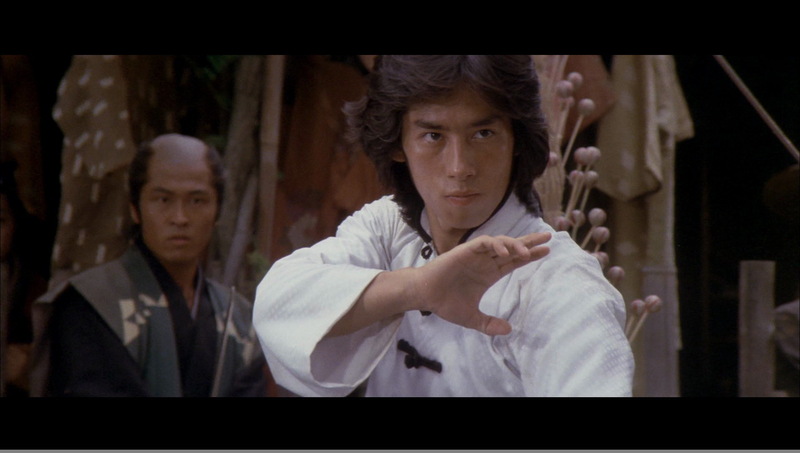
Hiroyuki Sanada is the element capable of surviving all of those changes. At only 20 when SHOGUN'S NINJA gave him his first leading role, Sanada already looks completely comfortable carrying an action picture. Takamaru Momochi returns to Japan after years in China, seeking revenge against Shiranui Shōgen for the destruction of the Momochi clan and the death of his father.
Sanada brings more to Takamaru than just the youthful energy. His movement has a precision that makes the stunt work look like part of the character rather than a performer waiting for the next set piece. He can leap, climb, fight with weapons, and move through complicated choreography without Suzuki having to hide the action behind frantic editing. Even when Takamaru's emotional development gets lost inside the crowded plot, Sanada keeps him believable.
Watching him here after decades of later work makes the movie particularly interesting. The presence familiar from his mature performances hasn't formed in full, though the discipline behind it is already visible. SHOGUN'S NINJA frequently asks him to work at a much louder level, including moments of grief and expression that are so exaggerated they border on surreal. Sanada commits anyway. Restraint wouldn't make much sense in a movie where ninjas occasionally seem to consider gravity a suggestion.
Sonny Chiba plays the counter as Shiranui Shōgen. Having Chiba play the villain opposite his real-life protégé gives their conflict an extra dimension even without knowing anything about their relationship outside the movie. Shiranui doesn't require constant rage. Chiba gives him the confidence of a man accustomed to power, allowing the surrounding violence to demonstrate what he's capable of ordering. The role also lets Chiba step away from the heroic image associated with much of his reputation. He can be intimidating simply by remaining composed while everyone around him schemes or fights. When the movie asks more of his physical presence, the contrast pays off. Suzuki knows that putting Sanada and Chiba on opposite sides creates anticipation long before either man raises a weapon.
Etsuko Shihomi adds another martial arts presence as Ai-Lian. Her history with the Japan Action Club is evident whenever Suzuki gives her room to move, and she never feels like someone who needs to be protected simply because Takamaru is the hero. The movie could have made far more use of her. The congestion becomes increasingly noticeable across 117 minutes. Takamaru's return, his family history, the hidden gold, competing warriors, shifting loyalties, romance, keep piling on top of one another. The basic revenge story is easy enough to follow, but the screenplay keeps adding to it until motivation becomes secondary to figuring out who has entered the conflict now.
The violence can hit with a surprising force. Suzuki isn't making an especially grim samurai drama, so the brutality often becomes another ingredient in the movie's mix rather than something that changes its mood. A character can die, and the story may soon be rushing toward another colorful encounter. That looseness is harder to accept during the stretches between fights. Comedy comes in at odd moments, romance develops enough, and emotional scenes occasionally become so broad that they undermine the seriousness surrounding them. The movie has enough plot for something a lot heavier, then repeatedly behaves as though carrying that weight for too long would be boring.
The music makes that contradiction impossible to ignore. Funk, jazz, and contemporary vibes accompany action taking place centuries earlier, sometimes energizing a sequence and sometimes draining it of tension. There are scenes where the mismatch is so deep that it becomes funny whether Suzuki intended that reaction or not. A more conventional period score would probably make the movie more coherent. Yet, it would also remove one of the things that makes SHOGUN'S NINJA difficult to ignore.
Suzuki's background in exploitation filmmaking is easy to recognize in that refusal to play by the rules. He isn't chasing the elegance of a prestige samurai production. Movement, color, violence, strange humor, and sensation matter more. The result can be exhausting. Nearly two hours is a long time for a movie operating at this level of restlessness. Takamaru's objective is strong enough that the story doesn't need every detour surrounding it. Each additional alliance or complication postpones the confrontations that carry the most energy.
Sanada prevents the excess from being empty. His performance gives the action an urgency, and there is something satisfying about watching a future international star being asked to prove himself at this level in his first starring vehicle. No one could have known exactly where his career would lead, but the ability is difficult to miss.
The Arrow release, as per usual, comes at an especially fitting moment, after SHŌGUN introduced another generation of viewers to Sanada as an actor capable of commanding a story through patience and authority. SHOGUN'S NINJA shows almost the opposite end of his range. This Sanada is running, flipping, kicking, climbing and throwing himself into danger, working under the guidance of the action tradition that helped shape him. SHOGUN'S NINJA is messy, a little too long and frequently unsure whether the next scene should inspire excitement, laughter or genuine emotion. Several supporting characters deserve more attention, and the story has enough moving pieces to make a straightforward revenge tale feel unnecessarily complicated.
It’s also difficult to dismiss a movie willing to throw this much effort onto the screen. Chiba makes an effective antagonist, Shihomi brings genuine skill whenever she gets the opportunity, and Sanada attacks his first lead role like someone aware that another chance isn't guaranteed. Suzuki surrounds them with enough swords, traps, battles, and oddball decisions to ensure that boredom rarely lasts.
SHOGUN'S NINJA may not be a hidden classic waiting for rediscovery. It’s a movie whose entertainment value regularly outruns its storytelling discipline. Its rough edges are obvious, sometimes spectacularly so, but the same lack of restraint gives it a personality that a more sensible version might have lost. When a young Hiroyuki Sanada comes flying through the trees while the soundtrack seems to be breaking out of your speakers, sensible isn't really the point.
Bonus Materials:
LIMITED EDITION CONTENTS
High Definition (1080p) Blu-ray presentation
Original lossless mono Japanese and English-dubbed mono audio
Optional English subtitles
Brand new audio commentary by Asian cinema expert Chris Poggiali
The Rebirth of Japanese Action Cinema, a brand new interview with Japanese cinema expert Clément Rauger
Collectors’ booklet featuring new writing on the film by Earl Jackson
Reversible sleeve featuring original and newly commissioned artwork by Chris Skinner
Please visit https://linktr.ee/overlyhonestr for more reviews.
You can follow me on Letterboxd, Instagram, Twitter, and YouTube. My social media accounts can also be found on most platforms by searching for 'Overly Honest Reviews'.
I’m always happy to hear from my readers; please don't hesitate to say hello or send me any questions about movies.
[photo courtesy of ARROW VIDEO, MVD ENTERTAINMENT]
DISCLAIMER:
At Overly Honest Movie Reviews, we value honesty and transparency. Occasionally, we receive complimentary items for review, including DVDs, Blu-rays, CDs, Vinyl Records, Books, and more. We assure you that these arrangements do not influence our reviews, as we are committed to providing unbiased and sincere evaluations. We aim to help you make informed entertainment choices regardless of our relationship with distributors or producers.
Amazon Affiliate Links:
Additionally, this site contains Amazon affiliate links. If you purchase through these links, we may receive a commission. This affiliate arrangement does not affect our commitment to honest reviews and helps support our site. We appreciate your trust and support as you navigate these links.


Happy
0 %

Sad
0 %

Excited
100 %

Sleepy
0 %

Angry
0 %

Surprise
0 %
 1
1
 0
0

Average Rating