Nautical Nonsense Refuses to Grow Old
Read Time:15 Minute, 18 Second
TV SERIES REVIEW
SpongeBob SquarePants: The Complete Sixteenth Season
TV-Y7 – 

Genre: Animation, Comedy, Family
Year Released: 2025–2026
Runtime: 4h 54m
Creator: Stephen Hillenburg
Executive Producers: Marc Ceccarelli, Vincent Waller
Voice Cast: Tom Kenny, Bill Fagerbakke, Rodger Bumpass, Clancy Brown, Carolyn Lawrence, Mr. Lawrence, Jill Talley, Lori Alan, Mary Jo Catlett, Dee Bradley Baker
Where to Watch: available now; order your copy here: www.moviesunlimited.com or www.amazon.com
RAVING REVIEW: SPONGEBOB SQUAREPANTS has been around long enough that some of the people who grew up watching it probably have children who are now watching it themselves. That's an impressive accomplishment for a cartoon about a sponge who works at a fast-food restaurant, lives in a pineapple, and considers failing his boating school exam a perfectly normal part of life. With THE COMPLETE SIXTEENTH SEASON, Nickelodeon's longest-running animated series continues finding increasingly ridiculous situations for its familiar characters. The adventures are often bizarre, occasionally nostalgic, and completely uninterested in making Bikini Bottom a more sensible place. After more than a quarter-century, that stubborn commitment to absurdity remains one of the show's greatest strengths.
A debate has long persisted over whether SPONGEBOB SQUAREPANTS can match the quality of its earliest seasons. Plenty of longtime fans consider the original Stephen Hillenburg era untouchable, with episodes such as "Band Geeks," "Chocolate with Nuts," and "Pizza Delivery" becoming permanent fixtures in the show's history. Those stories helped establish the characters and the particular brand of comedy that made the series popular well beyond its original audience. Comparing everything that followed against those early favorites has become almost unavoidable, but it also creates an expectation that the show should continue making the same kind of episodes indefinitely.
The sixteenth season offers a different perspective on that question. Rather than recreating the show's original formula exactly, it lets established characters take part in stories that regularly stretch the boundaries of their world. Alternate realities, supernatural transformations, and even a trip through the program's own history become opportunities for the kind of nonsense that would've been difficult to predict when SpongeBob first appeared on television. Not every premise needs to become an elaborate adventure, either. Some of the season's smaller stories still rely on the simple idea that putting these personalities together in an ordinary situation is enough to create trouble.
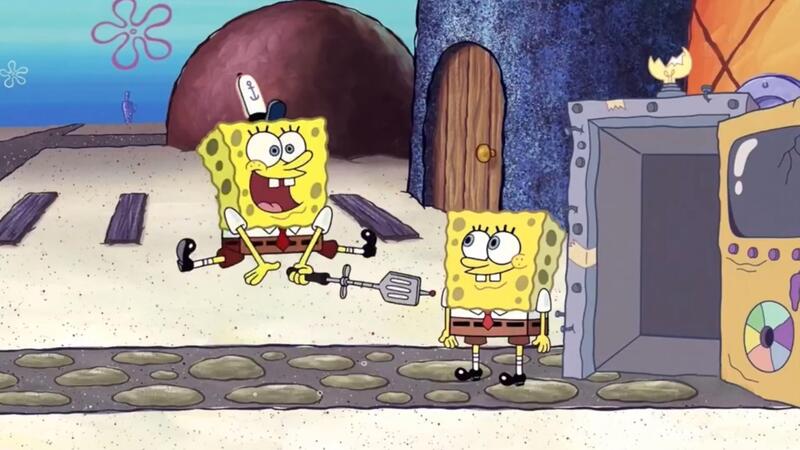
"SpongeBob and Patrick's Timeline Twist-Up" makes the season's relationship with its own history especially obvious. The extended special centers on Patrick's malfunctioning time closet, which allows visitors from THE PATRICK STAR SHOW to interfere with important moments from SpongeBob's past. The resulting changes threaten Bikini Bottom's familiar history, forcing SpongeBob and Patrick to deal with the consequences. It's an appropriately ridiculous excuse to revisit earlier material, and the premise acknowledges that the franchise now has an enormous collection of stories and characters available for new adventures.
Something is amusing about a cartoon that has spent decades resisting conventional continuity suddenly making its history the subject of a time-travel story. SPONGEBOB SQUAREPANTS has never been particularly concerned with establishing a consistent timeline. Characters experience impossible situations, survive circumstances that should permanently change their lives, and return to their usual routines without much explanation. A story built around protecting the show's history therefore carries a certain amount of intentional absurdity. The series has always been willing to contradict itself when a good joke requires it, making a carefully preserved timeline funny before anyone even starts traveling through it.
The special also lets fans revisit earlier material without turning the entire season into a nostalgia exercise. References to familiar episodes can be entertaining, but relying on recognition alone can't sustain an animated comedy. The appeal of revisiting something like "Rock Bottom" comes from remembering how unusual that adventure was when it first appeared. A trip through the show's past works best when it uses those memories as a starting point for more nonsense, rather than assuming recognition automatically qualifies as a punchline.
"Bizarro Bottom" takes the idea of changing familiar surroundings in another direction. SpongeBob finds himself in a strange location populated by alternate versions of Bikini Bottom's residents, creating an opportunity to reconsider characters whose personalities are well established. The premise takes advantage of how recognizable the show's regular cast has become. Viewers know what to expect from SpongeBob, Patrick, and their neighbors, so changing those expectations provides an immediate comedic foundation. It also demonstrates how the series can introduce unfamiliar concepts without abandoning the personalities that make its world recognizable.
Character-based comedy remains especially important for Squidward, whose frustration with the people around him has supplied material for countless episodes. "Squidward's Tough Break" gives him an entirely different personality after he loses his memory, allowing the normally miserable clarinet player to embrace a tough-guy identity. There's an obvious appeal in watching a character who regularly complains about everyone else become someone he would probably find equally irritating under ordinary circumstances. Squidward's established personality makes the transformation meaningful, providing a reason to explore an exaggerated alternative instead of simply giving him another terrible day.
That distinction is useful because Squidward's suffering has occasionally become an easy substitute for more imaginative writing. He's an entertaining character precisely because his expectations rarely match the reality of living next door to SpongeBob and Patrick, but endlessly punishing him can make those stories predictable. Changing his circumstances provides a different approach to the same familiar personality. The underlying comedy still depends on understanding who Squidward normally is, but the premise gives the writers something else to work with beyond his irritation.
The return of DoodleBob in "Curse of the WereDoodle" is another example of the season revisiting established material without simply repeating the original story. DoodleBob remains one of the franchise's more recognizable creations despite originating as a strange drawing brought to life. This time, a bite transforms SpongeBob into a monstrous doodle version of himself, combining the character's history with a supernatural transformation premise. It's the kind of idea that sounds completely ridiculous when described aloud, which is also a reasonable explanation for why it belongs in this particular series.
The transformation concept highlights one advantage of animation. A cartoon has no practical reason to limit itself to what could happen in the real world, especially one that already features a talking sponge working alongside a squid and a crab. The writers can manipulate established designs and physical rules whenever it serves the idea. "Gorilla Suit Day" similarly builds its premise around SpongeBob being mistaken for a real gorilla because of a costume. Both stories make use of exaggerated visual possibilities rather than demanding complicated explanations for why their situations occur.
The season also continues exploring the show's recurring fascination with horror imagery, though in a much less threatening way. "The Kreepy Krab" introduces Slappy, whose unsettling personality becomes a problem when he's hired to work at the restaurant. "The Haunted Bucket" brings supernatural trouble to Plankton's struggling establishment, placing familiar characters in a Halloween-themed adventure. These stories fit comfortably within a franchise that has never been afraid to include monsters or disturbing-looking creatures alongside its more innocent comedy.
That willingness to embrace weirdness is worth appreciating because younger audiences don't necessarily need every strange situation softened into something completely harmless. SPONGEBOB SQUAREPANTS has always included imagery that can be surprisingly grotesque, especially when exaggerated facial expressions and unusual character designs become part of a joke. The show rarely approaches horror seriously, but its willingness to borrow from that genre gives the writers additional ways to distinguish individual adventures. Bikini Bottom is a bizarre place even before someone introduces a monster or an unexplained supernatural event.
"Go Fetch!" offers a different kind of adventure by centering Gary on retrieving his favorite ball from a dangerous underwater trench. Gary has always been more than a background pet, despite communicating primarily through meows. His relationship with SpongeBob adds an affectionate component to the series, and making him the center of an adventure gives the writers a chance to step away from their usual character combinations. The segment's computer-generated animation also represents a distinctive visual departure from the traditional presentation.
Elsewhere, the season finds material in activities that wouldn't ordinarily sound especially promising. "Laundro-Madness" takes Squidward to a laundromat, where sharing space with his fellow Bikini Bottom residents becomes another source of frustration. "SpongeBob TrashPants" turns an effort to clean up the community into an adventure, and "Krusty Kafeteria" sends the Krusty Krab crew to Pearl's school to handle lunch service. These smaller premises remind us that the series doesn't always need time travel or supernatural creatures. The personalities involved can turn practically any environment into a source of trouble.
Mr. Krabs remains particularly well suited to these everyday disasters because his obsession with money still provides an easily recognizable motivation. "Stupor-stition" approaches him from another direction, concentrating on his superstitious behavior during Friday the 13th. His personality has always been defined by more than greed, even if his financial priorities frequently determine his decisions. This different kind of irrational obsession keeps his stories from relying exclusively on another attempt to save money or exploit a profit opportunity.
Plankton's endless attempts to obtain the Krabby Patty secret formula are similarly familiar, making "Near-Mint Plankton" an entertaining variation on his usual behavior. Disguising himself as a collectible figurine is exactly the kind of questionable strategy someone with his history would consider reasonable. The collectible angle also connects the story to something recognizable outside Bikini Bottom, where figures and other merchandise have become an enormous part of popular entertainment. Something is fitting about a cartoon character pretending to be merchandise when the actual franchise has spent decades appearing on practically every kind of product imaginable.
"Karen's Klatch" gives Plankton's computer wife a different opportunity for attention when she organizes a gathering for her digital friends. Karen has become increasingly important to the franchise because her intelligence and patience contrast usefully with Plankton's obsessive personality. Their relationship provides an unusual form of domestic comedy, with a scheming supervillain frequently depending on someone far more practical than he is. Giving Karen stories that extend beyond supporting Plankton's latest plan makes sense for a character who has been part of the series for so long.
Pearl receives her own opportunity in "Pigskin Pearl," an extended episode that places her on a high school football team. She's an interesting character because her teenage concerns frequently exist alongside the absurd circumstances of being a whale raised by a crab. Football offers a different environment to explore her personality and physical abilities, especially given the obvious contrast between her size and that of Bikini Bottom's other residents. It also lets the show focus on a character whose appearances are less frequent than those of the central group.
Sandy's role in the season reflects another longstanding ensemble advantage. "The Green Tentacle" involves her efforts to help an ailing tree, bringing Squidward into a situation where their different approaches create complications. "Karate Pals" expands one of Sandy's familiar interests by introducing other characters to martial arts. Sandy has always provided the show with a personality who can be both capable and wonderfully ridiculous. Her scientific interests and physical abilities give the writers opportunities that wouldn't necessarily work with SpongeBob or Patrick in the same roles.
The voice cast deserves considerable credit for maintaining the personalities that have made these characters recognizable across so many years. Tom Kenny's SpongeBob remains inseparable from the character's exaggerated enthusiasm, and Bill Fagerbakke continues giving Patrick the particular delivery that makes his spectacularly questionable intelligence entertaining. Rodger Bumpass has the difficult task of making Squidward's irritation distinctive after hundreds of episodes, and Clancy Brown's Mr. Krabs remains an essential part of the show's comic identity. Carolyn Lawrence, Mr. Lawrence, Jill Talley, and the rest of the regular performers have helped build a world where even the most absurd characters have familiar voices.
Consistency matters for an animated series that's been running this long. The characters have been through countless adventures, and their personalities have changed in certain ways as different writers and production teams have contributed over the years. Keeping them recognizable without restricting every episode to familiar behavior is an ongoing challenge. The sixteenth season benefits from a cast whose vocal performances are so firmly tied to their characters that even unusual stories retain a recognizable connection to the larger series.
The show's visual approach has also changed considerably since its earliest episodes. Modern SPONGEBOB SQUAREPANTS embraces much more aggressive expressions and physical exaggeration than some longtime viewers may remember. The characters can become almost unrecognizable during particularly elaborate visual jokes, and the animation regularly treats their bodies as objects that can be stretched or transformed for comedic purposes. That approach won't appeal equally to everyone, especially viewers who prefer the comparatively restrained presentation of the earliest seasons. That flexibility lets the artists pursue ideas that would lose much of their appeal if everything remained visually conventional.
The variety of stories in this collection also demonstrates the advantages of the show's traditional short-segment format. Most adventures don't need to sustain an entire half hour, allowing the writers to introduce a ridiculous situation and pursue it without developing an unnecessarily complicated plot. The longer specials provide a contrast when an idea requires more room. That arrangement makes sense for a series where some of the funniest concepts can be explained in a single sentence. Spending too much time justifying the premise would often be less entertaining than accepting the absurdity and moving forward.
As a physical-media release, THE COMPLETE SIXTEENTH SEASON is also a welcome continuation of Nickelodeon's season-by-season DVD collections. The two-disc set includes the season's 22 individually titled segments, with a listed running time of 294 minutes. These episodes are worth collecting together, especially for viewers who prefer owning television programs rather than relying entirely on streaming subscriptions. Animated series can become surprisingly difficult to navigate when episodes are divided among changing services, television schedules, and digital storefronts.
That concern matters even more for a show with such an extensive history. SPONGEBOB SQUAREPANTS has accumulated hundreds of episodes, multiple movies, and spin-offs, making an organized physical-media collection an appealing alternative to searching through different catalogs. The sixteenth-season release continues that tradition without requiring collectors to purchase an enormous box set containing material they already own. Its appeal is primarily the convenience of having the season available as a dedicated collection, which is a perfectly reasonable reason for longtime fans to appreciate the release.
There are certainly arguments to be made about how much longer the series can continue, but longevity alone doesn't establish whether a particular season is worthwhile. A cartoon doesn't suddenly become less entertaining because its original audience has grown older. The relevant question is whether the writers can continue developing situations that justify spending time with these characters. The sixteenth season provides a substantial assortment of adventures, ranging from elaborate callbacks to stories built around everyday frustrations. It knows the audience already understands these personalities and uses that familiarity to explore increasingly unusual circumstances.
SPONGEBOB SQUAREPANTS: THE COMPLETE SIXTEENTH SEASON isn't trying to convince everyone that the series has returned to some universally agreed-upon golden age. It doesn't need to. There's plenty of enjoyment in watching familiar characters find new ways to make terrible decisions, misunderstand obvious situations, and survive adventures that shouldn't be possible. The season's willingness to embrace nostalgia without becoming completely dependent on it is particularly welcome, and the mixture of larger specials with smaller adventures gives the collection a useful variety.
After all these years, SpongeBob is still enthusiastic about his job, Patrick remains gloriously clueless, and Squidward continues suffering the consequences of living near both of them. That may not sound like much has changed, but the situations surrounding those personalities have become increasingly unpredictable. The sixteenth season proves that there's still room for strange ideas beneath the ocean, even when the people experiencing them are among television animation's most familiar faces. Apparently, living in a pineapple under the sea never gets any less ridiculous, and I wouldn't have it any other way.
Please visit https://linktr.ee/overlyhonestr for more reviews.
Follow me on Letterboxd, Instagram, Twitter, and YouTube. You can also find my social media accounts on most platforms by searching for 'Overly Honest Reviews'.
I’m always happy to hear from my readers; please don't hesitate to say hello or send me any movie questions.
[photo courtesy of ALLIANCE HOME ENTERTAINMENT, MOVIES UNLIMITED, NICKELODEON]
DISCLAIMER:
At Overly Honest Movie Reviews, we value honesty and transparency. Occasionally, we receive complimentary items for review, including DVDs, Blu-rays, CDs, Vinyl Records, Books, and more. We assure you these arrangements do not influence our reviews, as we are committed to unbiased, sincere evaluations. We aim to help you make informed entertainment choices regardless of our relationship with distributors or producers.
Amazon Affiliate Links:
This site also contains Amazon affiliate links. If you purchase through these links, we may receive a commission. This affiliate arrangement does not affect our commitment to honest reviews and helps support our site. We appreciate your trust and support as you navigate these links.


Happy
0 %

Sad
0 %

Excited
0 %

Sleepy
0 %

Angry
0 %

Surprise
0 %
 0
 0

Average Rating