No Gods, Just Consequences
Read Time:5 Minute, 54 Second
MOVIE REVIEWS
Iphigenia (Ifigeneia)
 –
– 

Genre: Drama
Year Released: 1977, Radiance Films Blu-ray 2026
Runtime: 2h 7m
Director(s): Michael Cacoyannis
Writer(s): Michael Cacoyannis, Euripides
Cast: Irene Papas, Kostas Kazakos, Kostas Karras, Tatiana Papamoschou
Where to Watch: available now, order your copy here: www.radiancefilms.co.uk, www.mvdshop.com, or www.amazon.com
RAVING REVIEW: There’s nothing decorative about IPHIGENIA. No gold-plated mythmaking. No hero worship. Just sunburnt earth, restless soldiers, and a father being asked to murder his daughter in the name of national pride. From its opening, the film places you in a world where history, politics, and family collapse into a single unbearable decision.
Michael Cacoyannis had already adapted Euripides before, with the 1962 film ELECTRA, but here he strips the story down to something more immediate. The Greek army waits at Aulis, unable to sail to Troy because Agamemnon has offended Artemis. The price to move forward is Iphigenia’s life. It’s a premise as ancient as time. Still, the emotional mechanics feel disturbingly modern, even for a film from almost 50 years ago, a leader trapped between public expectations and their own conscience, pressured by men who treat sacrifice as a strategy.
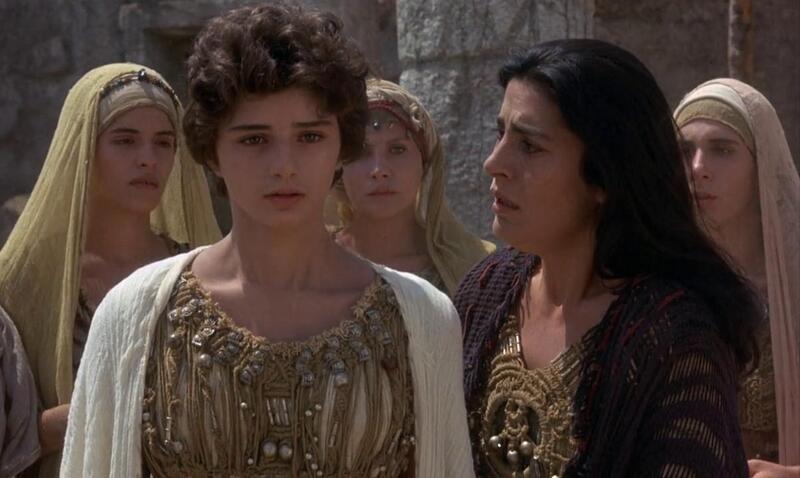
What makes IPHIGENIA so effective isn’t scale. It’s restraint. Cacoyannis rejects the idea of Hollywood’s marble palaces and polished armor. Agamemnon’s quarters look like a shack. The soldiers look exhausted, dusty, and bored. The myth isn’t staged as legend; it’s staged as inevitability. That grounded aesthetic matters because it reframes the Trojan War not as some epic destiny but as political theater fueled by ego, pride, and groupthink.
Kostas Kazakos plays Agamemnon as a man shrinking under the weight of authority. He’s not some towering warlord; he’s a father unraveling. His inner conflict doesn’t explode to the surface in imposing speeches. It simmers in close-ups, in hesitation, in eyes that know there’s no perfect outcome. The army becomes its own character, a faceless force demanding blood in exchange for momentum. Odysseus is more of a politician than a hero; he understands optics. He knows how to frame cruelty as necessity.
And then there’s Irene Papas. As Clytemnestra, she doesn’t ask, she doesn’t plead. She burns. Papas plays grief like it’s already halfway to vengeance. Every frame she occupies tightens around the throat of the viewer. When she realizes the deception behind her daughter’s supposed marriage to Achilles, her fury lands with a mythic inevitability. You can already feel the violence her character will unleash beyond this story.
Tatiana Papamoschou’s Iphigenia is where the film becomes most devastating. She begins with innocence, then confusion, then horror. What’s remarkable is how the performance pivots. Iphigenia doesn’t remain a victim. As the reality settles in, she chooses composure. The transformation from a frightened girl to a tragic symbol happens gradually. It’s one of the film’s most haunting decisions: letting her acceptance carry more weight than any divine intervention.
Cacoyannis also makes a bold structural choice in how he handles the ending. Rather than lean into myth’s ambiguities, he refuses. The focus stays human. That refusal sharpens the tragedy. This isn’t about whether a goddess intervenes. It’s about what people are willing to justify when wrapped in religion, patriotism, or destiny.
IPHIGENIA cuts deeper than any straightforward adaptation could have. Euripides questioned war, power, and the manipulation of belief. The army’s impatience mirrors a society whipped into a frenzy by promises of glory. Calchas, representing divine authority, becomes a symbol of institutional power. What takes the film further is its centering of women in a story usually dominated by men. Clytemnestra and Iphigenia hold the moral ground. The men posture about honor and obligation, yet they fold under pressure from soldiers and prophets. The supposed heroes are terrified of losing control. The women, though powerless in title, carry the emotional clarity the men lack.
The film embraces simplicity. Giorgos Arvanitis’ cinematography leans into natural light and wide, unforgiving landscapes. The Mediterranean sun doesn’t romanticize the settings; it exposes. Theodorakis’ score supports the scenes without overwhelming them. There’s a sparseness to the staging that mirrors the ethical bareness of the situation. At times, you can sense the adaptation’s origin. But that theatrical DNA rarely undermines the emotional throughline. If anything, it reinforces the classical structure beneath the film’s realism.
The question isn’t just whether Agamemnon kills his daughter. It’s whether a society demanding sacrifice is already morally destitute. The film doesn’t offer condemnation or absolution. It just shows the cost. And that cost isn’t abstract. It’s a girl standing alone while men debate her worth in strategic terms. For a 1977 film, its visual language and clarity feel startlingly direct. It doesn’t treat myth like museum art. It feels urgent, stripped, uncomfortably relevant. The Trojan War becomes less about Helen and more about the machinery of collective justification. IPHIGENIA earns its reputation. The performances anchor the story. The refusal of spectacle strengthens it. And its political undercurrents keep it alive.
Bonus Materials:
High-definition digital transfer
Uncompressed mono PCM audio
New interview with Greek film expert Dimitris Papanikolaou on Michael Cacoyannis (2025)
Archival press conference interview with Michael Cacoyannis (1977)
Archival interview with director Michael Cacoyannis and actress Irene Papas (1977)
Newly improved English subtitle translation
Reversible sleeve featuring original and newly commissioned artwork by Time Tomorrow
Limited edition booklet featuring new writing by Vrasidas Karalis
Limited edition of 3000 copies, presented in full-height Scanavo packaging with removable OBI strip, leaving packaging free of certificates and markings
Please visit https://linktr.ee/overlyhonestr for more reviews.
You can follow me on Letterboxd, Instagram, Twitter, and YouTube. My social media accounts can also be found on most platforms by searching for 'Overly Honest Reviews'.
I’m always happy to hear from my readers; please don't hesitate to say hello or send me any questions about movies.
[photo courtesy of RADIANCE FILMS, MVD ENTERTAINMENT]
DISCLAIMER:
At Overly Honest Movie Reviews, we value honesty and transparency. Occasionally, we receive complimentary items for review, including DVDs, Blu-rays, CDs, Vinyl Records, Books, and more. We assure you that these arrangements do not influence our reviews, as we are committed to providing unbiased and sincere evaluations. We aim to help you make informed entertainment choices regardless of our relationship with distributors or producers.
Amazon Affiliate Links:
Additionally, this site contains Amazon affiliate links. If you purchase through these links, we may receive a commission. This affiliate arrangement does not affect our commitment to honest reviews and helps support our site. We appreciate your trust and support as you navigate these links.


Happy
0 %

Sad
0 %

Excited
0 %

Sleepy
0 %

Angry
0 %

Surprise
100 %
 1
1
 0
0



Average Rating