The Fragile Distance Between Connection and Isolation
Read Time:6 Minute, 30 Second
MOVIE REVIEW
Love Letter (with All About Lily Chou-Chou in most theaters)
 /
/  –
– 

Genre: Drama, Romance
Year Released: 1995 / 2001, 2026 Restoration
Runtime: 1h 57m / 2h 26m
Director(s): Shunji Iwai
Writer(s): Shunji Iwai
Cast: Miho Nakayama, Etsushi Toyokawa, Miki Sakai, Takashi Kashiwabara / Hayato Ichihara, Shûgo Oshinari, Ayumi Ito, Yû Aoi, Takao Osawa
Where to Watch: opens in theaters beginning June 5, 2026
RAVING REVIEW: There are filmmakers who tell stories, and then there are filmmakers who seem to recreate the journey through emotion itself. Shunji Iwai belongs firmly in the second category. Watching LOVE LETTER and ALL ABOUT LILY CHOU CHOU together creates an almost overwhelming portrait of how differently people process absence, loneliness, longing, and emotional survival. One film reaches toward healing through remembrance. The other stares directly into collapse and asks whether music and connection can keep somebody from disappearing inside themselves.
What’s remarkable is how naturally these films complement one another despite operating on completely different levels. LOVE LETTER feels delicate without becoming fragile. ALL ABOUT LILY CHOU CHOU feels devastating without ever tipping into misery. Together, they create a kind of conversation about youth, memory, identity, and emotional isolation that still feels startlingly relevant, even decades later.
LOVE LETTER remains one of the most sincere films ever made about grief because it understands that mourning rarely arrives in clear, dramatic waves. It lingers inside ordinary routines, unfinished thoughts, forgotten objects, and moments where people continue speaking to someone they know can’t answer. On paper, the premise sounds almost impossibly sentimental. A woman grieving her deceased fiancé sends a letter to his old address and unexpectedly receives a reply from another woman connected to his past. In the wrong hands, that setup could’ve collapsed into manipulation very quickly. Instead, Iwai approaches the material with such patience and emotional precision that the coincidence never feels artificial. The film slowly turns into something far more intimate and emotionally truthful than its premise initially suggests.
Miho Nakayama’s dual performance is extraordinary because she doesn’t treat the two women as mirror images or symbolic opposites. Hiroko carries grief like an open wound she’s trying desperately to keep stable. Itsuki Fujii feels more emotionally guarded, practical, and disconnected from the significance these memories hold for someone else. Watching the correspondence gradually reshape both women becomes the emotional core of the film. Neither understands what they’re initially searching for. They only know the act of remembering keeps pulling them back toward each other.
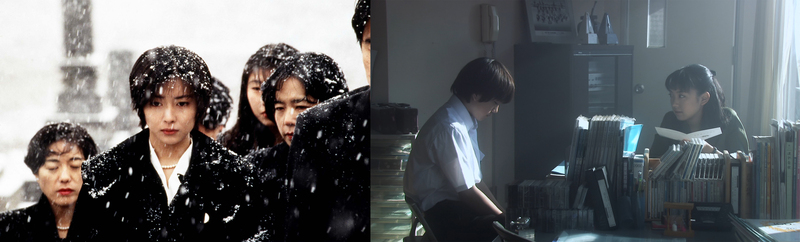
Iwai’s visual style throughout LOVE LETTER deserves enormous credit. Snow-covered landscapes, empty hallways, libraries, distant mountains, and handwritten letters all become extensions of emotional space rather than simple aesthetic choices. The film constantly feels suspended between memory and reality. Scenes drift in and out with the softness of recollection itself. Even the pacing contributes to that atmosphere. Iwai refuses to rush the discovery because the film understands that people rarely process grief through dramatic revelations. Meaning arrives gradually, almost accidentally.
What gives LOVE LETTER so much lasting power is that it never treats memory as reliable. The entire film revolves around incomplete understanding. Both women are reconstructing a man through fragments, assumptions, and selective recollection. That idea becomes increasingly powerful as the story progresses, because the film asks whether we ever truly know the people we love, or whether we simply preserve emotional versions of them within ourselves.
Then there’s ALL ABOUT LILY CHOU CHOU, which feels like the emotional inverse of LOVE LETTER in almost every possible way. Where LOVE LETTER moves with warmth and melancholy, LILY CHOU CHOU feels jagged, unstable, and emotionally suffocating. It’s one of the most brutally honest films about adolescence because it captures how isolating teenage life can feel before people understand themselves. The film doesn’t romanticize youth; it exposes how cruel, alienating, and directionless it can be when kids are left to navigate violence, humiliation, sexuality, and identity without meaningful support.
What makes the film so devastating is that Iwai understands disconnection before social media consumed our lives. The online message boards, anonymous identities, and obsession surrounding Lily Chou-Chou herself now feel almost prophetic. These teenagers desperately want connection, but most of their interactions only deepen the emptiness consuming them. Music becomes the only thing approaching transcendence because it offers a temporary escape from lives they barely know how to survive.
Hayato Ichihara gives an incredible performance as Yuichi, who spends much of the film trapped between passivity and desperation. He absorbs cruelty as he searches for something capable of making existence feel meaningful again. Shûgo Oshinari’s Hoshino becomes equally important because his transformation shows how quickly adolescence can distort a person emotionally as power, humiliation, and rage feed on one another. Their relationship becomes the film’s fracture point.
That contrast is part of what makes ALL ABOUT LILY CHOU CHOU so difficult to shake. Iwai photographs fields, skies, life, and landscapes with overwhelming beauty while simultaneously depicting devastation underneath them. The imagery often feels dreamlike, but the emotions underneath it are painfully grounded. Violence appears unexpectedly. Emotional cruelty feels casual. Entire lives begin unraveling while adults remain almost completely absent from the reality these teenagers inhabit.
The music itself becomes essential to the film's success. Lily Chou-Chou isn’t simply a fictional singer inside the narrative; she functions almost like an emotional religion for these characters. Her music represents purity, escape, and emotional understanding inside a world that otherwise feels indifferent to their suffering. Iwai understands how deeply art can matter to isolated young people. Sometimes music isn’t entertainment; it’s survival.
The restorations themselves are gorgeous. LOVE LETTER especially benefits from the 4K presentation because the imagery gains even greater softness and depth. The snowy Hokkaido landscapes almost feel as if they are suspended outside time. Meanwhile, ALL ABOUT LILY CHOU CHOU’s textured aesthetic remains modern despite being over two decades old. Its fragmented structure, layered visuals, and internet-era presentation somehow feel even more relevant now than they likely did in 2001.
What connects both films is Iwai’s understanding that loneliness doesn’t always look dramatic on the surface. Sometimes it exists inside memory. Sometimes it hides behind cruelty or obsession. Sometimes it survives through letters, sometimes through music. But both films grasp the same painful truth, that people spend enormous portions of their lives desperately trying to feel understood by someone else. Few filmmakers have captured that with this much beauty.
Please visit https://linktr.ee/overlyhonestr for more reviews.
You can follow me on Letterboxd, Instagram, Twitter, and YouTube. My social media accounts can also be found on most platforms by searching for 'Overly Honest Reviews'.
I’m always happy to hear from my readers; please don't hesitate to say hello or send me any questions about movies.
[photo courtesy of FILM MOVEMENT CLASSICS]
DISCLAIMER:
At Overly Honest Movie Reviews, we value honesty and transparency. Occasionally, we receive complimentary items for review, including DVDs, Blu-rays, CDs, Vinyl Records, Books, and more. We assure you that these arrangements do not influence our reviews, as we are committed to providing unbiased and sincere evaluations. We aim to help you make informed entertainment choices regardless of our relationship with distributors or producers.
Amazon Affiliate Links:
Additionally, this site contains Amazon affiliate links. If you purchase through these links, we may receive a commission. This affiliate arrangement does not affect our commitment to honest reviews and helps support our site. We appreciate your trust and support as you navigate these links.


Happy
0 %

Sad
0 %

Excited
0 %

Sleepy
0 %

Angry
0 %

Surprise
0 %
 0
0
 0
0



Average Rating