The Long Way Back to Yourself
Read Time:5 Minute, 27 Second
MOVIE REVIEWS
The Rose: Come Back to Me
 –
– 

Genre: Documentary, Music
Year Released: 2025, 2026
Runtime: 1h 35m
Director(s): Eugene Yi
Where to Watch: global theatrical release on February 14, 2026
RAVING REVIEW: What does it take to keep creating when the industry keeps asking you to disappear? THE ROSE: COME BACK TO ME presents that question hovering beneath every image and interview, even when it’s never stated outright. Rather than framing itself as a victory lap or fan-service celebration, the film commits to something more honest: an exploration of endurance, identity, and the emotional cost of choosing authenticity in a system built to reward conformity.
Directed by Eugene Yi, the documentary traces the band’s evolution from the early days through institutional conflict, forced silence, and eventual reemergence. What distinguishes this film from the many music documentaries that chart similar trajectories is its refusal to mythologize struggle. Pain isn’t aestheticized here. It is acknowledged, examined, and then allowed to exist without resolution. The film understands that survival is rarely cinematic in the moment, and that growth often arrives unevenly, accompanied by doubt rather than clarity.
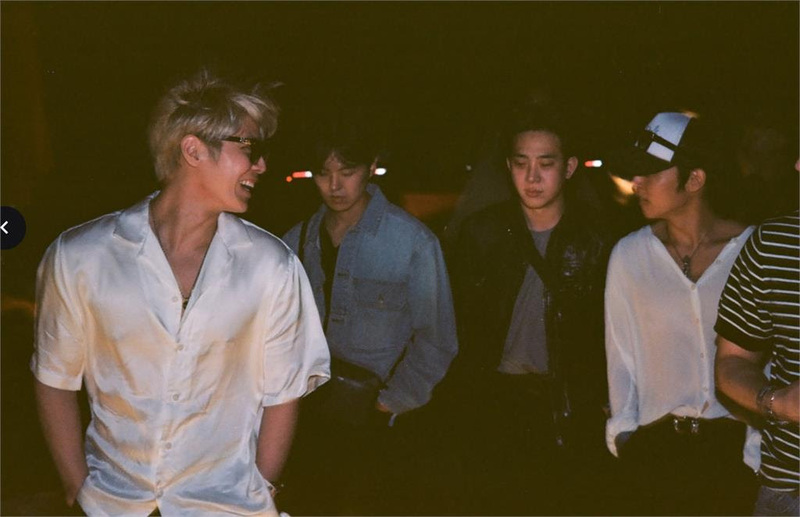
The four members of The Rose are presented not as interchangeable parts of a brand, but as distinct creatives whose bond has been repeatedly tested by external pressure. The documentary gives each member space to articulate what music means to them personally, and just as importantly, what it has cost them. These reflections never drift into self-pity. Instead, they reveal how deeply the act of making music became entangled with survival itself, emotionally, professionally, and psychologically.
Woosung’s arc is particularly revealing, not because it is more dramatic than the others, but because the film refuses to flatten it into a cautionary tale or redemption narrative. His experiences with industry expectation, public scrutiny, and personal guilt are allowed to coexist without judgment. The documentary treats vulnerability as information rather than confession, and that restraint gives his story weight without exploitation.
Dojoon emerges as the film’s architect, someone whose relationship to music feels inseparable from instinct and risk. His reflections on creative control and trust underscore one of the documentary’s central ideas: that artistic integrity isn’t an abstract value, but a daily negotiation that can isolate as easily as it can empower. The film doesn’t present this as noble suffering. It presents it as reality.
Hajoon and Jaehyeong provide a grounding counterbalance, particularly in how the documentary frames mental health and emotional fatigue. Their stories aren’t framed as detours from the band’s narrative, but as integral to it. The film understands that cohesion doesn’t mean uniform experience, and that collective strength is often built from uneven resilience. This emphasis on internal dynamics is where the documentary finds much of its emotional depth.
The documentary’s handling of industry conflict is notably measured. Rather than turning legal disputes or management battles into villains, the film focuses on how systemic pressure shapes behavior and erodes trust. This choice keeps the narrative grounded and avoids oversimplification. The industry isn’t portrayed as a single antagonist, but as an environment that rewards silence and compliance. Against that backdrop, the band’s insistence on self-definition becomes quietly radical.
One of the film’s strongest achievements is its resistance to the temptation to frame fan devotion as validation. While the band’s global audience is acknowledged, the documentary doesn’t lean on crowd reaction as proof of worth. Instead, it positions connection as reciprocal, something earned through honesty rather than performance. This approach prevents the film from slipping into promotional territory and reinforces its commitment to authenticity.
Structurally, the documentary maintains momentum without feeling rushed. At times, the chronology compresses complex events into brief segments, and some viewers may want a deeper exploration of specific conflicts or creative processes. Yet with that, the film’s pacing reflects its intent. It is not attempting to catalog every obstacle. It is tracing emotional continuity, how one choice leads to another, and how identity survives prolonged uncertainty.
What elevates THE ROSE: COME BACK TO ME is its refusal to collapse hardship into inspiration. The film does not insist that pain automatically produces beauty, nor does it pretend that perseverance guarantees peace. Instead, it offers something rarer: a portrait of artists who continued because stopping would have meant losing themselves entirely. Music, in this context, is not a career path. It is a lifeline. Even viewers unfamiliar with The Rose will recognize the broader questions at play: how to maintain identity under pressure, how to rebuild trust after betrayal, and how to keep creating when the cost keeps rising. These themes give the film durability beyond its immediate cultural moment.
This is not a story about reclaiming fame. It is about reclaiming agency. In choosing to tell that story without exaggeration or self-mythology, Eugene Yi delivers a documentary that respects both its subjects and its audience. THE ROSE: COME BACK TO ME stands as a thoughtful, emotionally grounded music documentary that understands the difference between success and survival. This is a film that resonates emotionally, holds up structurally, and avoids the common traps of the genre, even if it leaves a few questions intentionally unanswered.
Please visit https://linktr.ee/overlyhonestr for more reviews.
You can follow me on Letterboxd, Instagram, Twitter, and YouTube. My social media accounts can also be found on most platforms by searching for 'Overly Honest Reviews'.
I’m always happy to hear from my readers; please don't hesitate to say hello or send me any questions about movies.
[photo courtesy of ARTEMIS RISING FOUNDATION, BREVITY FILMS, HYBE AMERICA, JANET YANG PRODUCTIONS, MARGINAL MEDIAWORKS, QUONCO PRODUCTIONS, WAVELENGTH, INTERTREND COMMUNICATIONS]
DISCLAIMER:
At Overly Honest Movie Reviews, we value honesty and transparency. Occasionally, we receive complimentary items for review, including DVDs, Blu-rays, CDs, Vinyl Records, Books, and more. We assure you that these arrangements do not influence our reviews, as we are committed to providing unbiased and sincere evaluations. We aim to help you make informed entertainment choices regardless of our relationship with distributors or producers.
Amazon Affiliate Links:
Additionally, this site contains Amazon affiliate links. If you purchase through these links, we may receive a commission. This affiliate arrangement does not affect our commitment to honest reviews and helps support our site. We appreciate your trust and support as you navigate these links.


Happy
0 %

Sad
0 %

Excited
0 %

Sleepy
0 %

Angry
0 %

Surprise
0 %
 0
0
 0
0

Average Rating