The Trouble With Teaching Humanity
Read Time:7 Minute, 45 Second
MOVIE REVIEW
Karayr (Cave)
 –


Genre: Science fiction, Drama, Short
Year Released: 2025, 2026
Runtime: 17m
Director: Neo Apelian
Writer: Razan Takash
Cast: Jay Abdo, Ahmad Srour
Where to Watch: shown at the 2026 FilmQuest Festival
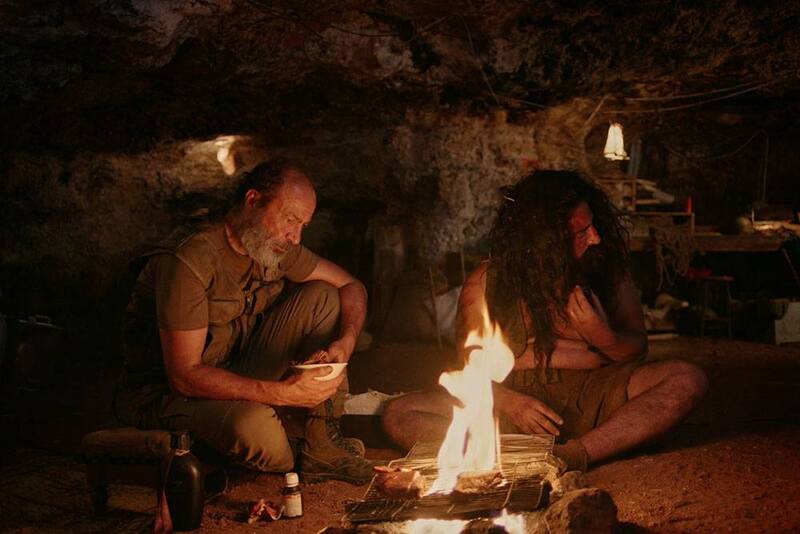
RAVING REVIEW: The Man in the Cave has been getting by on his own when he finds somebody he can teach. That’s a pretty specific way of sizing up the first person you might be able to share your life with. Jay Abdo plays the man who’s managed to keep his memory of the world before a bio-war, and Ahmad Srour plays the man he takes in. This all makes sense from the survivor’s point of view. He’s been looking for traces of his old life, and now he’s found someone who might be able to build a new one with him. He takes it for granted that this other man needs to start where he says.
The characters don’t have names beyond Man in the Cave and Caveman. Written down, those are almost the same. One becomes a man who happens to be living in a cave. The other has the cave attached to his identity, as if that explains everything about him. It’s a small distinction that gets at something more interesting than the premise’s idea that humanity has gone backward. Both men are alive in the same world, and both had to learn how to get by there. The man who remembers how people used to live gets to decide which of them needs an education.
Neo Apelian and Razan Takash started with the idea of getting a modern man and a prehistoric person into a room together. What gives KARAYR a story of its own is that the men are contemporaries. Srour’s character belongs to the aftermath every bit as much as Abdo’s. A conversation across centuries would give the modern man a chance to show off everything that came after. There’s hardly anything left of that. A person can talk all he wants about the things humanity figured out. Where does he even begin when the evidence of all that progress is the world outside his door?
The decision to build the short around teaching gives the two men something to do together. Survival skills have a use. Art is a different proposition, especially for someone whose days revolve around finding food and keeping a shelter. The man can keep a relic from the old world because he knows what it means to him. Passing something on requires another person who can do something with it. That’s a more interesting idea than putting an object on a shelf and calling it a symbol of lost civilization. It gives the Caveman something he can take from the lesson without owing the teacher his entire way of life.
There’s a difference between helping someone feed himself and deciding what kind of person he needs to become. The survivor’s working with a sample size of one, which sounds ridiculous until you consider how long he’s spent scavenging and collecting the remains of a society he can’t get back. For somebody alone that long, even being able to show another person how to do something gives the day a purpose. That helps explain why he might put more into this all than the other man agreed to. It’s easy to see how a small misunderstanding could feel like a personal rejection to somebody who’s built that much of his life around teaching.
The story's setup may be a little too convenient. The war is what caused people to revert to being primitive, with Abdo’s character positioned as the exception. A fable can get away with almost anything, but here the story starts by asking us to make a giant leap. That puts the movie in an awkward position. Its best question is what the survivor fails to see about the person he takes in, while its own description of the world gives us such a narrow way to understand him in the first place.
Seventeen minutes go by quickly when a film asks you to see two people learn to live together. KARAYR gives the men a shared world with little in common, yet everything in common, letting a bond form without either of them having to explain why. Their misunderstandings are where the film makes the most of that short runtime. It’s one thing to understand that something has gone wrong. Feeling what it costs either man means first understanding what an ordinary day with the two of them is worth. For a story this interested in the small things people do for each other, there’s a case for spending more of its time on days when the lessons go well.
KARAYR was filmed in the mountains of northern Jordan and takes place in an imagined future Middle East. There’s a familiarity to the way post-apocalyptic movies use empty places as proof that the whole world has gone away. Here the mountains were there long before anybody invented a bomb, and it makes sense that the land can outlast the society the survivor remembers. He has a shelter and goes looking for what he needs. Rebuilding civilization is the ambition that grows out of the much smaller idea.
Apelian spoke about drawing on Armenian choral and sacred music while developing the film, particularly Komitas's music. Arto Tunçboyacian is credited with the music. There’s an interesting relationship between that influence and the Arabic setting. Apelian and Takash made a film about how much culture one person can carry at a time, using cultural traditions that had already traveled with people. The survivor is surrounded by broken things he can collect. Music offers a useful way to think about a piece of the old world that can survive through someone remembering it, even after the place he first heard it is gone.
The story also has a stricter view of the past than the man’s search for its leftovers might suggest. He’s trying to recover knowledge from a society that used some of that knowledge to destroy itself. The film needs the war for more than an explanation of how everybody wound up in caves. It gives his project a flaw that would exist even if all his lessons went exactly to plan. At some point he would have to decide what he wanted to leave out. There’s no museum committee in this world, or anybody else, to tell him that what he misses and what's worth saving could be two very different collections.
Takash traced the idea to a conversation she and Apelian had in 2017, and the filmmakers eventually turned to crowdfunding to make it. Eight years is a long time to spend getting two people into a cave for 17 minutes. It’s also a reminder of how rarely an imagined future Middle East becomes the starting point of a science-fiction film. KARAYR takes that future for granted in a way a bigger production might have felt obligated to explain. The war is already over when the story needs it to be. Apelian can spend the short on what one person does with one day in its aftermath.
The survivor has a place for the other man to stay and something he can show him. That’s a starting point to a friendship, provided there’s room for the guest to decide what to make of it. The film’s idea of rebuilding civilization comes down to something as basic as making space for a second person in a place you’ve set up for yourself. The Man in the Cave has spent his time gathering pieces of the world he knows. Then the world sends him a person he can’t put on a shelf.
Please visit https://linktr.ee/overlyhonestr for more reviews.
Follow me on Letterboxd, Instagram, Twitter, and YouTube. You can also find my social media accounts on most platforms by searching for 'Overly Honest Reviews'.
I’m always happy to hear from my readers; please don't hesitate to say hello or send me any movie questions.
[photo courtesy of JAZZ FILMS, REEL78 PRODUCTIONS, SLATE FILM SERVICES]
DISCLAIMER:
At Overly Honest Movie Reviews, we value honesty and transparency. Occasionally, we receive complimentary items for review, including DVDs, Blu-rays, CDs, Vinyl Records, Books, and more. We assure you these arrangements do not influence our reviews, as we are committed to unbiased, sincere evaluations. We aim to help you make informed entertainment choices regardless of our relationship with distributors or producers.
Amazon Affiliate Links:
This site also contains Amazon affiliate links. If you purchase through these links, we may receive a commission. This affiliate arrangement does not affect our commitment to honest reviews and helps support our site. We appreciate your trust and support as you navigate these links.


Happy
0 %

Sad
0 %

Excited
0 %

Sleepy
0 %

Angry
0 %

Surprise
0 %
 0
 0

Average Rating