The World’s Clingiest Relationship
Read Time:14 Minute, 18 Second
MOVIE REVIEW
Addicted to It
 –


Genre: Animation, Comedy, Musical, Short
Year Released: 2026
Runtime: 6m
Directors: Nigel Tierney, Federico Heller
Writers: Andrew Hawkins, Jeff Marx
Cast: Jeff Marx, Mel Brooks, Dixie D'Amelio, Dionne Warwick, Morgan Jay, Andrew Bachelor, Andrew Hawkins
Where to Watch: shown at the 2026 HollyShorts Film Festival and SIGGRAPH Computer Animation Festival
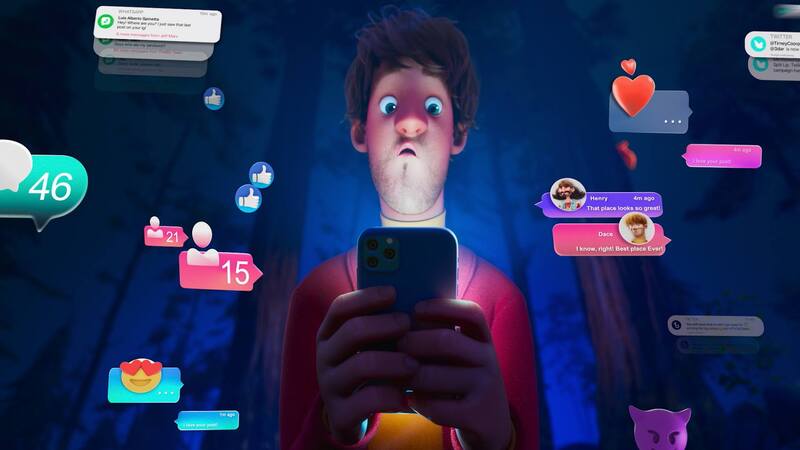
RAVING REVIEW: How many times have you picked up your phone to check one thing, only to realize twenty minutes later that you've completely forgotten what you were originally doing? It's an experience that's become so familiar that most of us barely question it anymore. We carry these devices everywhere, give them our attention at the slightest notification, and somehow convince ourselves that we're still in control of the relationship. ADDICTED TO IT takes that dependency and turns it into an absurd animated musical, complete with a smartphone that refuses to let its owner enjoy a few minutes of peace. Directors Nigel Tierney and Federico Heller aren't delivering some revolutionary argument about modern technology, but they have a playful approach to a subject that's already been discussed to death. Sometimes a ridiculous song and a cartoon rabbit are more appealing than another lecture about screen time.
Dace (voiced by Jeff Marx) has decided to attempt something that shouldn't qualify as an accomplishment. He wants to take a short walk through the park without using his phone. Unfortunately, his device has developed a personality of its own, taking the form of Phoney Bunny, a relentlessly persistent creature voiced by comedy legend Mel Brooks. What should be a simple opportunity to disconnect becomes a musical confrontation with a technology that has absolutely no intention of surrendering its owner's attention. The premise is intentionally ridiculous, but the behavior it's exaggerating is recognizable. Dace isn't struggling to complete some elaborate technological detox. He simply wants to go outside for a few minutes without answering to a device that has become an almost permanent extension of his body.
The film's most obvious strength is that it understands a familiar message benefits from an entertaining presentation. We've had documentaries, public service announcements, news reports, and countless articles warning us about excessive smartphone use. Most people already understand that spending hours staring at a screen probably isn't the healthiest way to experience the world. Knowing that doesn't necessarily change the behavior, especially when the device responsible for the problem also provides entertainment, communication, and information throughout the day. ADDICTED TO IT isn't especially interested in providing a detailed explanation of digital dependency. It turns the situation into a comedy where the phone literally pursues the person trying to escape it. The metaphor is about as subtle as getting smacked in the face with an iPad, but subtlety clearly wasn't the objective.
Jeff Marx, whose Broadway work includes co-creating the Tony Award-winning musical AVENUE Q with Robert Lopez, provides the original music and lyrics. That background makes considerable sense for a production that wants to address uncomfortable behavior through exaggerated characters and humor. AVENUE Q famously borrowed the visual familiarity of children's educational programming to explore distinctly adult frustrations, and ADDICTED TO IT operates with a somewhat similar sense of contradiction. Its bright animated presentation makes the subject approachable, even when the underlying behavior has troubling implications. The music serves as the primary storytelling device, allowing the filmmakers to communicate their argument through a sustained musical performance rather than stopping repeatedly for conventional dialogue.
The song also establishes the short's limitations. Musical comedy depends on the relationship between repetition and progression, and there's only so much new information to introduce when the entire production revolves around a single recognizable observation. The escalating visual absurdity helps maintain the entertainment value, but the underlying argument remains relatively straightforward. Smartphones are designed to keep us engaged, and we're frequently willing participants in that arrangement. ADDICTED TO IT doesn't substantially complicate that conclusion. It doesn't try to distinguish between necessary technology use and unhealthy dependence, or investigate the commercial incentives behind increasingly aggressive engagement tactics. It chooses the more accessible approach of turning our collective habits into something ridiculous enough to laugh at.
That decision works within the short's limited runtime, although it also means the film functions more as a musical demonstration of an existing problem than an exploration of its consequences. The premise also allows for a more complicated story, particularly given how much of modern life requires access to digital services. Work expectations, personal relationships, financial responsibilities, and everyday communication have all become connected to devices we're simultaneously encouraged to use less frequently. The contradiction makes the broader subject fascinating, but ADDICTED TO IT isn't built to examine those competing demands. Its objective is simpler. Recognize the habit, laugh at its absurdity, and perhaps reconsider how much attention you're giving away.
Mel Brooks is an inspired choice to voice Phoney Bunny, particularly because the character's existence is already a joke about the relationship between technology and its users. Brooks has spent decades finding comedy in exaggerated personalities and situations that recognize their own ridiculousness. Hearing him participate in a contemporary animated production about smartphone addiction is entertaining on the strength of the casting alone. There's also an interesting historical connection to his earlier animation work, including the Academy Award-winning short THE CRITIC from 1963. More than six decades later, he's lending his unmistakable comedic identity to another animated project, this time representing an object that couldn't have existed when his career began.
The amusing part is that Brooks isn't given an elaborate collection of dialogue to dominate the production. According to Tierney, much of the character's performance consists of vocalizations rather than conventional speech. That makes his involvement an unusual use of an actor whose reputation is so closely connected to verbal comedy. Phoney Bunny becomes a physical-comedy creation, with the animation communicating much of the character's behavior. Something about casting a performer associated with decades of entertainment history as the embodiment of a technology that has fundamentally changed how audiences consume entertainment feels fitting. The short doesn't need to build an elaborate argument around that contrast. The association is interesting enough on its own.
The supporting voice cast is another indication of the project's ambitions. Dionne Warwick, Dixie D'Amelio, Morgan Jay, and Andrew Bachelor are among the performers contributing to its crowded animated world. It's an unusual combination of entertainment generations, with established musical and comedy figures appearing alongside personalities whose careers developed during the social media era. That range suits a story about technology that affects practically everyone, regardless of age. Warwick's involvement is especially interesting given the longevity of her musical career, while D'Amelio represents the kind of contemporary celebrity whose public recognition is closely tied to digital platforms. The casting provides an entertaining generational connection without requiring every performer to become a fully developed character in a film that barely lasts six minutes.
Tierney and Heller bring considerable animation experience to the project, having previously collaborated on Lil Dicky's EARTH music video. Their work together helps explain the production's interest in combining celebrity voices with elaborate animated scenarios. ADDICTED TO IT was developed with the Argentine animation studio 3dar, and the international collaboration involved contributors across Argentina, Ireland, and the United States. The filmmakers have described an extensive production process involving more than two hundred artists and musicians, a substantial undertaking for something audiences can watch in less time than it takes to prepare a cup of coffee. That amount of labor is worth acknowledging, particularly when short-form animation is sometimes mistaken for a simpler alternative to feature-length filmmaking.
The filmmakers reportedly developed more than forty original computer-generated characters and over twenty environments, creating a world designed to reflect the different ways people become absorbed in digital entertainment. That creative decision moves the production beyond the basic image of someone endlessly scrolling through social media. Gaming, online gambling, and other forms of digital engagement are part of the broader behavior being examined. These aren't identical experiences, and they don't necessarily carry the same consequences, but they can increasingly occupy someone's attention. Animation gives the production the freedom to exaggerate those relationships into physical situations without requiring an elaborate explanation of how the technology actually works.
There's an amusing contradiction in using an elaborate digital production to encourage audiences to reconsider their dependence on digital technology. ADDICTED TO IT exists because of the same technological advances that have transformed entertainment over the past several decades. Computer animation, remote creative collaboration, and digital distribution all make a project like this possible. The film isn't arguing that technology itself should disappear, and that distinction is important. The problem isn't that smartphones exist or that people enjoy what they offer. It's the degree to which their use can become automatic, reducing the amount of attention available for experiences that don't involve a screen.
The filmmakers have been especially deliberate about another technological issue. Despite its extensive computer-generated animation, ADDICTED TO IT was produced without generative artificial intelligence, something the creators explicitly acknowledge in the film's closing credits. Tierney has discussed that decision as a reflection of the artists responsible for bringing the production to life. At a time when generative AI is increasingly being incorporated into creative workflows, the distinction has significance beyond a simple promotional statement. The technology used to create computer animation isn't automatically equivalent to generative AI, and the production's commitment to human authorship recognizes that difference. The filmmakers aren't rejecting digital tools. They're emphasizing the creative participation of the people making decisions about how those tools are used.
That choice also connects interestingly to the film's broader argument. ADDICTED TO IT is concerned with the consequences of allowing technology to dominate ordinary behavior, while its production emphasizes artists maintaining control over their creative process. Those aren't identical issues, but both involve questions about how much authority people surrender to increasingly sophisticated systems. The film's closing acknowledgment doesn't need to become a separate lecture on artificial intelligence to matter. Recognizing the animators and musicians responsible for the project is a worthwhile statement about the labor behind creative entertainment, particularly when that work can become invisible beneath the finished digital imagery.
Another advantage of animation is the opportunity to make an ordinary smartphone seem genuinely intrusive without suggesting its owner faces a literal threat. Phoney Bunny takes a familiar relationship to a comically unreasonable extreme. The device wants attention, and Dace has become accustomed to giving it exactly that. Transforming the phone into a persistent character makes the dynamic easier to recognize because it removes the illusion that checking a device is always a completely independent decision. Notifications and algorithmic recommendations exist because companies want people to continue interacting with their products. The film represents that commercial reality through a cartoon antagonist, simplifying the mechanisms involved without losing the basic point.
The emphasis on humor helps prevent the material from becoming unnecessarily severe. Smartphone dependence is a legitimate subject for concern, but an animated musical doesn't need to approach it with the seriousness of a medical documentary. The audience is being invited to recognize its own behavior, not diagnose itself with a clinical condition. That's an important distinction because the language of addiction is frequently applied to ordinary habits without much consideration for what the term means. ADDICTED TO IT uses the word as part of a comedic exaggeration, and the production works best when understood within that context. It wants people to consider whether they're spending too much time looking at screens, not convince everyone with a smartphone that they have a serious disorder.
The film also faces the challenge of competing with the very entertainment habits it's criticizing. A six-minute animated musical fits comfortably within a culture accustomed to consuming short videos online. Its quick delivery, accessible humor, and emphasis on a memorable song make it appropriate for audiences who might never seek out a longer examination of digital dependency. There's an irony in creating something designed to capture attention while warning people about the dangers of having their attention captured. The filmmakers are aware of that contradiction, and Tierney has discussed the need to reach viewers through the same platforms associated with the problem. It's a practical acknowledgment that criticizing an aspect of modern technology doesn't necessarily mean refusing to participate in the systems that make contemporary communication possible.
Where ADDICTED TO IT falls short of becoming something more substantial is in the familiarity of its central message. There isn't much here that audiences haven't encountered through other animated productions, comedic sketches, or everyday conversations about screen time. Its creativity lies more in the presentation than the argument. That's no small achievement, especially in an industry where plenty of projects struggle to make familiar subjects entertaining. There's a difference between delivering a message effectively and discovering something new to say about it. The short concentrates on the former, relying on musical energy and animated absurdity to distinguish itself from countless other warnings about our relationships with technology.
The festival recognition the production has received indicates that its approach has connected with audiences and animation programmers. Screenings at the HollyShorts Film Festival and the SIGGRAPH Computer Animation Festival place it within two different environments for appreciating short-form filmmaking. At the same time, additional recognition at animation festivals highlights its musical and artistic contributions. Its selection for SIGGRAPH is especially appropriate given the technical work required to create its densely populated digital world. The short is also an interesting example of how independently developed animation can assemble recognizable performers and extensive production resources without necessarily originating from one of the major studios traditionally associated with the medium.
For all its technological ambition, ADDICTED TO IT ultimately depends on a joke that everyone with a smartphone can understand. Dace wants to spend a few minutes enjoying life without his device interfering, and his phone has developed other ideas about how that time should be spent. The concept doesn't require much explanation, which is both the film's greatest convenience and its most obvious creative limitation. Tierney and Heller have turned something we've become increasingly comfortable accepting as normal into an energetic musical comedy. The production doesn't offer a meaningful solution, and it doesn't need to pretend that one animated song can reverse years of changing behavior. Its modest objective is to make the familiar seem absurd again.
ADDICTED TO IT is an entertaining reminder that we've developed some ridiculous habits around objects that were originally supposed to make our lives easier. The animation and musical presentation give the short a distinctive personality, and Mel Brooks's presence adds another reason to appreciate the talent assembled for such a brief production. Its message is familiar, and the storytelling doesn't extend much beyond that initial observation. The filmmakers understand how to make their point without demanding a significant commitment from the audience. There's also a wonderfully appropriate irony in spending six minutes watching an animated short about putting down your phone, probably on the very device it's asking you to ignore. Phoney Bunny would undoubtedly approve.
Please visit https://linktr.ee/overlyhonestr for more reviews.
Follow me on Letterboxd, Instagram, Twitter, and YouTube. You can also find my social media accounts on most platforms by searching for 'Overly Honest Reviews'.
I’m always happy to hear from my readers; please don't hesitate to say hello or send me any movie questions.
[photo courtesy of TIERNEY CORP PRODUCTIONS, HAVE A SLEEPOVER PRODUCTIONS, 3DAR]
DISCLAIMER:
At Overly Honest Movie Reviews, we value honesty and transparency. Occasionally, we receive complimentary items for review, including DVDs, Blu-rays, CDs, Vinyl Records, Books, and more. We assure you these arrangements do not influence our reviews, as we are committed to unbiased, sincere evaluations. We aim to help you make informed entertainment choices regardless of our relationship with distributors or producers.
Amazon Affiliate Links:
This site also contains Amazon affiliate links. If you purchase through these links, we may receive a commission. This affiliate arrangement does not affect our commitment to honest reviews and helps support our site. We appreciate your trust and support as you navigate these links.


Happy
0 %

Sad
0 %

Excited
0 %

Sleepy
0 %

Angry
0 %

Surprise
0 %
 0
 0


Average Rating