Childhood Becomes a Dangerous Place to Hide
Read Time:7 Minute, 39 Second
MOVIE REVIEWS
Cute
 –
– 


Genre: Drama
Year Released: 2026
Runtime: 1h 46m
Director: Marlene Emilie Lyngstad
Writers: Marlene Emilie Lyngstad, Emilie Koefoed Larsen
Cast: Jan Gunnar Røise, Gina Jaqueline, Karin Bertling, Kitt Maiken Mortensen, Molly Kirk Rasmussen
Where to Watch: shown at the 2026 San Sebastián International Film Festival
RAVING REVIEW: I don’t normally include trigger warnings at the beginning of my reviews, but CUTE deals directly with sexual attraction toward a child, sexualized age-regression, and other uncomfortable material involving minors. I want to make clear that the film itself does not place any children in harm’s way, but the subjects it explores could still be extremely difficult or upsetting for some viewers, so I think it’s important to say that upfront. The title CUTE is ultimately less a description and more an accusation. We traditionally associate the word with harmless things. Children, stuffed animals, oversized eyes, soft colors, tiny things, and anything designed to provoke affection before we've had time to think about why. Director/co-writer Marlene Emilie Lyngstad takes that and turns it inside out, building a story around adults whose relationships with childhood, innocence, protection, and desire have become tangled in deeply uncomfortable ways.
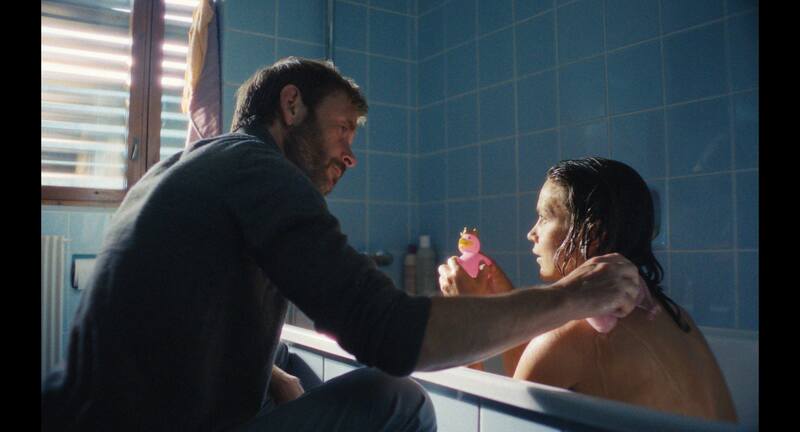
Richard (Jan Gunnar Røise) knows enough about himself to recognize that there’s something wrong. Troubled by feelings toward his girlfriend's seven-year-old daughter, he doesn't move forward with the family they were planning. Instead, he leaves and returns to his childhood home, intending to renovate it before the property is sold. That decision gives CUTE a very important distinction right from the start, because Richard isn't introduced through an act of abuse. He's a man confronting an attraction he knows shouldn't exist, and Lyngstad places us on the more complicated path of what happens after someone recognizes something within themselves that they can't and shouldn’t accept.
That doesn't make Richard sympathetic, far from it, and the story would collapse if recognizing the problem replaced accountability. There's a meaningful difference between understanding why someone behaves a certain way and forgiving the behavior itself. CUTE positions itself directly inside that discomfort, asking us to spend time with a character whose life is disturbing without suggesting that discomfort gives him a free pass.
Returning Richard to his childhood home is an especially smart choice because he's literally preparing to dismantle one connection to his past while struggling to leave childhood behind. The house isn't simply somewhere he can disappear. It becomes a place where memory, regression, loneliness, and adulthood sit side by side, with Richard trying to move forward while surrounding himself with the remnants of where he came from. Then Stella (Gina Jaqueline) enters the picture.
She's an adult caregiver looking after Richard's mother, but her private life defies almost every assumption we could make about her. Online, Stella presents herself through a deliberately childlike Lolita persona, turning innocence into performance and performance into something you can buy. Richard's fascination with childhood and Stella's decision to imitate it eventually bring them into a surrogate father-daughter relationship, though calling it "surrogate" almost sounds too nice for everything going on beneath the surface.
Richard and Stella aren't simply attracted to one another as two lonely adults, nor is their arrangement built around an ordinary romantic fantasy. Each appears to be asking the other to become something missing from their life. Stella can fill that childhood void again instead of just performing like an adult. Richard can assume the role of protector and father without confronting the real child whose presence made that role dangerous for him.
Their arrangement turns intimacy into a kind of controlled environment. They can set rules, assign identities, and create a private reality where uncomfortable desires become easier to handle, but giving something a different name doesn't necessarily make it healthier. The disturbing part isn't merely the role-play. It's the possibility that both people understand exactly what they're doing while using one another to make it feel okay.
Through that lens, the title becomes increasingly important because “cuteness” itself isn't inherently innocent. It's an aesthetic, and aesthetics can be manufactured. Adults buy objects designed to resemble babies, decorate rooms to evoke childhood, sexualize school uniforms, build online identities around infantilization, and consume endless products designed to trigger affection.
Stella complicates the story further because she's not an actual child. She's an adult choosing to present herself in a particular way, which keeps the movie from reducing everything to Richard simply finding a victim. Agency exists here, but that doesn't eliminate the ugliness underneath their arrangement. An adult consenting to perform like a child for someone still leaves the question of why childhood itself is necessary to the fantasy. The most impactful question here isn’t whether they explore this relationship; it’s that Richard uses Stella to fill a gap for something he knows would be wrong.
Lyngstad also has to navigate an unusually narrow path with Richard. Make him too monstrous, and there's little reason to explore his psychology for nearly two hours; make him too miserable and the movie risks asking the audience to comfort the wrong person. His decision to leave his girlfriend and stepdaughter establishes that he understands a boundary before he crosses it, but understanding the boundary doesn't erase what brought him there.
The stepdaughter's return eventually threatens the world Richard and Stella have built, and that's an essential pressure point, not just another complication. Fantasy becomes considerably harder to maintain when the real person whose absence helped create it is in the same room. Richard can play father within an arrangement designed around his own needs, but actual parenthood requires responsibility toward someone who doesn't exist for his benefit.
Richard's problem isn't merely that he wants something forbidden; it's that his version of intimacy seems increasingly dependent on control. A real child grows, changes, requires independence, and eventually stops being little. A fantasy can be frozen exactly where the person creating it wants it to remain. That gives CUTE something beyond its most immediately shocking premise. The movie is dealing with loneliness and sexual transgression, but it's also interested in adults who want childhood to remain available to them long after it has ended. Nostalgia can be harmless. Regression can even be comforting. The trouble begins when someone else has to help preserve that illusion.
This entire story carries an obvious risk. Disturbing subject matter can be mistaken for depth simply because audiences don't know how they're supposed to feel. CUTE has no shortage of difficult ideas, but the important question is whether those ideas remain attached to people rather than becoming an exercise in making everyone uncomfortable. For any of this to matter, Richard and Stella need lives beyond the concepts they represent. There are easier stories to tell about forbidden desire. Safer ways to build a feature exist, but CUTE seems determined to investigate something most movies would rather label, condemn, and move away from as quickly as possible. Condemnation is easy. Understanding why people build these emotional hiding places is far messier.
Even the word "cute" starts feeling different after spending this much time thinking about what it actually describes. Something can appear soft while concealing something harmful, and innocence can be imitated without actually being present. CUTE turns that contradiction into an unsettling examination of two adults trying to rebuild childhood for themselves, only to discover that pretending something is innocent doesn't make it so.
Please visit https://linktr.ee/overlyhonestr for more reviews.
You can follow me on Letterboxd, Instagram, Twitter, and YouTube. You can also find my social media accounts on most platforms by searching for 'Overly Honest Reviews'.
I’m always happy to hear from my readers; please don't hesitate to say hello or send me any questions about movies.
[photo courtesy of NORDISK FILM PRODUCTION, FILM I VÄST, UNDER SKI TOWER]
DISCLAIMER:
At Overly Honest Movie Reviews, we value honesty and transparency. Occasionally, we receive complimentary items for review, including DVDs, Blu-rays, CDs, Vinyl Records, Books, and more. We assure you that these arrangements do not influence our reviews, as we are committed to unbiased, sincere evaluations. We aim to help you make informed entertainment choices regardless of our relationship with distributors or producers.
Amazon Affiliate Links:
This site also contains Amazon affiliate links. If you purchase through these links, we may receive a commission. This affiliate arrangement does not affect our commitment to honest reviews and helps support our site. We appreciate your trust and support as you navigate these links.


Happy
0 %

Sad
0 %

Excited
0 %

Sleepy
0 %

Angry
0 %

Surprise
0 %
 0
0
 0
0

Average Rating