A Good Man Has a Bad Night
Read Time:8 Minute, 14 Second
MOVIE REVIEW
It's a Wonderful Life
 –

Genre: Holiday, Drama, Fantasy
Year Released: 1946, 2026 4K set
Runtime: 2h 10m
Director: Frank Capra
Writers: Frances Goodrich, Albert Hackett, Frank Capra
Cast: James Stewart, Donna Reed, Lionel Barrymore, Thomas Mitchell, Henry Travers, Beulah Bondi, Ward Bond, Frank Faylen, Gloria Grahame, H.B. Warner, Jimmy Hawkins
Where to Watch: available now; order your copy here: www.moviesunlimited.com or www.amazon.com
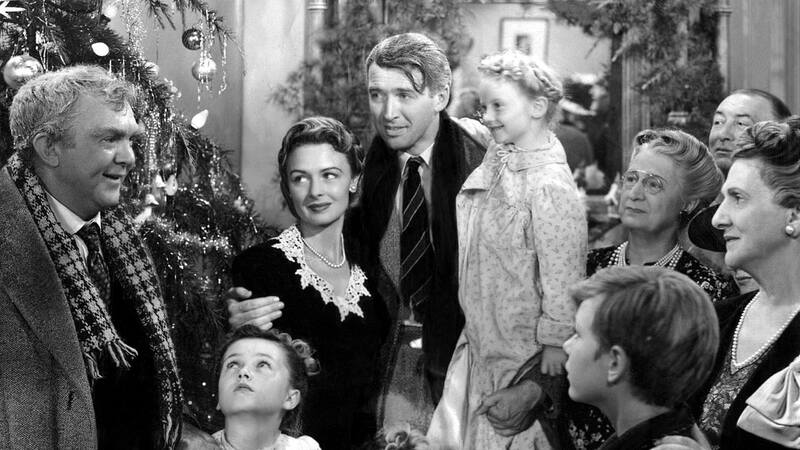
RAVING REVIEW: I’m old enough to remember the transition from standard definition to high-definition TV; a lot of it felt like a natural evolution over time. There was a moment, though, that I really felt it, an apples-to-apples comparison that let me see how good a film could look, compared to what I was used to for most of my life. I don’t remember the year, but I was flipping through channels, and IT’S A WONDERFUL LIFE was playing, and I was blown away. I had seen this film more than probably any other holiday movie. Yet this was different; there was something I would have a hard time putting into words. The image was crisper, the shadows felt deeper, and something made it feel “real”; it was my first time seeing a film really take advantage of the new technology. We see a woman ask for seventeen dollars and fifty cents, and George Bailey leans across the counter and kisses her on the cheek. The Building and Loan is going through a rough time, and every customer at the counter has good reason to want all their money. This woman asks for exactly what she needs. James Stewart conveys a feeling you can feel through the TV in one gesture, making the whole thing funny, even though a business could go under before the end of the day. Ellen Corby has a few seconds to make the woman’s decision matter. She needs the money and has done the math. I love that the movie gets so much out of fifty cents. It’s my favorite Christmas movie, and I don’t see anything ever taking its place.
George talks about travel early on with the passion of somebody who’s already halfway out of town. He wants a big suitcase and can picture everything he’ll build once he’s seen the world. Director Frank Capra gives those plans an appeal before he starts cutting into them. Every time something goes wrong, the people who rely on him have one more reason to expect he’ll stay. George arranged his life around the idea that somebody else will eventually take a turn. He has good reason to be disappointed when no one does.
For a few minutes at the graduation dance, George has nothing more pressing in his life than dancing with Mary. They’re doing the Charleston, having a better time than the guy who decides to open the floor underneath them. And yes, there really was a pool under the gym floor at Beverly Hills High School. Capra lets us see it coming and gives George and Mary just enough time to get themselves right to the edge. What gets me is how quickly everyone else decides to jump in. Somebody went to all that trouble to embarrass George and wound up giving the whole room a party.
Later on, Sam Wainwright calls with a business proposition and finds himself talking to two people who are barely listening. George and Mary have to share the phone, and for a guy who can usually fill any silence by telling you what he’s going to do with his life, George suddenly has very little to say. Donna Reed gives him time to run out of things to do with his eyes. Sam can keep talking about plastics for as long as he wants. By then, I’m just watching the two of them try to pretend the call is why they’re standing that close.
Mary also knows when to get on with things. During the run on the Building and Loan, she brings out the money they’d put aside for their honeymoon. We’ve heard George talk for years about getting away, so there’s a real cost to seeing them put that cash on the counter. I like how George explains where everybody’s savings have gone. The money is in their neighbors’ houses. Lionel Barrymore balanced the other side of that conversation by making Potter sound almost reasonable when he offers to buy people out for fifty cents on the dollar. He knows some of them have no choice, and need that money. He’s got the luxury of waiting for them to come to him.
Then there’s Clarence, who’s been sent to help a man having the worst night a person can have and has to be brought up to speed first. Henry Travers is funny because he takes this assignment as seriously as anybody trying to earn his wings ought to. He sounds like somebody you’d trust with a little bad news, which is a great quality in the person who finally gets George to stop and listen. Travers doesn’t make the film iconic, nor do Stewart, Reed, or Barrymore; what makes the film so iconic is how they all work together and the one-liners that have become inseparable from film history over the years.
The scene that’s hardest to sit through comes before Clarence has much to do with George getting home on Christmas Eve and finding Janie practicing piano, with a house full of people who all want his attention. It’s the sort of chaos he’d come home to on a good day. Stewart shows how much it’s getting to him, and then George starts taking it out on everyone in reach. Reed’s reaction here is a supporting pillar of the film. Mary can see that something’s wrong with him, and she’s also right there with the kids who have no idea why he’s so angry. I think about that scene whenever the movie gets described as comforting. It can be, but it lets you spend a few minutes in that house when nobody knows what to say to him.
Five Oscar nominations didn’t keep the film from losing money on its original run. Years later, the missed copyright renewal meant local stations could show it on repeat, and for a long time there was a good chance you’d run across it on a 24-hour marathon in December. It’s easy to see how people got to know it scene by scene. You can come in at the dance and know enough about George and Mary to want to see where they go after they get out of the pool.
The 80th anniversary edition includes the film on 4K UHD, Blu-ray, and DVD, along with a digital copy. Paramount’s 4K restoration goes back to the original nitrate negative and two fine-grain masters. The Blu-ray also has the colorized version, but we don’t talk about that lol. The black-and-white version is what I will always remember from flipping through channels. The snow can look as bright as you’d want it to look in a Christmas movie, and the street George is walking down can look cold enough that you’d hate to be on it with him.
The thing I’m happiest to see in the set is Jimmy Hawkins’s THE HEART OF IT’S A WONDERFUL LIFE. Hawkins played Tommy Bailey as a kid, and the book includes photographs and script excerpts alongside stories from the production. For a movie I know well, that’s a better reason to spend time with it than new cover art. The person telling you about that house and everybody in it used to be one of the kids running around in it.
On the walk home from the dance, George offers Mary the moon and explains how she could swallow it and what would happen after. A man sitting on his porch has heard enough and tells George to kiss her already. Then he goes inside and shuts the door. I love that he gets to be in the movie long enough to have an opinion about how this is going, then goes back to whatever he was doing before George Bailey came down his street.
Please visit https://linktr.ee/overlyhonestr for more reviews.
Follow me on Letterboxd, Instagram, Twitter, and YouTube. You can also find my social media accounts on most platforms by searching for 'Overly Honest Reviews'.
I’m always happy to hear from my readers; please don't hesitate to say hello or send me any movie questions.
[photo courtesy of MOVIES UNLIMITED, ALLIANCE HOME ENTERTAINMENT, PARAMOUNT]
DISCLAIMER:
At Overly Honest Movie Reviews, we value honesty and transparency. Occasionally, we receive complimentary items for review, including DVDs, Blu-rays, CDs, Vinyl Records, Books, and more. We assure you these arrangements do not influence our reviews, as we are committed to unbiased, sincere evaluations. We aim to help you make informed entertainment choices regardless of our relationship with distributors or producers.
Amazon Affiliate Links:
This site also contains Amazon affiliate links. If you purchase through these links, we may receive a commission. This affiliate arrangement does not affect our commitment to honest reviews and helps support our site. We appreciate your trust and support as you navigate these links.


Happy
0 %

Sad
0 %

Excited
0 %

Sleepy
0 %

Angry
0 %

Surprise
0 %
 0
 0

Average Rating