Some Towns Are Better Left Behind
Read Time:9 Minute, 39 Second
MOVIE REVIEWS
The Hot Spot
 –
– 


Genre: Film Noir, Crime, Drama, Thriller
Year Released: 1990
Runtime: 2h 10m
Director(s): Dennis Hopper
Writer(s): Charles Williams, Nona Tyson
Cast: Don Johnson, Virginia Madsen, Jennifer Connelly, Charles Martin Smith, William Sadler, Jerry Hardin, Barry Corbin, Jack Nance
Where to Watch: available now; order your copy here: www.radiancefilms.co.uk, www.mvdshop.com, or www.amazon.com
RAVING REVIEW: You can almost feel the temperature rising before anybody has done anything particularly dangerous. THE HOT SPOT looks sweaty, dusty, and uncomfortable from practically the moment Harry Madox enters town, and Dennis Hopper understands that the heat shouldn't simply be part of the setting. It needs to affect everything.
That makes the slow pace considerably easier to accept at first. Hopper isn't rushing Harry toward the next robbery, affair, blackmail scheme, or bad decision because this isn't really that kind of crime movie. People linger around this little Texas town as if the heat has drained whatever urgency they might otherwise possess, while trouble gradually collects around them.
Don Johnson is perfectly comfortable playing Harry as someone who seems capable of leaving at any moment. He's a drifter who talks himself into a job at a used-car dealership and quickly begins looking for opportunities beyond legitimate employment, including a local bank that appears practically designed to tempt someone like him. Harry doesn't arrive with much emotional baggage for us to unpack, and Johnson makes his lack of attachment part of the character's appeal.
There's confidence there, but Harry isn't quite as clever as he believes. He's good at reading opportunities and considerably worse at recognizing when someone else has already figured him out. That becomes especially important once Dolly Harshaw takes an interest in him, because Virginia Madsen doesn't play Dolly like somebody Harry has successfully seduced. She looks more like someone who has decided what she wants and informed Harry that he's going to participate.
Madsen is easily the most memorable person in the movie. Dolly is funny, aggressive, sexual, manipulative, unpredictable, and completely comfortable making Harry nervous when he would much rather believe he's controlling the situation. There's always a suggestion that she's thinking one or two moves beyond whatever Harry believes is happening, and Madsen gives even otherwise simple conversations a little danger.
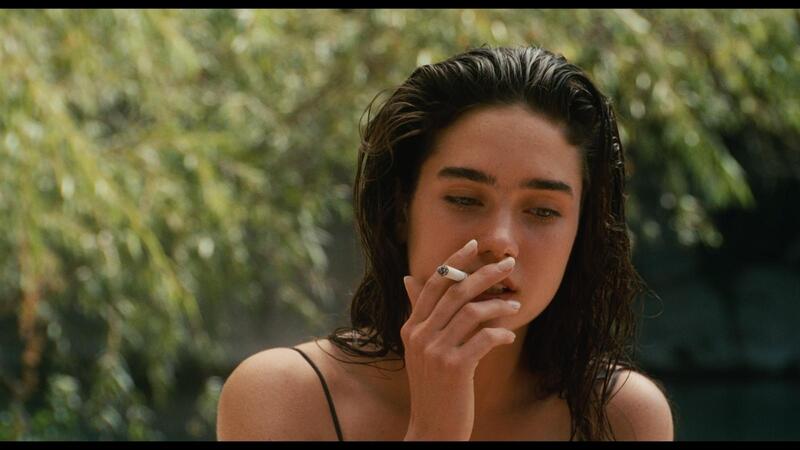
Jennifer Connelly's Gloria Harper is positioned almost opposite her. She's quieter, more vulnerable, and carrying a problem that gradually pulls Harry further into the town's uglier corners. Connelly doesn't compete with Madsen's larger presence by trying to match it. Her restraint is what makes the contrast between Gloria and Dolly so effective.
The problem is that the contrast sometimes overshadows the characters themselves. Dolly gets enough personality to push beyond the familiar femme fatale role, but Gloria spends considerably more time occupying the story's idea of innocence. Connelly gives her warmth and sensitivity, yet the screenplay doesn't always give her as much complexity as the increasingly complicated situation surrounding her deserves.
Harry suffers from a different version of the same issue. Johnson has the right confidence for the character, but the women increasingly become more interesting than the man supposedly connecting everything. Harry's criminal instincts, romantic interests, and willingness to keep making increasingly questionable choices are entertaining. Still, there are stretches when he feels more like the delivery system for the movie's noir conventions than someone I particularly needed to understand.
Hopper doesn't seem terribly bothered by that. THE HOT SPOT is much more interested in what Harry gets himself into than explaining who he was before he arrived, and that simplicity suits the older crime-story structure being used here. Harry walks into town, sees money and women, assumes everything is available to him, and slowly discovers that taking whatever you want gets considerably more complicated once everybody else starts doing the same thing.
The bank robbery itself is almost amusingly straightforward compared with everything surrounding it. Harry sees an opportunity, develops a plan, and acts with the confidence of someone convinced he can manipulate circumstances faster than consequences can catch him. The criminal material gives the movie direction, but Hopper seems far more interested in sex, jealousy, blackmail, and the uncomfortable arrangements people create when they realize they can use one another.
That brings William Sadler into some of the nastier material as Frank Sutton. Sadler has always been good at making an unpleasant character feel immediately unpleasant without requiring much explanation, and Sutton brings a different type of threat than Dolly. Nothing seductive or particularly entertaining about what he represents, which helps keep the movie's sleazier elements from becoming entirely playful.
Hopper surrounds all of this with an excellent collection of character actors. Charles Martin Smith, Jerry Hardin, Barry Corbin, and Jack Nance make the town feel populated by actual people rather than just bodies positioned between Harry and the next major plot development. They also fit the slightly heightened quality of the movie, where almost everyone feels recognizable while still being just strange enough to belong in Harry's increasingly bad week.
Ueli Steiger's photography may be as important as any performance. THE HOT SPOT doesn't rely on the nighttime streets, rain, and heavy shadows most immediately associated with classic noir. Much of this corruption happens under punishing sunlight, where the brightness somehow makes everything feel dirtier, not safer.
That approach gives the 4K presentation a real opportunity to shine. Radiance's restoration from the original negative, overseen and approved by Steiger, preserves the photography's earthy quality while adding impressive detail and depth. The HDR and Dolby Vision presentation particularly benefits the contrast between brutal exterior sunlight, darker interiors, skin tones, dusty environments, and the more saturated colors scattered throughout the town.
Just as important is the music. Jack Nitzsche's score, combined with contributions featuring Miles Davis, John Lee Hooker, and Taj Mahal, gives the movie a blues-heavy sound that feels completely connected to its setting. The music doesn't simply accompany Harry's trouble; it makes the entire town feel slower, heavier, and slightly dangerous.
At times, that commitment to mood works against the movie. Two hours and ten minutes is a lot of room for a story built from relatively familiar noir ingredients, and THE HOT SPOT occasionally seems perfectly content to sit in the heat when it should probably move along. The deliberate pace can get repetitive once the relationships and threats are established.
The middle section feels this most noticeably. Harry moves between Gloria, Dolly, the robbery, and various complications. At the same time, the movie keeps applying pressure, but not every scene adds enough to justify how long Hopper lets everything breathe. Cutting even fifteen minutes could have made the eventual tightening of the screws feel considerably stronger without sacrificing the atmosphere.
Yet shortening it too aggressively might also remove the quality that makes THE HOT SPOT distinctive. This isn't supposed to feel efficient. Hopper wants us trapped in that town long enough to understand why Harry can't simply commit his crime, have his affairs, and drive away in the same easy manner he arrived.
There's also something entertainingly old-fashioned about how unapologetically THE HOT SPOT embraces noir behavior while placing it in a contemporary setting. Nobody seems particularly concerned with making Harry morally acceptable, Dolly secretly misunderstood, or every criminal decision psychologically complicated. These are people driven by money, sex, jealousy, desperation, and the belief that they can always make one more bad choice without paying for the previous one.
Radiance's two-disc release gives the film the sort of treatment its visual and musical strengths deserve. Along with the restored feature, the package includes interviews with Madsen and Sadler, an archival Dennis Hopper piece, discussions of Hopper and Charles Williams' source novel, and a booklet examining both the film and the erotic thriller tradition around it. It's substantial without turning the movie into something more important than it actually is.
That's probably the right way to approach THE HOT SPOT in general. It isn't some forgotten landmark that rewrites noir, and its length makes its limitations harder to overlook. Hopper takes familiar material, gives it an unusually oppressive sense of place, surrounds Johnson with two women considerably more interesting than he is, and lets everyone make enough terrible decisions to keep the temperature climbing.
By the time everything finally catches up with Harry, THE HOT SPOT has made its point without needing to reinvent anything. Some people walk into trouble accidentally, while Harry practically introduces himself to it, gets a job nearby, sleeps with it, and then acts surprised when it refuses to let him leave. The movie takes too long getting him there, but watching that trap slowly close is still a pretty satisfying way to spend time in the heat.
Bonus Materials:
4K restoration from the original negative, presented in HDR / Dolby Vision, overseen and approved by cinematographer Ueli Steiger
4K UHD and Blu-ray presentation of the feature
Uncompressed stereo PCM audio
Archival interview with Dennis Hopper, who discusses The Hot Spot and features footage of John Lee Hooker and images from the set (1991, 4 mins)
Interviews with stars Virginia Madsen (2021, 7 mins) and William Sadler (2021, 6 mins)
Nick Dawson on Dennis Hopper and The Hot Spot, an interview with the editor of Dennis Hopper: Interviews (2023, 20 mins)
Duane Swierczynski on Charles Williams’ source novel, the crime writer and expert looks at the adaptation and provides a background of the author (2023, 25 mins)
Trailer
English subtitles for the deaf and hard of hearing
Reversible sleeve featuring original and new artwork by Time Tomorrow
Limited edition booklet featuring writing by critics Elena Lazic on the film, Leslie Byron Pitt on the erotic thriller genre and the film’s place within it, and an archival piece on the film featuring an interview with Hopper by RJ Smith
Limited edition of 10,000 copies, presented in full-height Scanavo packaging with a removable OBI strip, leaving packaging free of certificates and markings
Please visit https://linktr.ee/overlyhonestr for more reviews.
You can follow me on Letterboxd, Instagram, Twitter, and YouTube. You can also find my social media accounts on most platforms by searching for 'Overly Honest Reviews'.
I’m always happy to hear from my readers; please don't hesitate to say hello or send me any questions about movies.
[photo courtesy of RADIANCE FILMS, MVD ENTERTAINMENT]
DISCLAIMER:
At Overly Honest Movie Reviews, we value honesty and transparency. Occasionally, we receive complimentary items for review, including DVDs, Blu-rays, CDs, Vinyl Records, Books, and more. We assure you these arrangements do not influence our reviews, as we are committed to unbiased, sincere evaluations. We aim to help you make informed entertainment choices regardless of our relationship with distributors or producers.
Amazon Affiliate Links:
This site also contains Amazon affiliate links. If you purchase through these links, we may receive a commission. This affiliate arrangement does not affect our commitment to honest reviews and helps support our site. We appreciate your trust and support as you navigate these links.


Happy
0 %

Sad
0 %

Excited
0 %

Sleepy
0 %

Angry
0 %

Surprise
0 %
 0
0
 0
0


Average Rating