Thirty Days to Face the Past
Read Time:9 Minute, 37 Second
MOVIE REVIEWS
Last Stand at Butte City
 –
– 


Genre: Western, Drama, Short
Year Released: 2026
Runtime: 17m
Director: Natalie Schwan
Writer: Natalie Schwan
Cast: Kerry O'Malley, Jamie Lynn Richards, Nick Wilder, Jeff Medley, Cara Wilder, Beau Linnell
Where to Watch: shown at the 2026 HollyShorts Film Festival and Richmond Film Festival
RAVING REVIEW: The traditional Western prepares us for a showdown. Someone takes the land, somebody refuses to move, guns come out, and sooner or later the dispute gets settled in the dirt. Writer-director Natalie Schwan uses those expectations to her advantage in LAST STAND AT BUTTE CITY, a 17-minute Western that initially looks ready to send an aging rancher into battle against the railroad before gradually revealing that the confrontation she has spent decades avoiding is much more personal.
Charlotte (Kerry O'Malley) has lived alone on her Montana homestead for more than 30 years when Northern Pacific Railway representatives arrive with an eviction notice. Their tracks are coming through, her land has been claimed, and she has 30 days to leave. Charlotte has no interest in cooperating, particularly when she discovers that neighbors who might have joined her resistance have already accepted the railroad's offers and decided to move on.
It's a familiar conflict for the genre, but Schwan isn't especially interested in making the railroad a straightforward villain. Progress is arriving whether Charlotte approves of it or not, and the people around her aren't necessarily cowards because they've chosen compensation over a hopeless fight. That leaves Charlotte standing alone, which is precisely how she has spent most of her adult life.
The land means something very different to her than it does to everyone else. Her husband and daughter are buried there, and the homestead contains the remnants of the family and future she once expected to have. Leaving isn't simply a question of surrendering property. In Charlotte's mind, walking away means abandoning the people she lost and admitting that a part of her life she has preserved for decades really is over.
Kerry O'Malley makes that history visible without turning Charlotte into someone constantly announcing her pain. The performance is guarded and physically rigid, as if every year alone has added another layer between Charlotte and anyone close enough to hurt her. O'Malley communicates an astonishing amount by simply standing in a room or reacting to someone entering her space, and the film is smart enough to let those small moments stay quiet.
That restraint becomes especially effective when Charlotte's determination starts to look less like strength and more like fear. She's unquestionably tough, resourceful, and capable of defending herself, but Schwan gradually asks whether those qualities have become excuses for remaining isolated. Survival kept Charlotte moving after devastating loss, yet surviving and living aren't the same.
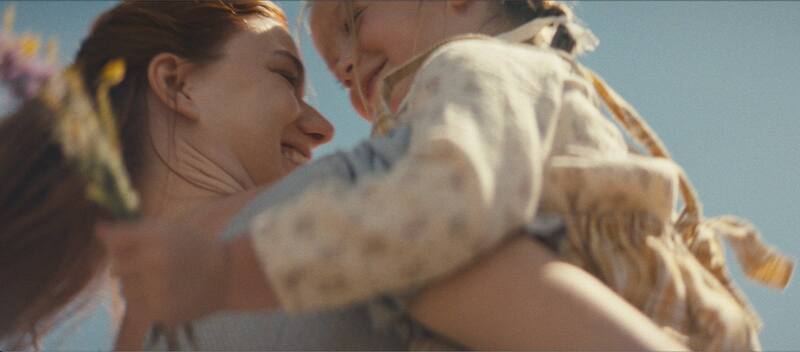
The younger Charlotte, played by Jamie Lynn Richards, makes that distinction clearer. Rather than asking Richards to imitate O'Malley's mannerisms, the film presents a version of Charlotte before grief changed how she moved through the world. She's warmer, more open, and visibly excited by the life being built around her, which makes the distance between the two performances feel like the result of everything that happened between them.
Richards' performance matters because the flashbacks could easily function as basic exposition. We need to understand what Charlotte lost, but simply showing a husband and daughter wouldn't automatically explain why she has spent decades effectively frozen in place. Richards gives those memories enough joy that their absence later hurts, while the contrast with O'Malley shows how much of Charlotte has been buried along with her family.
Schwan doesn't separate those memories from the present with oversized visual signals. The past enters in fragments, triggered by spaces, objects, and moments that Charlotte has surrounded herself with for years. That feels appropriate for someone whose entire home has essentially become an archive of a life she refuses to leave behind.
Cinematographer Kyle Deitz makes particularly good use of the Montana landscape. Westerns have always understood the visual power of putting a person against an enormous horizon, but LAST STAND AT BUTTE CITY uses that scale to emphasize isolation rather than freedom. Charlotte owns all this space, yet appears increasingly trapped within it.
The wide 2.39:1 framing gives the exterior photography the scope you'd expect from a much larger Western. Mountains and open land stretch around Charlotte, while negative space frequently emphasizes just how little human connection remains in her life. It's beautiful enough that her attachment to the place never needs much explanation, but Schwan and Deitz also keep reminding us that beauty alone doesn't make somewhere healthy to stay.
The homestead itself reinforces that contradiction. It feels lived in rather than arranged as a pristine period set, with small possessions suggesting a woman who accumulated an entire lifetime within the same walls. Traces of who Charlotte was before Montana hardened her remain, including objects that seem almost too delicate for the frontier environment around them. The home feels comforting at first, then increasingly resembles a place where time stopped.
That's one of the film's strongest ideas. Charlotte has convinced herself that remaining close to the physical evidence of her family keeps them present, but she's also arranged her life so nothing can challenge that memory. The railroad becomes threatening not simply because it wants her acreage but because it removes her ability to continue living exactly as she has.
At only 17 minutes, LAST STAND AT BUTTE CITY doesn't have much time to complicate that realization. Charlotte's history, the arrival of the railroad, her relationship with the neighboring community, and decades of unresolved grief all have to be established and resolved quickly. At times, the emotional progression feels compressed, particularly once someone finally finds a way through the armor she has spent so long building.
A feature could give those relationships more room, and that's apparently where Schwan ultimately intends to take the material. The short was conceived as a proof of concept for a longer version, and that origin is occasionally visible. Characters and pieces of Charlotte's past feel as though they belong to a larger story we are only briefly visiting.
Normally, describing something as a proof of concept can sound like an excuse for incompleteness. That's not quite the case here because LAST STAND AT BUTTE CITY still establishes a complete emotional arc. Still, I came away wanting more context about the community Charlotte has withdrawn from. Understanding who once tried to reach her, who eventually stopped trying, and how the town changed while she remained fixed in place could make her isolation even more powerful.
The railroad could also become more complicated with additional time. Schwan's choice not to portray it as some evil corporation twirling its mustache is one of the film's better decisions. Railroads meant connection and opportunity to countless communities while simultaneously displacing people and transforming landscapes, and Charlotte happens to be standing directly where that contradiction becomes personal.
The movie doesn't need her to win that argument because winning isn't actually the point. Charlotte can load a rifle, refuse every offer, and prepare to defend the homestead until there's nobody left to remove, but none of that solves what has kept her there. The Western imagery begins to look increasingly like armor she has built around herself.
That shift is where O'Malley's performance becomes most effective. When Charlotte's defenses finally weaken, she doesn't suddenly become someone else or deliver a giant speech explaining the film's lesson. O'Malley lets the emotion arrive reluctantly, making it feel like something Charlotte has actively prevented herself from experiencing for years.
Clark Rhee's score respects that approach instead of constantly informing us that something sad is happening. Silence and natural surroundings are allowed to occupy space, which matters in a story where loneliness is practically another character. When the music does become more present, O'Malley has already laid the emotional groundwork rather than handing it off to the soundtrack.
The film's recent HollyShorts appearance, where producers Natalie Schwan and Susie Talbot received a Best Producer nomination, also makes sense after seeing how much period detail has been packed into such a short production. Period Westerns aren't exactly the easiest, least expensive films to mount, yet the costuming, locations, and production design generally avoid drawing attention to the limitations behind the camera.
There are still moments where the short format works against the ambition. A few transitions move more quickly than I'd like, and the emotional destination becomes apparent well before Charlotte reaches it. The basic idea that holding onto grief can become another form of imprisonment isn't particularly new, either, so the movie depends heavily on performance and atmosphere to keep that observation from feeling overly familiar.
Fortunately, those are its strongest elements. O'Malley gives Charlotte the kind of interior life that makes seventeen minutes feel much longer, Richards creates a believable younger version without resorting to imitation, and Schwan knows how to use Western conventions without getting trapped by them.
I'm not someone who automatically gets excited by the word "Western," which may actually make LAST STAND AT BUTTE CITY more interesting to me. The guns, horses, railroad, and Montana landscape are all here, but Schwan ultimately uses them to tell a story about a woman discovering that her final stand may not require pulling a trigger at all.
LAST STAND AT BUTTE CITY is beautifully photographed and anchored by a strong Kerry O'Malley performance, while its emotional approach gives familiar Western imagery a different purpose. Its 17-minute runtime compresses parts of Charlotte's world, but the short understands something more important: sometimes refusing to leave isn't evidence that you've remained strong. Sometimes it's proof that you've been afraid to move for a very long time.
Please visit https://linktr.ee/overlyhonestr for more reviews.
You can follow me on Letterboxd, Instagram, Twitter, and YouTube. You can also find my social media accounts on most platforms by searching for 'Overly Honest Reviews'.
I’m always happy to hear from my readers; please don't hesitate to say hello or send me any questions about movies.
[photo courtesy of VELOCITY FILMS, PUFF PIECE PRODUCTIONS]
DISCLAIMER:
At Overly Honest Movie Reviews, we value honesty and transparency. Occasionally, we receive complimentary items for review, including DVDs, Blu-rays, CDs, Vinyl Records, Books, and more. We assure you these arrangements do not influence our reviews, as we are committed to unbiased, sincere evaluations. We aim to help you make informed entertainment choices regardless of our relationship with distributors or producers.
Amazon Affiliate Links:
This site also contains Amazon affiliate links. If you purchase through these links, we may receive a commission. This affiliate arrangement does not affect our commitment to honest reviews and helps support our site. We appreciate your trust and support as you navigate these links.


Happy
0 %

Sad
0 %

Excited
0 %

Sleepy
0 %

Angry
0 %

Surprise
0 %
 0
0
 0
0

Average Rating