A Protest Powered by Diesel
Read Time:10 Minute, 1 Second
MOVIE REVIEW
Convoy
 –
– 

Genre: Action, Crime, Adventure, Drama, Comedy
Year: 1978, 2026 4K
Runtime: 1h 51m
Director: Sam Peckinpah
Writers: Bill L. Norton, based on the song by C.W. McCall, Chip Davis, and Bill Fries
Cast: Kris Kristofferson, Ali MacGraw, Ernest Borgnine, Burt Young, Madge Sinclair, Franklyn Ajaye, Seymour Cassel, Cassie Yates
Where to Watch: available now; order your copy here: www.kinolorber.com or www.amazon.com
RAVING REVIEW: CONVOY probably shouldn't exist in anything close to the form it does. A hit novelty country song about CB radios and truckers somehow became a major studio production directed by Sam Peckinpah, the man behind THE WILD BUNCH and STRAW DOGS. What could have been little more than a quick attempt to cash in on a late-1970s craze became a strange mix of working-class rebellion, broad comedy, road-movie spectacle, and several hundred thousand pounds of machinery rolling across the American Southwest.
That contradiction is more interesting than the story itself. Peckinpah works with material that often feels too thin for nearly two hours. Yet, whenever CONVOY stops worrying about its plot and simply watches an endless line of trucks fill the horizon, the movie suddenly understands exactly what it wants to be.
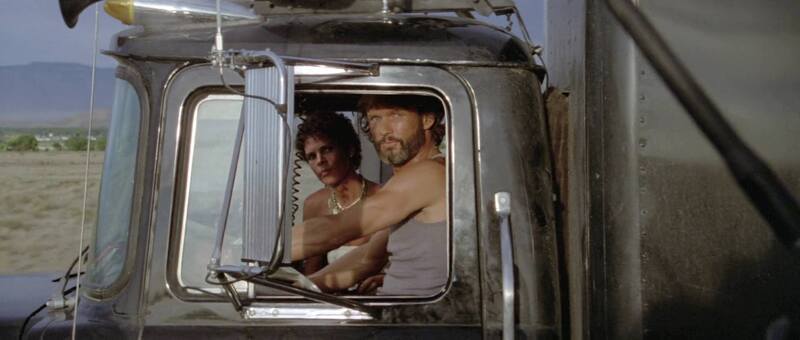
Kris Kristofferson plays Martin “Rubber Duck” Penwald, an independent trucker who crosses paths with Sheriff Lyle Wallace, better known over the CB as Cottonmouth. Ernest Borgnine plays Wallace as a man who clearly enjoys making truckers miserable, using his badge less as a public responsibility than as permission to bully whoever rolls through his territory.
Their hostility isn't new when we meet them. Rubber Duck understands Wallace's games, Wallace knows exactly how far he can push Duck, and their latest confrontation is just one more round in an argument neither man intends to end. Once Wallace's harassment escalates, however, Duck and several other truckers stop playing along.
What begins as a relatively personal feud starts attracting drivers through CB chatter until Rubber Duck finds himself leading a massive convoy. Pig Pen, Widow Woman, Spider Mike, and a growing collection of truckers fall in line behind him, turning the highway into an accidental protest movement. Before long, the convoy has become large enough that law enforcement can't simply pull everyone over and make the problem disappear.
There's something inherently satisfying about watching the convoy grow. Every additional truck makes the confrontation feel bigger, and Peckinpah understands the visual power of putting that much machinery into formation. Harry Stradling Jr.'s widescreen photography turns the highways, deserts, and distant horizons into the kind of American landscape that once held cowboys instead of eighteen-wheelers.
That's where CONVOY's connection to the western becomes obvious. Rubber Duck isn't far removed from the aging outlaws and stubborn loners Peckinpah had spent much of his career examining. He values independence, distrusts authority, doesn't particularly want to lead anyone, and discovers the world is far more complicated once people start treating him like one.
The truck replaces the horse, the CB replaces the campfire, and the open highway becomes the latest version of a frontier where people imagine they can escape anyone telling them what to do. Peckinpah doesn't need to turn that comparison into a speech because the images are already doing the work.
Kristofferson fits that role naturally. Rubber Duck spends much of the movie looking like a man who would rather keep driving than explain himself, and Kristofferson's relaxed confidence prevents the character from turning into an overplayed folk hero. He's charismatic enough to make hundreds of truckers following him believable while remaining uncomfortable with what their support starts to represent.
Borgnine has far more fun. Wallace is loud, stubborn, petty, corrupt, and frequently hilarious, but Borgnine avoids making him completely cartoonish. These two men have history, and some of the movie's best moments suggest a twisted familiarity beneath all the hostility.
Ali MacGraw has the less rewarding job as Melissa, a photographer who ends up traveling with Rubber Duck after her car becomes collateral damage. Their relationship gives the movie someone outside trucker culture who can ask questions about what all of this means. Too much of her role amounts to watching Duck become increasingly important to everyone around him.
The romantic material never generates the same energy as the road. Kristofferson and MacGraw aren't terrible together, but every time CONVOY stops the trucks to talk, it's hard not to wonder how quickly everyone can get moving again.
Movement is the movie's greatest asset. Peckinpah photographs trucks as though they're living things, giving enormous machines weight, personality, and occasionally a strange kind of grace. Watching dozens of rigs stretch across the highway can be more exciting than the chase itself because the scale is so impressive.
Then comes the famous sequence where the convoy arrives to support Spider Mike, and Peckinpah transforms what could have been a straightforward rescue into something approaching a cavalry charge. Seeing huge trucks rolling toward a small-town jail shouldn't feel heroic, but the movie completely commits to the image.
His trademark slow motion gets put to particularly entertaining use during the action. Fights become messy ballets of bodies crashing through furniture, vehicles become enormous projectiles, and destruction gets stretched just long enough for us to appreciate every piece of something being demolished.
The problem is that CONVOY doesn't have enough narrative momentum to match its physical momentum. The convoy keeps moving, but the story periodically feels like it's driving in circles. Rubber Duck argues with Wallace, more trucks arrive, law enforcement reacts, politicians notice, and the movie repeatedly manufactures another reason for everyone to keep driving down the road.
At 111 minutes, that repetition starts showing. Some sequences could disappear without hurting anything, and the middle has stretches where the sheer novelty of seeing more trucks join the convoy does most of the work.
The politics are similarly interesting without ever becoming especially focused. The truckers are frustrated by corrupt police, unfair treatment, regulations, and the general sense that working people are expected to accept whatever authority hands them. Their convoy becomes a national symbol before anyone involved has actually decided what they're protesting.
That ambiguity is one of the movie's better ideas. Rubber Duck doesn't set out to lead a movement, and when reporters and politicians begin asking him to explain what the convoy represents, he doesn't have a satisfying answer. Everyone else starts projecting meaning onto something that began because a handful of truckers were angry at one abusive cop.
Seymour Cassel's Governor Haskins sees political opportunity almost immediately. The convoy stops being a group of people once television cameras arrive and becomes something candidates, journalists, police departments, and spectators can use for their own purposes.
Peckinpah doesn't treat Rubber Duck as completely innocent in that transformation either. An ego hides beneath his reluctance, and the attention begins changing the dynamic among the truckers. A movement built around individual freedom develops its own expectations about what its reluctant leader is supposed to do.
Spider Mike, played by Franklyn Ajaye, gives some of those larger ideas a more personal weight. His experiences expose the gap between the convoy's romantic idea of rebellion and what happens when the authorities decide to make an example of someone without Rubber Duck's growing public protection.
CONVOY is strongest when that anger cuts through the silliness. For all the CB nicknames, corny humor, country music, bar fights, and trucker mythology, there's genuine frustration underneath the movie about who gets to exercise power and what happens when ordinary people decide they've had enough.
It just isn't disciplined enough to develop those ideas consistently. The tone swings from broad comedy to serious social commentary to romantic road movie to large-scale action without always finding a comfortable bridge between them.
Knowing the production was reportedly chaotic makes the finished movie's unevenness easier to understand, but it doesn't excuse it. Peckinpah was improvising heavily, accidents became usable footage, the shoot ran into numerous problems, and his control over the final edit has long been questioned. CONVOY sometimes feels like a movie assembled from several different versions of itself.
Oddly enough, that messiness gives it personality. A cleaner studio production might have turned the same concept into a more efficient comedy. It probably wouldn't have contained the same odd melancholy about independence, aging ideas of freedom, and a country eager to turn rebellion into entertainment.
The new 4K presentation also makes the visual side easier to appreciate than ever. The desert landscapes, chrome, smoke, dust, and long lines of trucks benefit enormously from the restored image, and Stradling's photography frequently looks far better than you'd expect from something built around a novelty song.
For a certain generation, though, the movie almost feels secondary to the song that inspired it. C.W. McCall’s “Convoy” became such a defining piece of 1970s trucker and CB-radio culture that plenty of people know the chorus, the slang, and the basic mythology without ever having seen Peckinpah’s film. The song was a phenomenon in its own right, turning phrases like “Rubber Duck” and “breaker one-nine” into pop-culture shorthand and helping push CB culture far beyond the trucking world. In that sense, CONVOY the movie isn’t so much responsible for creating the legend as for trying to catch up with one that already existed. For viewers who grew up hearing the song everywhere, the film can almost feel like the adaptation of something bigger than itself.
That may be CONVOY in miniature. The foundation sounds ridiculous, the screenplay doesn't always know what to do with it, and the movie runs longer than the material really supports. Then Peckinpah points his camera at a line of eighteen-wheelers rolling across the desert and, for a few minutes, the whole thing becomes strangely magnificent.
CONVOY isn't one of Peckinpah's great movies, even if it became his biggest commercial success. It's too loose, too repetitive, and too unsure whether Rubber Duck's rebellion is satire, celebration, or warning.
Enough grit under the commercial premise keeps it interesting. Somewhere between the CB chatter, country songs, police cars, truck-stop mythology, and Ernest Borgnine yelling at everyone, Peckinpah turned a novelty-song adaptation into an imperfect working-class western. The story may occasionally run out of road, but those trucks never stop looking good as they roll down it.
Please visit https://linktr.ee/overlyhonestr for more reviews.
You can follow me on Letterboxd, Instagram, Twitter, and YouTube. You can also find my social media accounts on most platforms by searching for 'Overly Honest Reviews'.
I’m always happy to hear from my readers; please don't hesitate to say hello or send me any questions about movies.
[photo courtesy of KINO LORBER]
DISCLAIMER:
At Overly Honest Movie Reviews, we value honesty and transparency. Occasionally, we receive complimentary items for review, including DVDs, Blu-rays, CDs, Vinyl Records, Books, and more. We assure you these arrangements do not influence our reviews, as we are committed to unbiased, sincere evaluations. We aim to help you make informed entertainment choices regardless of our relationship with distributors or producers.
Amazon Affiliate Links:
This site also contains Amazon affiliate links. If you purchase through these links, we may receive a commission. This affiliate arrangement does not affect our commitment to honest reviews and helps support our site. We appreciate your trust and support as you navigate these links.


Happy
0 %

Sad
0 %

Excited
0 %

Sleepy
0 %

Angry
0 %

Surprise
0 %
 0
0
 0
0



Average Rating