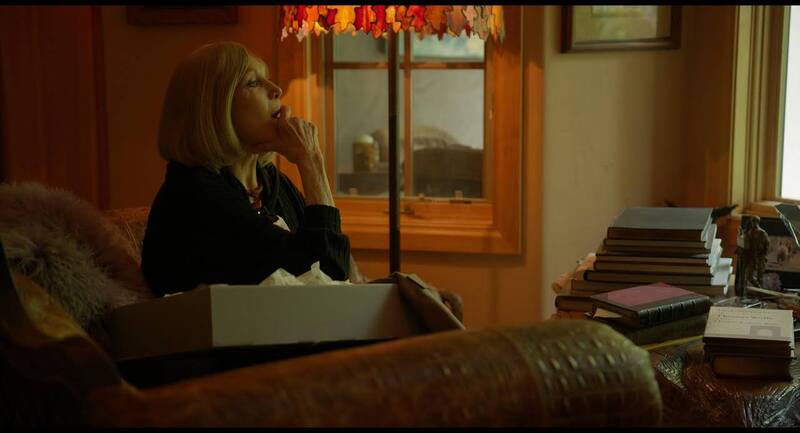
Novak Looks Back on Her Own Terms
Read Time:8 Minute, 57 Second
MOVIE REVIEW
Kim Novak's Vertigo
 –
– 


Genre: Documentary, Biography
Year: 2025, 2026 DVD
Runtime: 1h 17m
Director: Alexandre O. Philippe
Where to Watch: available now; order your copy here: www.kinolorber.com or www.amazon.com
RAVING REVIEW: The most interesting thing about KIM NOVAK'S VERTIGO is that its title initially sounds like a documentary about Alfred Hitchcock's VERTIGO, but the possessive matters. This isn't really another examination of Hitchcock's movie. It's Kim Novak looking back at the version of herself that Hollywood created, the woman underneath that image, and the decades she spent trying to understand the difference between the two.
Alexandre O. Philippe has built much of his documentary career around films that inspired obsession. 78/52 dissected the shower scene from PSYCHO, MEMORY: THE ORIGINS OF ALIEN explored ALIEN, and LYNCH/OZ examined the relationship between David Lynch and THE WIZARD OF OZ. KIM NOVAK'S VERTIGO starts from a similarly recognizable piece of cinema history, but Philippe gradually moves away from analyzing a movie and toward listening to the woman who inhabited it. That shift is ultimately what makes the documentary worthwhile.
Novak, now in her nineties, doesn't appear interested in delivering the polished Hollywood retrospective that documentaries about aging stars sometimes become. Her memories wander. Certain subjects lead unexpectedly into others. She talks about painting, childhood, fame, insecurity, James Stewart, the studio system, and the complicated feeling of looking back at a version of herself that belonged partly to everyone else. That loose structure can be frustrating, but it also feels appropriate for Novak.
Hollywood spent years trying to turn her into something carefully controlled. Columbia Pictures built an image around her, changed how she presented herself, and treated her beauty as something that could be packaged. Philippe keeps returning to the connection between that experience and VERTIGO, where Novak played a woman whose appearance is literally reconstructed according to a man's desired image. It's an obvious comparison. Sometimes the documentary makes it too obvious.
The parallel between Novak and Judy Barton is compelling enough that Philippe doesn't need to underline it as frequently as he does. VERTIGO already carries an enormous amount of baggage involving identity, obsession, control, performance, and the transformation of women into images. Novak's own experience with the Hollywood studio system naturally speaks to those themes without needing every memory filtered through Hitchcock's film. When KIM NOVAK'S VERTIGO relaxes that connection, Novak becomes far more interesting than the thesis.
Her recollections of becoming a star have a strange mixture of affection and discomfort. She clearly misses parts of that life, particularly performing and some of the people she worked with, but she doesn't seem to regret leaving Hollywood behind. Her decision to step away from that environment increasingly looks less like disappearing and more like taking control of a life other people had been managing for her. That distinction becomes one of the documentary's strongest ideas.
Novak didn't stop being an artist when she stopped appearing regularly in movies. She redirected that part of herself into painting and into a much quieter life away from Hollywood. Philippe spends considerable time with her artwork and her home in Oregon, allowing us to see someone who never stopped creating simply because audiences stopped seeing her on movie screens.
At times, those stretches threaten to drift. Anyone approaching the documentary primarily because of VERTIGO may wonder when the conversation will circle back toward Hitchcock, Stewart, or the production itself. Philippe doesn't structure this as a straightforward making-of documentary, and viewers hoping for a detailed account of one classic movie are likely to find the title somewhat misleading. That's also why the title eventually becomes interesting. This is Novak's VERTIGO, not another documentary about VERTIGO. The movie now belongs to her memory.
That becomes especially powerful when she encounters physical pieces of her past. One of the documentary's most affecting moments comes when Novak rediscovers the gray suit associated with Madeleine in VERTIGO. It's an object movie fans know immediately, but the emotional response isn't about costume history. For Novak, she's touching another version of herself.
That moment accomplishes more than much of Philippe's heavier thematic framing because it doesn't need an explanation. The dress represents the actress, the character, the studio-created image, Hitchcock's movie, and decades of audiences looking at Kim Novak through that one role. Watching her physically handle it decades later reverses something about that relationship. Now she's the one looking.
Novak's discussion of James Stewart also carries genuine warmth. Rather than turning the documentary into a collection of celebrity stories, Philippe lets those memories emerge naturally from her reflections. Stewart becomes important less because the documentary needs another famous name and more because Novak remembers the connection she felt while performing opposite him.
Her comments about acting are similarly revealing. She describes herself in ways that suggest instinct was more important than technique, responding emotionally to people and situations rather than approaching performance as something mechanical. That perspective makes her work in VERTIGO even more interesting because the role requires constant shifts between performance, concealment, vulnerability, and awareness. Several versions of one woman exist inside Novak's performance. That idea obviously fits Philippe's larger interest in identity, but I wish the documentary trusted Novak to carry more of that discussion herself.
At 77 minutes, KIM NOVAK'S VERTIGO isn't long, yet it occasionally feels less focused than documentaries twice its length. Philippe moves between movie clips, artwork, personal history, philosophical reflections, and conversations without always finding a strong rhythm connecting them. Some sections feel intimate and revealing. Others feel like fragments waiting for a clearer structure. The subject is consistently more compelling than the documentary built around her.
There are questions I would've liked Philippe to pursue more deeply. Novak worked inside one of the most controlling periods of Hollywood history, became one of its biggest stars, and then made the unusual decision to walk away from much of what the industry was offering her. That's an extraordinary life even before VERTIGO enters the conversation. The documentary touches on those ideas but doesn't always stay with them long enough.
It is also refreshing to hear Novak speak about herself without the usual chorus of historians and celebrities explaining what we're supposed to think about her. Philippe largely gives her space to define her own experiences, which is particularly appropriate for someone whose image was controlled by others for so much of her career. The drawback is that the movie rarely pushes back.
Novak's memories remain memories rather than becoming the starting point for a more investigative biography. Philippe isn't particularly interested in challenging her version of events or filling every chronological gap. That keeps the film intimate but limits how comprehensive it can become. KIM NOVAK'S VERTIGO works better as a conversation than as a definitive portrait.
We're spending time with someone from a Hollywood that essentially no longer exists, listening as she sorts through memories, artwork, possessions, regrets, and achievements. Sometimes those pieces fit together beautifully. Sometimes they don't. That imperfection has something valuable about it.
Novak spent decades being frozen in one of cinema's most famous images. That blonde hair, gray suit, carefully arranged appearance, standing inside somebody else's idea of perfection. Philippe's documentary allows that image to become messy again. She isn't Madeleine. She isn't Judy. She isn't simply Hitchcock's blonde. She's an elderly artist sitting in her own home, reconsidering a life others spent decades interpreting for her.
The documentary premiered at the Venice Film Festival alongside Novak receiving the Golden Lion for Lifetime Achievement, and that timing adds emotional weight. This isn't a posthumous attempt to explain who Kim Novak was. She's here to participate in the conversation herself. That matters.
Too many documentaries about classic Hollywood arrive after the people involved can no longer correct the mythology surrounding them. KIM NOVAK'S VERTIGO gives Novak the chance to look directly at that mythology and decide which pieces still belong to her.
The result isn't as penetrating as it might have been. Philippe's fixation on VERTIGO occasionally narrows a life that clearly extended far beyond one film, while the loose organization leaves some fascinating subjects only partially explored. Whenever Novak herself takes over, the documentary finds its purpose.
There's an obvious irony in a movie about a woman resisting other people's attempts to define her being built around the title of the movie that defined her more than any other. Philippe understands that contradiction, even when he leans on it too heavily. By the end, though, VERTIGO feels less like the destination than the doorway.
KIM NOVAK'S VERTIGO gives us the movie star people remember, but it seems much more interested in the woman who eventually decided she didn't have to remain that person. At its best, the documentary gives Novak something Hollywood rarely offered her at the height of her fame. The ability to look at the image and decide for herself what it means.
Please visit https://linktr.ee/overlyhonestr for more reviews.
You can follow me on Letterboxd, Instagram, Twitter, and YouTube. You can also find my social media accounts on most platforms by searching for 'Overly Honest Reviews'.
I’m always happy to hear from my readers; please don't hesitate to say hello or send me any questions about movies.
[photo courtesy of KINO LORBER]
DISCLAIMER:
At Overly Honest Movie Reviews, we value honesty and transparency. Occasionally, we receive complimentary items for review, including DVDs, Blu-rays, CDs, Vinyl Records, Books, and more. We assure you these arrangements do not influence our reviews, as we are committed to unbiased, sincere evaluations. We aim to help you make informed entertainment choices regardless of our relationship with distributors or producers.
Amazon Affiliate Links:
This site also contains Amazon affiliate links. If you purchase through these links, we may receive a commission. This affiliate arrangement does not affect our commitment to honest reviews and helps support our site. We appreciate your trust and support as you navigate these links.


Happy
0 %

Sad
0 %

Excited
0 %

Sleepy
0 %

Angry
0 %

Surprise
0 %
 0
0
 0
0

Average Rating