One Rescue Changes Everything
Read Time:7 Minute, 37 Second
MOVIE REVIEW
Retrieving Roadie
 –
– 

Genre: Animation, Comedy, Drama
Year: 2025
Runtime: 8m
Director: Luke Stone
Writer: David Craig Williams
Cast: Erika Harlacher, Sarah Miller-Crews
Where to Watch: shown at the 2026 St Kilda Film Festival
RAVING REVIEW: Some short films spend their entire running time proving how clever they are. RETRIEVING ROADIE spends roughly eight minutes introducing a lonely salesperson and a dog, sends them through an increasingly ridiculous trip home, and somehow lands somewhere much warmer than its simple setup initially suggests.
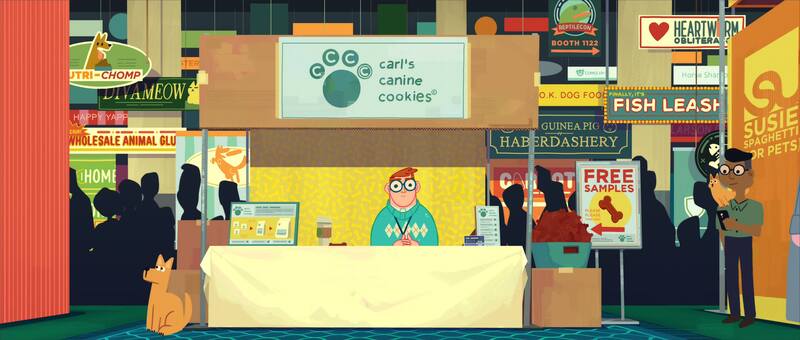
Carl sells pet food for a living, which makes his isolation particularly funny in retrospect. Professionally, he's surrounded by a product built around companionship, yet he seems to have very little of it himself. A routine business trip puts him in the path of Roadie, a rescue dog who immediately changes the direction of his day and, eventually, something much larger.
Writer David Craig Williams based the film on his own experience rescuing a dog from a Texas shelter. RETRIEVING ROADIE doesn't treat that history like an excuse for easy sentiment. Director Luke Stone keeps the movie moving, allowing the emotional attachment between Carl and Roadie to develop alongside the physical complications of getting this dog home. The result is affectionate without constantly demanding an emotional response from the audience.
That restraint becomes especially important because this is essentially a dialogue-free story. Vocal sounds, barks, reactions, and one particularly important use of Roadie's name appear, but the film doesn't rely on characters explaining themselves. Carl's loneliness, Roadie's personality, their growing connection, and the panic that follows when things go wrong are communicated primarily through movement, expressions, staging, and timing.
That's a considerably harder job than the film makes it appear. Animation can exaggerate emotion more freely than live action, but exaggeration can become obnoxious quickly, particularly when a cute animal is involved. Stone and the animation team understand that Roadie doesn't need to perform for the audience every few seconds to remain lovable.
Roadie's behavior feels recognizably doglike even as the movie pushes her into increasingly chaotic situations. She's curious, impulsive, affectionate, and completely unaware of how much trouble she's creating for the human desperately trying to keep up. Those qualities give the comedy a natural source rather than turning Roadie into a walking collection of adorable reactions.
Carl is equally important to making that relationship work. RETRIEVING ROADIE could've made him broadly miserable so that Roadie could magically repair his life, but the characterization is gentler than that. He's simply settled into something repetitive, and meeting this animal breaks through a routine he may not have fully realized had become so empty.
The animation complements that simplicity rather than overwhelming it. The character designs and environments have a clean, inviting quality, with enough exaggeration to support the comedy without making every frame scream for attention. The visual style isn't trying to compete with the enormous budgets of studio animation, and that's one of its strengths.
The festival response also makes sense because the film is built around a kind of accessibility that travels well. RETRIEVING ROADIE doesn't depend on dense dialogue, cultural references, or a complicated premise to connect with an audience, so the relationship at its center can land almost anywhere. That matters for an animated short moving through festivals, especially one with ambitions beyond a small regional run. Its selection for the 2026 St Kilda Film Festival, one of the more established short-film events on its circuit, fits the movie's strengths because this is exactly the kind of concise, emotionally direct storytelling that benefits from being seen with an audience. The laughs arrive quickly, the emotional beats are easy to read without becoming simplistic, and the ending earns its warmth without overstaying its welcome.
Movement carries much of the personality, particularly once the trip home becomes increasingly complicated. Airports, transportation, luggage, rental vehicles, and the basic nightmare of traveling with an animal become opportunities for physical comedy, but an emotional objective always lies beneath the mayhem. Carl isn't simply trying to complete a journey anymore; he's trying to get Roadie home safely.
That distinction is what turns RETRIEVING ROADIE from a cute animated short into something memorable. Plenty of stories can make an audience like a dog within seconds, especially in animation. Convincing us that this particular person needs this particular dog is a much more specific challenge, and the film manages that connection with surprisingly little screen time.
The pacing deserves a lot of credit here too. Eight minutes doesn't leave room for scenes that merely repeat information we've already understood, so nearly every new complication either moves the journey forward or strengthens Carl and Roadie's bond. It feels complete rather than compressed, which is one of the hardest things for a short film to accomplish.
At times, the escalating travel trouble comes close to feeling too broad, especially because the film stacks obstacles quickly. Yet that escalation also keeps the story from becoming eight straight minutes of sweetness, which would've flattened the emotional effect considerably. Roadie has to become a genuine disruption in Carl's life before she can convincingly become something he can't imagine leaving behind.
Knowing the story came from Williams' own experience gives certain details additional meaning, but that information isn't necessary for the film to work. RETRIEVING ROADIE stands perfectly well without a viewer knowing anything about its production because the emotional idea is immediately understandable. Anyone who's unexpectedly connected with an animal will recognize how quickly inconvenience can become attachment.
The film's strongest sequence comes when that attachment is suddenly threatened. Because Stone and Williams spend most of the running time communicating visually, they don't abandon that approach when the emotions grow heavier. Panic registers through Carl's actions, and the simplicity of hearing him call for Roadie carries more weight than a lengthy speech could.
It's also refreshing that RETRIEVING ROADIE never turns pet adoption into a lecture. The story obviously has affection for rescue animals, and the real-life inspiration gives that subject personal significance. The film makes its argument simply by showing what Roadie brings into Carl's life. That's much more effective than stopping everything to explain why the audience should care.
The score and sound design help fill the space normally occupied by dialogue without constantly announcing themselves. Music keeps the story playful during the travel sequences while leaving enough room for quieter emotional beats to register. The vocal work from Erika Harlacher and Sarah Miller-Crews similarly contributes personality through sounds rather than conventional spoken performances.
It's easy to underestimate a short like this because everything about it looks modest from the outside. The story is tiny, the running time is barely long enough to finish a cup of coffee, and its emotional destination isn't difficult to predict. None of that matters when the execution is this confident.
RETRIEVING ROADIE understands that predictability isn't automatically a weakness when the pleasure comes from watching two characters reach the place you hoped they would. Its success isn't built around surprising the audience with where Carl and Roadie end up. It's built around making their short time together convincing enough that we desperately want them to get there.
At eight minutes, there's almost no distance between meeting Roadie and realizing why Carl can't leave her behind. That's an impressive amount of character and emotion to fit into such a small space without making the film feel rushed or calculated. RETRIEVING ROADIE is funny, sweet, beautifully economical, and smart enough to trust a little dog to do most of the talking.
Please visit https://linktr.ee/overlyhonestr for more reviews.
You can follow me on Letterboxd, Instagram, Twitter, and YouTube. You can also find my social media accounts on most platforms by searching for 'Overly Honest Reviews'.
I’m always happy to hear from my readers; please don't hesitate to say hello or send me any questions about movies.
[photo courtesy of RETRIEVING ROADIE PRODUCTIONS]
DISCLAIMER:
At Overly Honest Movie Reviews, we value honesty and transparency. Occasionally, we receive complimentary items for review, including DVDs, Blu-rays, CDs, Vinyl Records, Books, and more. We assure you these arrangements do not influence our reviews, as we are committed to unbiased, sincere evaluations. We aim to help you make informed entertainment choices regardless of our relationship with distributors or producers.
Amazon Affiliate Links:
This site also contains Amazon affiliate links. If you purchase through these links, we may receive a commission. This affiliate arrangement does not affect our commitment to honest reviews and helps support our site. We appreciate your trust and support as you navigate these links.


Happy
0 %

Sad
0 %

Excited
100 %

Sleepy
0 %

Angry
0 %

Surprise
0 %
 0
0
 0
0

Average Rating