Survival Comes With a Heavy Price
Read Time:9 Minute, 41 Second
MOVIE REVIEW
Sister Brother Manhole Cover
 –


Genre: Dark Comedy, Crime, Drama, Thriller
Year: 2026
Runtime: 1h 55m
Director: Milcho Manchevski
Writer: Milcho Manchevski
Cast: Sara Klimoska, Filip Trajkovikj, Sonja Mihajlova, Dejan Lilich, Petar Mirchevski, Stefan Nikolovski, Jordan Simonov, Jasmina Vasileva
Where to Watch: shown at the 2026 Tokyo International Film Festival
RAVING REVIEW: Stealing bronze statues of national heroes probably isn't the career path most parents envision for their children, but Malina and Viktor don't have many options. In SISTER BROTHER MANHOLE COVER, writer-director Milcho Manchevski introduces two siblings surviving on the outskirts of Macedonia, where nearly everything has a price, compassion is increasingly difficult to find, and the people responsible for maintaining some sense of social order aren't necessarily interested in helping anyone. It's an unusual mixture of crime, dark comedy, family drama, and social commentary that finds considerable humor in some pretty miserable circumstances. Thankfully, Manchevski understands that making audiences laugh at an absurd situation doesn't require making light of the people trapped inside it.
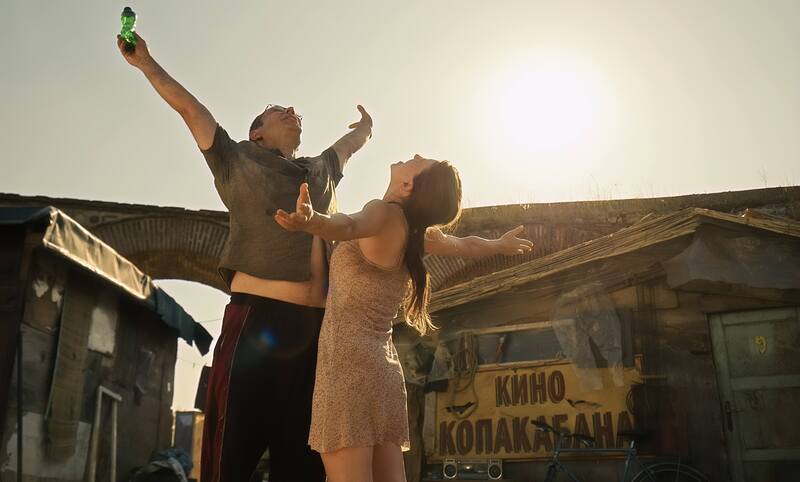
Sara Klimoska plays Malina, a resourceful young woman whose determination frequently makes her the more practical half of this criminal partnership. Her brother Viktor (Filip Trajkovik) supplies the muscle, helping her steal bronze busts and other valuable metal objects that can be sold for scrap. These aren't exactly sophisticated criminal operations, but sophistication matters little when you're worried about getting through another day. Their relationship is affectionate, occasionally abrasive, and built on a shared understanding that nobody else will rush to their rescue. They're not interested in becoming respectable members of a society that has already decided people like them don't matter.
The choice of stolen merchandise is also wonderfully pointed. Macedonia's national heroes, immortalized in bronze as symbols of historical pride, are worth considerably more to these siblings once they're melted down and sold. Reducing celebrated figures to their material value is an obvious political statement, but the humor comes from watching these two treat supposedly sacred objects with such complete indifference. History might be important to the people erecting monuments, but it doesn't pay Malina and Viktor's bills. The film establishes that contradiction without asking audiences to pretend the siblings' behavior is admirable simply because their circumstances are difficult.
Manchevski, whose BEFORE THE RAIN won the Golden Lion at Venice and received an Academy Award nomination, has never been particularly interested in telling straightforward stories. His latest continues that approach, although its initial setup is relatively accessible. A criminal misadventure involving a stolen bronze bust leaves Viktor injured, and their predicament becomes increasingly complicated when medical assistance comes with an appalling personal demand. It exposes the ugliness beneath the film's humor. Even someone with modest authority can exploit those with nowhere else to turn.
The resulting story moves through a Macedonia that looks nothing like the polished historical imagery those stolen monuments represent. Scrapyards, neglected industrial spaces, dusty roads, and deteriorating structures provide a fitting environment for two people operating outside conventional society. Cinematographer Stefano Falivene finds a striking visual identity in these surroundings, letting the locations communicate economic and social circumstances without making every image feel like an advertisement for misery. These environments have beauty, even when what they represent is far less appealing.
Klimoska gives Malina a personality that extends beyond her circumstances. She can be confrontational, calculating, funny, and protective, sometimes in the same stretch of conversation. Her health troubles add another layer of concern, but the character isn't reduced to her physical condition or presented as someone audiences should automatically pity. She's difficult because her life is difficult, although the film never uses that explanation as a blanket excuse for everything she does. Her personality matters as much as her predicament.
Trajkovikj provides an effective counterpart in Viktor, whose devotion to his sister helps establish the emotional foundation beneath their questionable activities. Their connection doesn't rely on constant declarations of affection or exaggerated displays of sibling loyalty. They understand each other's shortcomings and have developed their own way of existing together. Viktor might not approach situations with Malina's practicality, but their partnership has its own internal logic. The performances let the relationship feel imperfect without suggesting its imperfections diminish the affection holding it together.
There's an interesting distinction between asking an audience to understand someone and asking them to approve of everything that person does. Manchevski is clearly more interested in the former, and that's a valuable approach when dealing with characters whose decisions frequently disregard conventional morality. Neither sibling is a sanitized representation of poverty designed to make comfortable audiences feel charitable. They're crude, rebellious, occasionally reckless people who have learned to survive by rejecting rules that haven't offered them much protection in return. Their circumstances deserve examination without turning their crimes into something noble.
The film's humor operates along similar lines. Its situations can be outrageous, its characters hardly fear behaving badly, and Manchevski lets the comedy emerge from contradictions rather than stopping the story whenever a serious subject appears. That combination gives the material an unpredictable personality, though its determination to shift approaches isn't always equally effective. Some tonal shifts require more adjustment than others, and the film occasionally feels as though several ideas compete for attention. It's an ambitious approach, even when the individual pieces don't fit together as comfortably as intended.
Sonja Mihajlova enters the picture as Todora, a wealthy, blind older woman whose circumstances contrast sharply with everything the siblings have experienced. Her presence introduces another perspective on generosity, family, and personal responsibility, broadening the film's consideration of what people owe one another. It's also refreshing to see an elderly female character who isn't presented as a harmless grandmother waiting to dispense a few conveniently comforting words. Todora has her own personality, authority, desires, and complicated relationships. She's an individual, not a device created solely to help two younger characters learn an important lesson.
Mihajlova's contribution is important because the film's examination of family extends beyond biological connection. Manchevski challenges the assumption that relatives automatically provide unconditional love, just as he questions whether a person's social standing offers any useful indication of their morality. Wealth doesn't guarantee cruelty, poverty doesn't automatically produce kindness, and parenthood certainly doesn't make someone incapable of behaving selfishly. Those contradictions give the film far more substance than its initial criminal setup suggests.
Its unconventional construction also contributes to that identity. Rather than maintaining the same approach throughout, Manchevski shifts the emphasis as the story develops, letting the broader criminal adventure give way to a closer examination of relationships and individual behavior. The change is deliberate, although I found the contrasting approaches more interesting individually than entirely seamless together. The film's unruly personality is part of its appeal, but its willingness to pull in several directions occasionally makes its emotional focus less immediate than it could be.
What keeps the material engaging is its refusal to present social problems as something that can be explained away through a single political argument. The film takes place in post-Communist Macedonia, where the promises of competing ideologies haven't necessarily translated into meaningful improvements for those at the bottom. Manchevski's criticism extends to institutional hypocrisy, economic exploitation, and the willingness of people in positions of authority to abuse their advantages. None of those problems belong exclusively to one country or political system.
The filmmaker's own production history adds another dimension to that frustration. In the accompanying press materials, Manchevski describes years of difficulty getting the project made after he publicly alleged corruption involving the Macedonian Film Agency. He has also described legal battles and professional retaliation connected to his whistleblowing. Those are serious allegations with a history beyond the film itself, but understanding that background makes his interest in institutional failure and the abuse of authority easier to contextualize. This isn't a director approaching the subject as an entirely abstract creative exercise.
That personal investment doesn't turn SISTER BROTHER MANHOLE COVER into a straightforward political statement, either. Its interest in social injustice runs alongside a far more intimate examination of human relationships, and the film often finds its personality in the uncomfortable space between them. Manchevski allows his characters to be ridiculous without dismissing their struggles, and he recognizes that empathy doesn't require ignoring the harm people can cause. That distinction helps prevent the material from becoming another familiar exercise in presenting impoverished characters as morally superior to everyone around them.
I also appreciate the film's willingness to embrace its oddness. The title alone sounds like someone picked three unrelated subjects out of a hat and decided later how they fit together. That decision has a rebellious quality that extends into the production's humor, structure, and treatment of its characters. Not every creative choice lands with the same confidence. The film has enough personality to make its stranger decisions feel like part of a recognizable creative vision rather than an attempt to be unconventional for its own sake.
SISTER BROTHER MANHOLE COVER is ultimately an entertaining, occasionally uncomfortable examination of two people who have little reason to trust the world but every reason to trust each other. Manchevski doesn't excuse their behavior, and he doesn't pretend that good intentions automatically make difficult lives any easier. Instead, he presents a society where morality often becomes negotiable depending on who holds the money, who needs help, and who has enough power to dictate the terms.
The film's humor can be wonderfully inappropriate, its characters aren't always easy to embrace, and its structural ambitions occasionally work against its own momentum. The story has considerable value in its willingness to find affection within such an unruly collection of people and circumstances. Malina and Viktor might be stealing pieces of their country's history to survive. The greater crime is a society that has made those monuments more valuable than the people living beneath them.
Please visit https://linktr.ee/overlyhonestr for more reviews.
Follow me on Letterboxd, Instagram, Twitter, and YouTube. You can also find my social media accounts on most platforms by searching for 'Overly Honest Reviews'.
I’m always happy to hear from my readers; please don't hesitate to say hello or send me any movie questions.
[photo courtesy of BANANA FILM DOOEL, GALA FILM, SENSE PRODUCTION, TIRANA FILM INSTITUTE, BERKELEY MEDIA GROUP, AMARCORD PRODUCTION S.R.L., AUGUSTUS COLOR, COCCINELLE FILM]
DISCLAIMER:
At Overly Honest Movie Reviews, we value honesty and transparency. Occasionally, we receive complimentary items for review, including DVDs, Blu-rays, CDs, Vinyl Records, Books, and more. We assure you these arrangements do not influence our reviews, as we are committed to unbiased, sincere evaluations. We aim to help you make informed entertainment choices regardless of our relationship with distributors or producers.
Amazon Affiliate Links:
This site also contains Amazon affiliate links. If you purchase through these links, we may receive a commission. This affiliate arrangement does not affect our commitment to honest reviews and helps support our site. We appreciate your trust and support as you navigate these links.


Happy
0 %

Sad
0 %

Excited
0 %

Sleepy
0 %

Angry
0 %

Surprise
0 %
 0
 0



Average Rating