Seuss Can Still Teach Us a Thing or Two
Read Time:9 Minute, 55 Second
MOVIE REVIEW
Dr. Seuss: Classic TV Treasures Collection
 /G –


Genre: Animation, Family, Fantasy, Musical, Documentary
Year: 1942–1995, 2026 Blu-ray Collection
Runtime: 6h 15m
Directors: Various, including Bob Clampett, Chuck Jones, Hawley Pratt, Alan Zaslove, Gerard Baldwin, Bill Perez, Ralph Bakshi, and others
Writers: Dr. Seuss (Theodor Geisel), with additional adaptation and documentary contributors
Cast / Featured Voices: Boris Karloff, Hans Conried, Allan Sherman, Bob Holt, Paul Winchell, Charles Durning, and others
Where to Watch: available November 3, 2026. Pre-order your copy here: www.amazon.com
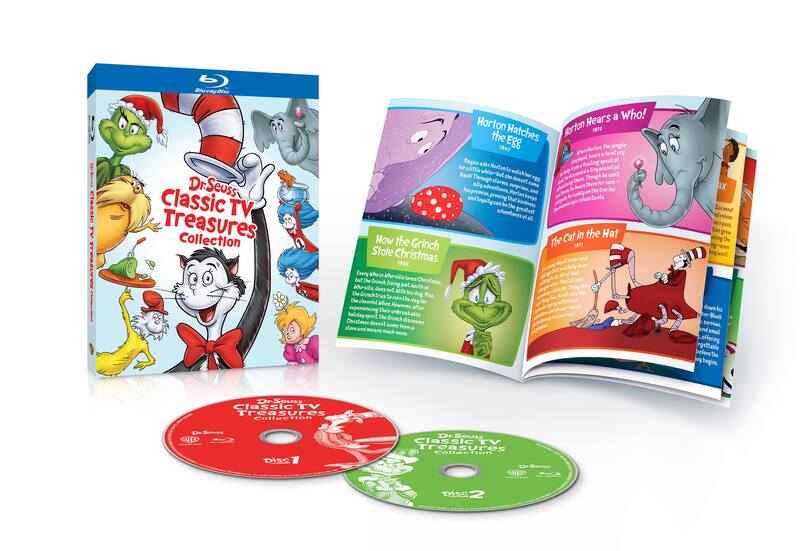
RAVING REVIEW: Dr. Seuss understood that you could teach children some pretty important lessons while simultaneously introducing them to creatures with ridiculous names, impossible hairstyles, and a concerning disregard for the laws of physics. His stories have entertained generations, but their lasting appeal comes from how effortlessly they mix complete nonsense with observations about human behavior. Warner Bros. Discovery Home Entertainment's DR. SEUSS: CLASSIC TV TREASURES COLLECTION brings together 15 animated and television treasures spanning more than five decades, offering over six hours of entertainment that goes well beyond the holiday favorites most people associate with his work. It's a wonderful reminder that the world of Dr. Seuss has always been much bigger than one grouchy green fellow with a Christmas problem.
Of course, HOW THE GRINCH STOLE CHRISTMAS! remains the collection's biggest attraction, and rightfully so. Chuck Jones' 1966 adaptation is practically inseparable from the holiday season, with Boris Karloff's unforgettable narration, expressive animation, and a soundtrack that has probably been stuck in our collective heads for sixty years. What's impressive is how little the special needs to accomplish everything it sets out to do. In roughly half an hour, it establishes the Grinch's bitterness, introduces the relentlessly cheerful Whos, and delivers a conclusion that feels sentimental without drowning in holiday sweetness. The Grinch's transformation still works because the story understands that its message doesn't require a complicated explanation. Sometimes a stolen Christmas and an unexpectedly enlarged heart are plenty.
Limiting this collection to its most recognizable special would mean overlooking some fantastic material. HORTON HEARS A WHO! (1970), also directed by Jones, remains one of Seuss' finest adaptations, following an elephant determined to protect an entire civilization living on a speck of dust. Its message about the importance of every individual remains relevant, and Horton's insistence on defending creatures nobody else believes exist gives the story emotional weight beneath its absurd premise. The animation has that recognizable Jones personality, especially in the exaggerated expressions and movements that let the characters communicate so much without extra dialogue.
The collection actually reaches back to 1942 with HORTON HATCHES THE EGG, a Merrie Melodies short directed by Bob Clampett. Its inclusion provides an interesting look at Seuss before the television adaptations that would eventually define his animated legacy. The visual approach is unmistakably different, leaning into the energetic exaggeration associated with Warner Bros. cartoons rather than the later specials' more recognizable storybook presentation. It's also a fitting companion to HORTON HEARS A WHO!, allowing audiences to experience two interpretations of the same wonderfully stubborn elephant separated by nearly three decades.
THE CAT IN THE HAT (1971) brings another beloved troublemaker into the picture, with Allan Sherman voicing the mischievous visitor whose arrival turns an otherwise ordinary afternoon into absolute chaos. The animation captures the strange proportions and impossible environments of Seuss' illustrations without feeling overly polished. That's an important quality throughout these earlier productions. Their unusual shapes, expressive character designs, and occasionally bizarre movements are part of their identity, and watching them today reminds us how much personality can come from letting animation look a little weird.
Then there's THE LORAX (1972), which might be the collection's most pointed example of Seuss refusing to underestimate his audience. Its environmental message is hardly subtle, but why should it be? The Once-ler's destructive pursuit of profit and the Lorax's increasingly desperate attempts to defend the natural world provide a straightforward examination of greed, responsibility, and the consequences of treating everything as an expendable resource. Decades later, its observations remain frustratingly relevant. The colorful Truffula Trees and unusual creatures make the material approachable for younger viewers without disguising what the story is actually saying. It also demonstrates how comfortable Seuss was using children's entertainment to address subjects that adults would rather avoid.
That willingness to tackle uncomfortable behavior continues through the three shorts originally presented as DR. SEUSS ON THE LOOSE in 1973. GREEN EGGS AND HAM takes a simple refusal to try something new and stretches it into an increasingly ridiculous confrontation. At the same time, THE SNEETCHES addresses prejudice through a society obsessed with whether its members have stars on their bellies. THE ZAX, meanwhile, reduces stubbornness to two individuals refusing to move out of each other's way. These stories are funny because their characters are absurd, but the behavior being criticized is painfully recognizable. Children can laugh at the nonsense while adults recognize just how accurately these ridiculous situations reflect the world around them.
Some of the collection's greatest pleasures come from its less-discussed entries. THE HOOBER-BLOOB HIGHWAY (1975) takes an unusual approach to the experience of entering the world, presenting a prospective newborn with various possibilities before beginning life. Its musical presentation and philosophical curiosity make it a fascinating departure from the more familiar adaptations. PONTOFFEL POCK, WHERE ARE YOU? (1980) follows an unsuccessful young worker who receives a magical piano capable of transporting him anywhere, only to discover that knowing where you want to go is considerably more complicated than having the ability to get there. These aren't necessarily the titles people immediately associate with Seuss, so having them alongside the better-known productions is a welcome part of this release.
The Grinch also receives two additional appearances, beginning with HALLOWEEN IS GRINCH NIGHT (1977). Anyone expecting another cozy holiday adventure might be surprised by how strange this one gets. The Grinch's Halloween mischief reveals a different side of the character, with wonderfully bizarre imagery that feels right at home in Seuss' imagination. THE GRINCH GRINCHES THE CAT IN THE HAT (1982) brings two of his most recognizable creations together, creating an entertaining clash of personalities. Neither special carries the same cultural weight as the 1966 Christmas classic, but that's hardly fair to expect. They're enjoyable additions that show how these characters continued to develop beyond their original appearances.
The collection takes a considerably darker turn with THE BUTTER BATTLE BOOK (1989), directed by Ralph Bakshi. Its escalating confrontation between the Yooks and Zooks, whose disagreement over which side of their bread should receive butter eventually becomes an arms race, is an unmistakable examination of Cold War hostility. The dispute's absurdity makes it entertaining, but its implications become increasingly disturbing. It's another example of Seuss trusting audiences to recognize that a seemingly ridiculous children's story can address something genuinely frightening. Its inclusion also broadens the collection considerably, demonstrating how these adaptations evolved alongside the social and political concerns of their respective periods.
The later entries provide a different experience. IN SEARCH OF DR. SEUSS (1994) combines live-action material, animation, biographical elements, and familiar stories to examine the man behind the extraordinary illustrations. It's an interesting addition because it provides context for the imagination responsible for everything else in the collection. DAISY-HEAD MAYZIE (1995), meanwhile, follows a young girl whose life changes when a daisy unexpectedly sprouts from her head. Its examination of unwanted attention and sudden celebrity feels like a natural extension of Seuss' interest in how people react when somebody doesn't fit their expectations.
Taken together, the specials show the variety in Seuss' television work. The animation styles change, the storytelling becomes more elaborate in certain productions, and the subjects range from childhood curiosity to discrimination, environmental destruction, and international conflict. Not every entry carries the same impact, and some of the lesser-known productions are more interesting as pieces of animation history than as enduring favorites. Their differences are part of what makes this collection worth exploring. It doesn't simply gather fifteen interchangeable cartoons under a recognizable name.
As a physical-media release, Warner Bros. offers something valuable by bringing these productions together, rather than requiring audiences to track down individual editions. The Blu-ray and DVD releases include a collectible episode guide booklet featuring illustrations and descriptions of the included titles, while the initial shipment also comes with an O-sleeve. English audio and English subtitles are provided. The booklet is a welcome addition, especially for viewers unfamiliar with the less-recognizable specials, though a collection covering this much television history could benefit from a more extensive look at the people and production companies responsible for bringing these stories to television.
The preservation aspect is arguably just as important as the convenience. Animation from this period deserves to remain accessible in its original form, especially as modern adaptations keep introducing these characters to new audiences. The distinct approaches of Chuck Jones, DePatie-Freleng Enterprises, and the other artists involved demonstrate how different creative teams interpreted Seuss' illustrations across several decades. Seeing those interpretations together lets audiences appreciate the changing techniques without losing sight of the personality that connects them.
It's also refreshing to have a collection that isn't exclusively focused on Christmas. The Grinch might be the biggest selling point, but the variety makes the set enjoyable year-round. Its shorter stories are accessible for younger audiences, while older viewers have plenty to appreciate in their historical context, humor, and surprisingly pointed social commentary. Parents introducing these productions to their children might even find that some stories become more meaningful with age, a pretty impressive feat for material involving talking elephants, argumentative creatures, and sentient headwear.
DR. SEUSS: CLASSIC TV TREASURES COLLECTION succeeds because it recognizes that these productions deserve attention beyond their most commercially recognizable characters. It's an entertaining assortment of childhood favorites, overlooked curiosities, and animation history that makes a convincing case for keeping Seuss' full range of work accessible. Some stories will bring back memories, others might be entirely discoveries, and a few will probably leave younger viewers asking questions that adults aren't quite prepared to answer. Considering the subjects Seuss regularly tackled, I suspect he'd be perfectly happy with that. After all, a little nonsense is considerably more enjoyable when there's something worth thinking about underneath it.
Please visit https://linktr.ee/overlyhonestr for more reviews.
Follow me on Letterboxd, Instagram, Twitter, and YouTube. You can also find my social media accounts on most platforms by searching for 'Overly Honest Reviews'.
I’m always happy to hear from my readers; please don't hesitate to say hello or send me any movie questions.
[photo courtesy of WARNER BROS. DISCOVERY HOME ENTERTAINMENT, DR. SEUSS ENTERPRISES]
DISCLAIMER:
At Overly Honest Movie Reviews, we value honesty and transparency. Occasionally, we receive complimentary items for review, including DVDs, Blu-rays, CDs, Vinyl Records, Books, and more. We assure you these arrangements do not influence our reviews, as we are committed to unbiased, sincere evaluations. We aim to help you make informed entertainment choices regardless of our relationship with distributors or producers.
Amazon Affiliate Links:
This site also contains Amazon affiliate links. If you purchase through these links, we may receive a commission. This affiliate arrangement does not affect our commitment to honest reviews and helps support our site. We appreciate your trust and support as you navigate these links.


Happy
0 %

Sad
0 %

Excited
0 %

Sleepy
0 %

Angry
0 %

Surprise
0 %
 0
 0

Average Rating