A Haunting Built on History
Read Time:7 Minute, 52 Second
MOVIE REVIEW
The Caged
 –
– 

Genre: Horror
Year: 2026
Runtime: 1h 45m
Director: Jeffrey Scott Collins
Writer: Jeffrey Scott Collins
Cast: Tamzin Merchant, Edmund Kingsley, Raffiella Chapman, Callen Carter, Whoopie Van Raam, Virge Gilchrist, Mark Moraghan, Oliver Henry Arnold
Where to Watch: shown at the 2026 Screamfest Horror Film Festival
RAVING REVIEW: Calling something “inspired by true events” has become one of horror’s easiest shortcuts. Slap the phrase across a trailer, mention a supposedly haunted building, and suddenly every creaking floorboard carries a little more weight. THE CAGED has a stronger claim to that marketing hook than most, though digging into the history behind Jeffrey Scott Collins’ supernatural horror movie reveals something far more complicated than a simple story about witches haunting an old house.
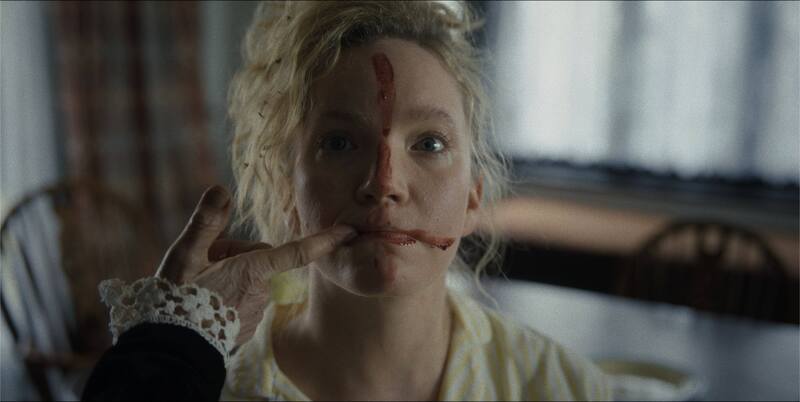
Set in Essex in 1988, THE CAGED follows the Smith family after they move into an old cottage with a particularly unpleasant past. Emily and Robert Smith, played by Tamzin Merchant and Edmund Kingsley, arrive with their children Isabella and Liam, played by Raffiella Chapman and Callen Carter. What initially seems like another chance at a fresh start gradually becomes something far darker as the family discovers the property’s connection to a former village lockup known as The Cage.
That foundation immediately gives Collins more to work with than another invented house where somebody conveniently committed a pile of murders decades earlier. The Cage is a real place in St Osyth, Essex, and its reputation has grown from an uncomfortable mixture of documented history, local folklore, paranormal claims, and stories that have become increasingly difficult to separate from one another. That uncertainty is far more interesting than simply declaring the building haunted.
The name most closely associated with the property is Ursula Kemp, a woman accused of witchcraft during the St Osyth trials of 1582. Kemp was eventually executed in Chelmsford alongside Elizabeth Bennet after an interrogation process that included testimony from Kemp’s own young son. Local tradition has long connected her imprisonment to The Cage, and that connection provides THE CAGED with much of its supernatural mythology.
But there’s an important wrinkle. The historical record doesn’t actually establish that Kemp was held inside this particular building. St Osyth Museum acknowledges the story but notes that no known evidence proves it happened. We know Kemp was interrogated in St Osyth and later executed, but the specific connection between her imprisonment and The Cage belongs somewhere between historical possibility and local legend.
That distinction matters because THE CAGED is playing with something more uncomfortable than a fictional ghost story. The women at the center of the St Osyth witch trials weren’t supernatural villains. They were people caught in accusations, fear, religious paranoia, coercion, and a legal process that ultimately killed them. Turning that history into horror creates an unusual responsibility for the movie. The frightening part of their story already happened without requiring demons.
Collins nevertheless uses that history as the entry point into a much more conventional haunted-house setup. Strange activity surrounds the Smith family, the house’s past becomes increasingly important, and discovering what happened there becomes tied to understanding whatever has entered their lives. It’s recognizable territory, right down to whether leaving the property will actually solve anything once the supernatural presence has taken hold.
Familiarity can be comforting when a horror movie uses it well, but it also creates THE CAGED’s biggest obstacle. Audiences have watched countless families move somewhere they shouldn’t, ignore increasingly obvious warning signs, research the house’s history, and eventually discover that something terrible happened on the property. The historical details may be unusual, but the framework surrounding them isn’t.
Setting the story in 1988 is a smart decision for that reason. Removing smartphones, instant searches, security cameras, and easy access to information keeps the family physically connected to the house and forces the mystery to unfold through older, less convenient methods. It also creates a natural separation between the family and the events of 1582 without making the story feel completely contemporary.
The 105-minute runtime raises another question. Haunted-house movies built around gradual escalation can benefit from patience, especially when the goal is to make a location feel increasingly oppressive rather than throwing something into the frame every few minutes. That same patience can become repetition quickly if the movie spends too long cycling through noises, shadows, frightened reactions, and another trip down a dark hallway before advancing the story.
THE CAGED therefore lives or dies on whether the Smith family matters as much as the building surrounding them. Merchant, Kingsley, Chapman, and Carter aren’t merely there to provide four potential victims. Collins describes the movie in terms that suggest he’s interested in what happens to a family under pressure, and that’s where the material has the best chance to distinguish itself.
Raffiella Chapman is an especially interesting piece of that equation. After work on projects including VESPER, she already has experience carrying genre material that asks for more than simple fear reactions. Pairing her with Merchant gives THE CAGED the potential for something more emotionally grounded than the disposable family dynamics that often exist only to get characters into a haunted location.
There’s also something effective about the physical idea of a home once associated with confinement becoming a trap for the people living inside it centuries later. The title works on more than one level without needing to underline the metaphor. A building once used to hold unwanted people becomes a place where another family begins losing its ability to escape.
Where THE CAGED becomes shakier is in how literally it appears prepared to connect historical persecution with supernatural evil. There’s a much stronger horror movie hiding in the idea that generations have transformed the suffering of accused women into ghost stories. If the movie simply makes the supposed witches responsible for the evil, it risks repeating the exact mythology that helped condemn women such as Kemp in the first place.
The more interesting possibility is that the house itself carries the damage rather than treating its victims as monsters. Horror has become much better in recent years at recognizing that witch trials are frightening because of what societies did to accused women, not because those societies were secretly correct about witchcraft. THE CAGED has enough genuine history beneath it to understand that difference.
Its real-life location has certainly accumulated enough mythology since then. The Cage has become known for reported paranormal experiences, television investigations, ghost hunters, and former residents claiming disturbing encounters inside the property. None of that proves supernatural activity, but it helps explain why the place has remained such fertile ground for stories long after its days as a village lockup ended.
That combination of history and folklore gives THE CAGED an identity that its familiar structure otherwise struggles to create on its own. Hundreds of haunted houses are available to horror filmmakers, but relatively few arrive with several centuries of stories already attached. Collins doesn’t need to manufacture much mythology when generations of people have already done the job.
The challenge is knowing what deserves to be believed, what deserves to be questioned, and what simply makes for a good ghost story. THE CAGED is most intriguing when those three things overlap. Its premise may look familiar from the outside, but the history buried underneath it gives the movie something worth digging into.
Whether that ultimately makes THE CAGED memorable will depend on how successfully Collins turns those ideas into horror rather than relying on the “true story” label to do the heavy lifting. There’s enough here for a solid supernatural story, along with enough historical ambiguity to make its mythology worth questioning instead of unquestioningly accepting.
For now, THE CAGED looks like the kind of horror movie that can overcome a familiar foundation when it trusts the stranger history underneath it. It may not reinvent the haunted-house story, but this particular house has considerably more locked inside it than another collection of things going bump in the night.
Please visit https://linktr.ee/overlyhonestr for more reviews.
You can follow me on Letterboxd, Instagram, Twitter, and YouTube. You can also find my social media accounts on most platforms by searching for 'Overly Honest Reviews'.
I’m always happy to hear from my readers; please don't hesitate to say hello or send me any questions about movies.
[photo courtesy of SABAN FILMS, ANGRY ADAM PRODUCTIONS, DARK MATTER STUDIOS, FEARLESS PRODUCTIONS, SET POINT ENTERTAINMENT, THIS SEEMS REEL ENTERTAINMENT]
DISCLAIMER:
At Overly Honest Movie Reviews, we value honesty and transparency. Occasionally, we receive complimentary items for review, including DVDs, Blu-rays, CDs, Vinyl Records, Books, and more. We assure you these arrangements do not influence our reviews, as we are committed to unbiased, sincere evaluations. We aim to help you make informed entertainment choices regardless of our relationship with distributors or producers.
Amazon Affiliate Links:
This site also contains Amazon affiliate links. If you purchase through these links, we may receive a commission. This affiliate arrangement does not affect our commitment to honest reviews and helps support our site. We appreciate your trust and support as you navigate these links.


Happy
0 %

Sad
0 %

Excited
0 %

Sleepy
0 %

Angry
0 %

Surprise
0 %
 0
0
 0
0

Average Rating