The Grim Reaper Meets His Match
Read Time:11 Minute, 42 Second
MOVIE REVIEW
A Little Death
 –


Genre: Animation, Fantasy, Dark Comedy, Short
Year Released: 2026
Runtime: 12m
Directors: Leto Meade, Jonathan Rockefeller
Writer: Jonathan Rockefeller, based on the book by Nicholas Gurewitch
Cast: John Sparkes, Nami Annette Gillet
Where to Watch: shown at the 2026 Annecy International Animation Film Festival
RAVING REVIEW: What happens when the Grim Reaper finds out that his apprentice is better at appreciating life than ending it? A LITTLE DEATH takes an occupation usually associated with dread and turns it into an affectionate workplace disaster. Death has a job to do, a pupil to train, and apparently little patience for anyone along the way. Unfortunately for him, Little Death is considerably more interested in the world than in following instructions. Directors Leto Meade and Jonathan Rockefeller use that to build a dark comedy most interesting for its exploration of tenderness. For all the skulls, scythes, and professional obligations, this is a story about learning to recognize something in another approach, even when that looks nothing like your own.
The premise sounds so simple. Death, voiced by John Sparkes, brings his apprentice, played by Nami Annette Gillet, along on what should be an ordinary assignment. His objective is straightforward. Demonstrate the process, have the young trainee follow his example, and presumably finish with his authority intact. Little Death has other interests. Where her mentor sees work that needs completing, she sees a world full of distractions and things worth noticing. The difference frustrates him, not because she's openly rebellious, but because she doesn't seem able to treat his established methods as the only acceptable ones. That gives the film a recognizable dynamic long before its supernatural profession enters the equation.
Anybody who has ever tried to teach someone a task will recognize the frustration of discovering that a clear explanation doesn't necessarily produce the expected result. The teacher believes the instructions are obvious. The student approaches the problem from an entirely different direction. Neither necessarily understands why the other finds the situation so difficult. A LITTLE DEATH turns that ordinary disagreement into comedy by making the assignment literally a matter of life and death. There's something inherently funny about an immortal-looking figure of doom having the same workplace aggravations as an exhausted supervisor trying to train a new employee.
The relationship is more interesting, though, when viewed beyond the workplace joke. The filmmakers have described the two central figures as sharing a bond closer to that of a father and daughter than a strictly professional partnership. That interpretation helps explain why Death's irritation carries more weight than a simple disagreement over efficiency. He wants to pass something on. His methods are familiar to him, and teaching them is also how he communicates who he is. Little Death, meanwhile, isn't rejecting her mentor by failing to imitate him. Her personality simply doesn't fit the rigid expectations he has brought to the lesson. Their conflict comes from affection struggling to make room for difference.
Rockefeller adapted the story from Nicholas Gurewitch's wordless, twenty-page book NOTES ON A CASE OF MELANCHOLIA, OR: A LITTLE DEATH. Gurewitch, known for THE PERRY BIBLE FELLOWSHIP, has a talent for pairing unsettling images with jokes that become stranger the longer they're considered. His original illustrations draw on the visual tradition associated with Edward Gorey, whose macabre drawings often make the morbid seem oddly domestic. Adapting that sensibility is more complicated than merely borrowing the characters' look. Still illustrations allow readers to spend as much time as they like studying an image. Animation controls the movement and the time available to absorb its details. The filmmakers needed to preserve the charm of those illustrations while creating a complete emotional progression in motion.
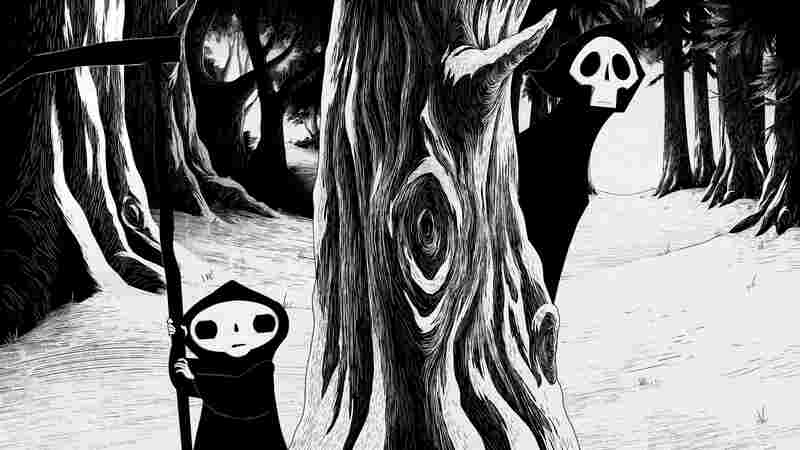
They've approached that problem with remarkable care for the material's handmade appearance. The production uses traditional hand-drawn animation, including customized brushes developed to reproduce the original illustrations' dense line work. Its backgrounds also incorporate physical printmaking, with textures etched onto copper and steel plates, printed in Scotland, and integrated into the environments. These aren't incidental details that exist only to make the production sound labor-intensive. They explain why the film's visual identity is inseparable from the techniques used to create it. A world inhabited by skeletal figures and shadowy landscapes gains an unusual warmth when its surfaces carry visible evidence of human craft.
The striking monochromatic design is an especially good match for the subject. A black-and-white world naturally suggests the traditional iconography of death, but the images don't have to remain oppressively gloomy. Crosshatched textures and exaggerated silhouettes make room for humor, and the occasional touch of color stands out precisely because so much of the surrounding environment avoids it. Pink is particularly significant within that visual scheme, a small interruption that reflects Little Death's different way of engaging with her surroundings. The contrast gives the film another storytelling tool without forcing its characters to explain what they're feeling.
That restraint matters because A LITTLE DEATH is largely driven by physical behavior rather than conventional dialogue. Sparkes and Gillet voice the central characters, but the film's storytelling depends on how the two figures move, react, and occupy the same space. The imposing adult Reaper and his smaller companion are immediately understandable as contrasting personalities. Their designs create an amusing imbalance of authority, while their movement can suggest hesitation or impatience without requiring speech. It's the kind of visual storytelling animation does especially well, making an emotion clear through a shift in posture or a moment of attention.
The contrast becomes more appealing because Little Death's distraction isn't treated as an absence of intelligence. Her gentle curiosity is central to how she experiences the world. The mentor's assumption that she's doing the job incorrectly may tell us as much about his expectations as it does about her abilities. That distinction matters in a teaching story. Children and inexperienced people don't always fail because they haven't understood an instruction. Sometimes they've noticed a possibility that experience has trained someone else to overlook. The film gives that difference room to become both the joke and the emotional heart of the relationship.
Its comedy also benefits from refusing to make Death a terrifying force at every moment. The familiar hood, skull, and scythe carry enough cultural baggage that the film can use the character's appearance as a shortcut and then contradict the personality audiences might expect. This Death has professional pride, habits, and an understandable wish for a little cooperation. A figure normally treated as an unavoidable cosmic certainty becomes almost embarrassingly human when his carefully planned instruction goes sideways. His frustration is funny because it isn't especially supernatural. It's the kind of frustration that could belong to anyone whose carefully rehearsed lesson has been ignored.
The film doesn't need to turn the apprentice into a miniature version of her mentor to make its point. In fact, doing so would undermine the pairing's appeal. Death's task isn't simply to enforce a procedure, even though that's all he initially understands his responsibility to be. He has ways to learn to teach someone whose instincts differ from his. The apprentice, in turn, isn't a symbol of perfect innocence who exists to lecture an adult about kindness. Her curiosity creates genuine inconvenience. The comedy needs those interruptions to register as frustrating, or the relationship would have nothing to overcome.
A further pleasure comes from the odd choice to approach mortality through the ordinary routines of an apprenticeship. Fiction has portrayed Death as a villain, a philosopher, a weary bureaucrat, and even an unexpectedly sympathetic companion. A LITTLE DEATH doesn't pretend to invent the idea of a personable Grim Reaper. Instead, it offers a charming variation; he has someone to care for and a responsibility he can't accomplish through his usual authority alone. The comedy doesn't come from death suddenly becoming harmless. It's that the figure entrusted with this enormous responsibility turns out to be unprepared for a small but difficult human problem.
The compact storytelling makes the film particularly suited to its format. At roughly twelve minutes, it can establish the contrast between the two characters and explore the consequences without building an elaborate mythology around their profession. No one needs an encyclopedia explaining where Reapers come from, who supervises them, or what paperwork they file after an assignment. The less the film explains about that larger supernatural organization, the easier it is to concentrate on the relationship in front of us. A little mystery also fits Gurewitch's style, where the unsettling implications of a joke can be more entertaining than a complete explanation.
The production team deserves credit beyond its directors. Story artist and animator Sophie Bird helped develop the visual narrative. In contrast, lead animator Jac Clinch and the wider animation team faced the unusual challenge of keeping densely textured drawings consistent in motion. Christopher Lindsey-Hill's work on the backgrounds and visual development contributes to a world designed around the appearance of print rather than a generic digital finish. Giorgia Zarantonello's editing supports the short's storytelling, and Alastair McNamara's score works with Miles Sullivan's sound design to give the predominantly visual comedy its emotional character. None of those contributions exist in isolation. The unified aesthetic results from many artists committing to a particular approach.
That dedication has an added relevance in an era when discussions about animation increasingly revolve around speed, automation, and reducing the labor required to produce images. Meade and Rockefeller have explicitly stated that they didn't use generative AI in making the film. Their decision is connected to the particular effect they wanted, not an abstract claim that a production becomes good merely because it was difficult to create. The handmade process suits this story because its characters are themselves learning that efficiency isn't the only useful measure of a task. The visual craft and the narrative concern reinforce one another without requiring the film to stop and explain the parallel.
That connection also prevents the message from becoming a generic lesson about being nice. Kindness is a common theme in family-oriented animation, but it can turn sentimental when a film treats it as an effortless solution to every difficulty. Here, the conflict stems from different ways of understanding responsibility. Death's established approach isn't meaningless, and the apprentice's gentleness doesn't automatically make every instruction unnecessary. The interesting idea is that an effective outcome might be reached through a method the experienced professional never considered. Respecting a person's different approach requires more than praising their good intentions. It requires being willing to reconsider your own certainty.
There's an emotional generosity to presenting that lesson through the relationship between an imposing skeletal figure and his small companion. The characters aren't physically designed to invite the same immediate response as ordinary humans, yet their disagreement centers on familiar needs. Wanting to be understood, hoping to make someone proud, and finding the courage to give someone else independence. Death's supernatural profession makes those feelings a little absurd, but not less recognizable. The film can be funny about mortality while remaining sincere about the people experiencing its unusual version of family life.
The short's festival journey began at the Annecy International Animation Film Festival, an appropriate setting for work so invested in the possibilities of two-dimensional animation. Its subsequent appearances at events including Encounters, Rhode Island, LA Shorts, and other international festivals have put it before audiences with different interests. Animation enthusiasts can appreciate its meticulous craft, while viewers interested in dark comedy can enjoy the contrast between an ominous profession and a surprisingly ordinary disagreement. Neither aspect has to compete with the other. The film's accessible setup lets them work together.
A LITTLE DEATH finds a great deal of personality within a tiny, beautifully peculiar premise. Its visual approach is distinctive because the artists commit to the handmade techniques that give the world its character, and its emotional appeal comes from refusing to treat different personalities as a problem to be corrected. Death begins with the confidence of someone who knows exactly how a job should be done. Little Death has an entirely different set of instincts. The wonderful joke is that the person who supposedly understands the end of everything still has something important to learn about living with someone else.
Please visit https://linktr.ee/overlyhonestr for more reviews.
Follow me on Letterboxd, Instagram, Twitter, and YouTube. You can also find my social media accounts on most platforms by searching for 'Overly Honest Reviews'.
I’m always happy to hear from my readers; please don't hesitate to say hello or send me any movie questions.
[photo courtesy of JANTE FILMS, ROCKEFELLER STUDIOS]
DISCLAIMER:
At Overly Honest Movie Reviews, we value honesty and transparency. Occasionally, we receive complimentary items for review, including DVDs, Blu-rays, CDs, Vinyl Records, Books, and more. We assure you these arrangements do not influence our reviews, as we are committed to unbiased, sincere evaluations. We aim to help you make informed entertainment choices regardless of our relationship with distributors or producers.
Amazon Affiliate Links:
This site also contains Amazon affiliate links. If you purchase through these links, we may receive a commission. This affiliate arrangement does not affect our commitment to honest reviews and helps support our site. We appreciate your trust and support as you navigate these links.


Happy
0 %

Sad
0 %

Excited
0 %

Sleepy
0 %

Angry
0 %

Surprise
0 %
 0
 0

Average Rating