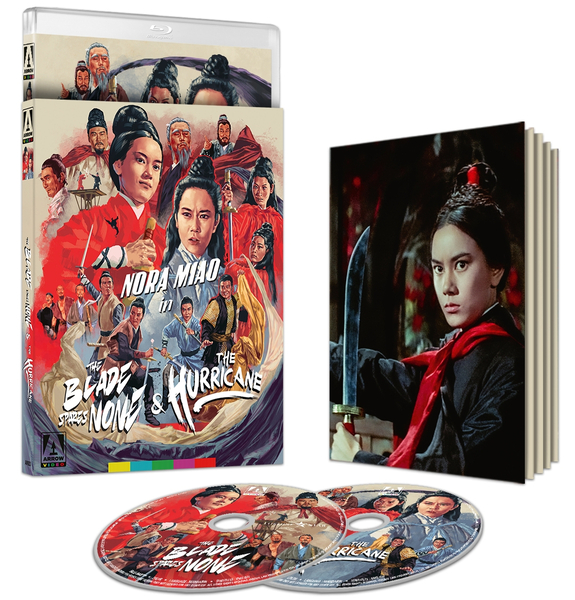
A Double Feature With Sharp Ambitions
Read Time:15 Minute, 35 Second
MOVIE REVIEW
The Blade Spares None / The Hurricane [Limited Edition]
 –


Genre: Wuxia, Martial Arts, Action, Adventure
Year Released: 1971–1972, 2026 Blu-ray
Runtime: 3h 17m (197 minutes combined)
Directors: Teddy Yip Wing-Cho, Lo Wei
Writers: David Lo Tai-Wai, Ni Kuang (story), Lo Wei
Cast: Nora Miao, Patrick Tse Yin, James Tien
Where to Watch: available now; order your copy here: www.arrowvideo.com, www.mvdshop.com, or www.amazon.com
RAVING REVIEW: How many people immediately think of Nora Miao when discussing Golden Harvest's early years? Bruce Lee understandably dominates conversations about the company. Hong Kong cinema was undergoing a much broader transformation when Raymond Chow broke away from Shaw Brothers and established a new studio. THE BLADE SPARES NONE and THE HURRICANE, brought together in Arrow Video's limited-edition Blu-ray release, offer an opportunity to explore that transition through two female-led swordplay adventures. Both feature Miao before her international recognition grew through appearances alongside Lee, and both belong to a period when Golden Harvest was still developing its identity. They're entertaining pieces of martial arts history, though their historical importance and individual accomplishments aren't necessarily the same. That distinction matters in a double feature like this, where the context can sometimes prove more compelling than the storytelling itself.
Nora Miao is easily the biggest reason to approach these films together. Her appearances in THE BIG BOSS, FIST OF FURY, and THE WAY OF THE DRAGON established her place in the Bruce Lee story, but concentrating exclusively on those associations overlooks an earlier phase of her career. THE BLADE SPARES NONE and THE HURRICANE place her in the tradition of the female swordswoman, where physical ability and personal determination can carry as much importance as the men surrounding her. That makes this pairing interesting beyond simple nostalgia. It's an opportunity to recognize an actress whose place in martial arts cinema deserves to be considered independently of the industry's most famous leading man.
THE BLADE SPARES NONE, directed by Teddy Yip Wing-Cho, introduces Miao as Ho Li-Chun, a skilled swordswoman pursuing revenge for her father's murder. The man responsible has assumed the identity of a prince, establishing a conflict in which political authority becomes a convenient disguise for personal corruption. Ho Li-Chun's pursuit brings her into contact with Tang Ching-Yun, played by Patrick Tse Yin, and Chen Jo-Yu, portrayed by James Tien. Their shared objective turns a personal vendetta into a larger confrontation with someone whose position shields him from the consequences of his actions. It's familiar territory for wuxia filmmaking, where revenge and questions of legitimate authority have long provided foundations for spectacular combat.
The revenge structure has an obvious advantage. It's easy to understand why Ho Li-Chun is willing to put herself in danger. Her motivation exists before the film begins, and the central conflict doesn't require an elaborate explanation. That lets the story focus on alliances, confrontations, and the complications of facing an opponent whose influence extends beyond his fighting ability. The approach also comes with limitations. Familiarity with this type of narrative makes certain developments relatively easy to anticipate, and recognizable conventions don't automatically become more interesting because the combatants are talented. The film's appeal depends more on how it presents the journey than on the novelty of its destination.
Miao's casting gives that journey an identity that a more conventional male-led revenge story might lack. Ho Li-Chun isn't simply accompanying the men on their adventure; her personal history establishes the central pursuit. That distinction matters because martial arts cinema has often given women memorable roles without consistently granting them comparable narrative authority. The heroine's abilities aren't treated as something requiring an elaborate justification. Within the film's world, extraordinary fighting skills are part of the accepted language of conflict. Miao belongs in that environment, and THE BLADE SPARES NONE provides a substantial early example of her work in a genre that would continue evolving around her.
Teddy Yip's film also embraces the heightened possibilities of wuxia rather than limiting its characters to strictly believable physical accomplishments. The genre has always allowed martial skill to approach the supernatural, with exceptional warriors operating according to an exaggerated understanding of what the human body can accomplish. That freedom separates these productions from later martial arts pictures built more directly around the apparent physical authenticity of their performers. Watching the two traditions as interchangeable can create the wrong expectations. THE BLADE SPARES NONE belongs to a fantasy-inflected swordplay tradition where the distinction between impressive athletic ability and outright impossibility is intentionally flexible.
That freedom creates some of the movie's appeal, but it can also make the action difficult to invest in beyond the immediate spectacle of a confrontation. When extraordinary abilities are an accepted part of nearly every major encounter, the stakes have to emerge from character relationships and dramatic circumstances. Ho Li-Chun's motivation provides a useful anchor, though the surrounding material remains closely attached to established genre conventions. The result is a film with a recognizable personality and an important central performer, without necessarily finding an equally distinctive approach to every part of its story. Enjoying the swordplay doesn't require pretending the narrative is more complicated than it actually is.
THE HURRICANE follows a different creative path, with Lo Wei directing another adventure built around deception and political betrayal. Miao reunites with Patrick Tse Yin in a story involving a corrupt minister whose activities threaten the Empire. The protagonists must navigate conflicting interests and develop an unlikely alliance to oppose a conspiracy operating within the established political order. The move from a personal revenge story to a broader conflict gives the second film a different organizing principle. Instead of concentrating on one woman's pursuit of a disguised killer, THE HURRICANE places its characters within a political situation where identifying the enemy is inseparable from understanding who can be trusted.
Lo Wei's involvement is historically significant. His association with THE BIG BOSS and FIST OF FURY puts him at the center of the period when Golden Harvest was establishing itself as a serious competitor to Shaw Brothers. His career also demonstrates how interconnected Hong Kong filmmaking was, with performers and directors moving among different studios and approaches as the industry changed. THE HURRICANE isn't automatically elevated by its director's more famous accomplishments, but placing it within that career reminds us that the films most frequently discussed today represent only part of the work these filmmakers produced.
The political conspiracy provides THE HURRICANE with possibilities that extend beyond its individual confrontations. Corruption within an empire is a particularly useful subject for wuxia because the genre often examines the difference between official power and moral legitimacy. A person can hold an impressive title without deserving anyone's loyalty, while an apparent outsider may show far greater integrity. That distinction gives the unlikely alliance at the center of THE HURRICANE a reason to exist. The protagonists aren't merely collecting companions for the next fight. Their cooperation is connected to a system in which the normal channels of authority have become unreliable.
Where THE BLADE SPARES NONE draws its dramatic energy from an identifiable personal grievance, THE HURRICANE operates within a more expansive web of competing interests. Neither approach is inherently superior. Revenge provides an immediate emotional objective, but it can make a story's eventual direction feel predetermined. Conspiracy allows more uncertainty about allegiances, though it also risks becoming an exercise in moving characters between one confrontation and the next. These films provide different examples of the storytelling structures available to Hong Kong swordplay filmmakers at the beginning of the 1970s, and considering them together makes their similarities less overwhelming.
There's an interesting conversation to be had about what Golden Harvest was trying to do in its earliest years. Raymond Chow's departure from Shaw Brothers in 1970 was an important development for an industry that had become closely associated with the older studio's production methods and extensive resources. Golden Harvest would eventually become one of the most influential names in Hong Kong cinema, but that reputation took time to build. These productions belong to its formative period, when the company was assembling talent and building a catalog rather than operating with decades of established success.
That history is valuable, but it shouldn't turn every early Golden Harvest production into an overlooked classic. It's tempting to look at a studio's later achievements and search its earliest films for evidence that greatness was inevitable. The problem is that historical hindsight can make ordinary genre filmmaking seem more revolutionary than it was. THE BLADE SPARES NONE, and THE HURRICANE are worth examining as individual works, not simply as evidence of what their distributor would eventually accomplish. Their contributions to Golden Harvest's development are meaningful, but a studio's future accomplishments shouldn't replace discussion of the movies' strengths and limitations.
The pairing also encourages a more careful look at the role women played in the development of martial arts cinema. Female warriors weren't a new invention when Nora Miao appeared in these films. Earlier Hong Kong productions had already established significant traditions of sword-wielding heroines, including performers such as Cheng Pei-pei, whose work helped shape the modern screen image of the female martial artist. Miao entered an established tradition, not a space waiting to be filled. This recognition makes her contribution more interesting, because it lets us see her as part of an evolving artistic lineage rather than an isolated exception.
There is, of course, an unavoidable connection between Miao's early work and her subsequent appearances opposite Bruce Lee. Those films reached an international audience on a scale earlier Hong Kong productions rarely enjoyed, and her participation helped keep her recognizable to generations of martial arts fans. Yet these two features demonstrate why using Lee as the primary reference point for her career is incomplete. Miao was already participating in action cinema during a period of considerable industrial change. Her filmography includes more than the handful of productions that became internationally famous, and Arrow's decision to give these two titles a dedicated release helps restore that perspective.
It's also worth considering the differences between wuxia and the hand-to-hand combat pictures that grew more prominent in the 1970s. The traditions frequently overlap, but their priorities aren't identical. Swordplay adventures often take place in historical or mythic settings, with conflicts shaped by loyalty, revenge, and the relationship between warriors and institutions. The physical action can be extravagant in ways that depart substantially from reality. Kung fu films can certainly embrace similar exaggeration, but the popularity of performers such as Bruce Lee helped shift the emphasis to the fighter's physical personality. These earlier Miao productions offer a useful glimpse of a genre operating according to its own established expectations before the international kung fu boom changed the conversation.
That doesn't mean viewers need a background in Hong Kong cinema to enjoy the double feature. The basic motivations are accessible, the confrontations are central to the entertainment, and the films don't require audiences to arrive with an academic understanding of wuxia traditions. At the same time, their appeal can grow with familiarity with the history. Recognizing the performers, understanding the rivalry between Golden Harvest and Shaw Brothers, or having an interest in the development of female-led martial arts filmmaking adds another dimension to material that might otherwise seem relatively conventional. The collection works on both levels, although its historical value is probably the stronger argument for seeking out these particular titles.
Arrow Video has built a considerable reputation for treating genre filmmaking as something deserving serious preservation, and this release fits that philosophy. THE BLADE SPARES NONE and THE HURRICANE receive their Blu-ray debuts through new 2K restorations by Fortune Star, presented in high definition with their original Mandarin-language mono soundtracks in lossless audio. Newly translated English subtitles are included for both films. The attention to original-language presentation is especially welcome for productions that have circulated internationally through editions of varying provenance, where English-language versions and inconsistent translations can complicate revisiting older Hong Kong cinema.
The supplements are divided between the two films rather than treating them as an indistinguishable double feature. THE BLADE SPARES NONE includes a commentary with Arne Venema and Stefan Hammond, along with DEADLY POISE, a newly produced appreciation of Nora Miao's career by film historian Victor Fan. The latter is an especially sensible inclusion because Miao's place in Golden Harvest history is the strongest connection between the two features. Giving her career dedicated attention helps broaden the discussion beyond these individual stories and the better-known productions that followed.
THE HURRICANE receives a commentary by Jonathan Clements, while IN THE EYE OF THE STORM features an interview with actor and stunt coordinator Mars. His participation brings another perspective on the people who helped define Hong Kong action filmmaking through their work both on camera and behind the scenes. Each disc also includes its respective theatrical trailer and an image gallery. These additions aren't unusual for an Arrow release, but they help set it apart from a straightforward catalog reissue. The company clearly understands that films with this kind of history benefit from accessible contextual material.
The limited edition also includes reversible artwork featuring a newly commissioned design by Ilan Sheady and a collectors' booklet with writing by Camille Zaurin and Johnny Burnett, also known as The Fanatical Dragon. For collectors interested in Hong Kong cinema, the written material has a purpose beyond providing another item in the package. Productions from this era are frequently discussed through their connections to more famous movies, and dedicated scholarship can give lesser-known titles room to exist on their own terms. A release doesn't need an enormous assortment of extras to justify itself, as long as the material contributes something worthwhile to our understanding of the films.
The restoration work is important for another reason. Availability strongly influences which films become part of cinema's accepted history. A production that receives multiple restorations and international releases has far more opportunities to develop a reputation than one that remains difficult to find. This is especially relevant to Hong Kong filmmaking, where enormous quantities of work were produced during periods of rapid commercial expansion. Not every title will become a rediscovered favorite, but preservation lets audiences make those judgments rather than relying entirely on reputations built through limited access.
As a double feature, THE BLADE SPARES NONE and THE HURRICANE make a convincing case for Nora Miao's importance without providing two equally indispensable genre landmarks. Their familiar narrative structures draw in viewers who enjoy traditional wuxia, but those same conventions can limit how memorable the individual stories become. There's no reason to dismiss that familiarity outright. Genre filmmaking depends on recognizable pleasures, and not every production needs to redefine its form. These two titles occupy a comfortable middle ground, where their cultural and historical significance adds interest to adventures that remain relatively straightforward in their objectives.
That middle ground is also why Arrow's decision to release them together makes sense. Neither film needs to carry the entire historical argument on its own. Viewed as companion pieces, they illuminate a moment when a new studio was developing its roster and established creative traditions were being carried into a different industrial environment. Miao provides continuity, but the distinct directors and narrative approaches keep the pairing from becoming two versions of precisely the same movie. The collection is more informative because it keeps those differences visible.
Ultimately, THE BLADE SPARES NONE / THE HURRICANE is an appealing release for viewers interested in the foundations of Golden Harvest and the careers that helped establish its reputation. Nora Miao deserves recognition beyond her association with Bruce Lee, and these films offer two worthwhile examples of her early presence in the action genre. Neither feature needs to be exaggerated into an essential lost achievement to justify the attention Arrow has given it. Sometimes a valuable addition to a film collection is simply a chance to spend more time with a performer whose work deserves wider recognition. In this case, that performer happens to be carrying a sword, which certainly doesn't hurt.
Bonus Materials:
LIMITED EDITION CONTENTS
Brand new 2K restorations by Fortune Star
High Definition (1080p) Blu-ray presentations of both films
Original lossless Mandarin mono audio for both films
Optional newly translated English subtitles for both films
Reversible sleeve featuring newly commissioned artwork by Ilan Sheady
Collectors’ booklet featuring new writing from Camille Zaurin and Johnny Burnett (aka The Fanatical Dragon)
DISC ONE – THE BLADE SPARES NONE
Brand new audio commentary with Arne Venema & Stefan Hammond
Deadly Poise, a newly filmed appreciation of Nora Miao’s career by historian Victor Fan
Theatrical trailer
Image gallery
DISC TWO – THE HURRICANE
Brand new audio commentary with Jonathan Clements
In the Eye of the Storm, a newly filmed interview with actor and stunt coordinator Mars
Theatrical trailer
Image gallery
Please visit https://linktr.ee/overlyhonestr for more reviews.
Follow me on Letterboxd, Instagram, Twitter, and YouTube. You can also find my social media accounts on most platforms by searching for 'Overly Honest Reviews'.
I’m always happy to hear from my readers; please don't hesitate to say hello or send me any movie questions.
[photo courtesy of ARROW VIDEO, MVD ENTERTAINMENT]
DISCLAIMER:
At Overly Honest Movie Reviews, we value honesty and transparency. Occasionally, we receive complimentary items for review, including DVDs, Blu-rays, CDs, Vinyl Records, Books, and more. We assure you these arrangements do not influence our reviews, as we are committed to unbiased, sincere evaluations. We aim to help you make informed entertainment choices regardless of our relationship with distributors or producers.
Amazon Affiliate Links:
This site also contains Amazon affiliate links. If you purchase through these links, we may receive a commission. This affiliate arrangement does not affect our commitment to honest reviews and helps support our site. We appreciate your trust and support as you navigate these links.


Happy
0 %

Sad
0 %

Excited
0 %

Sleepy
0 %

Angry
0 %

Surprise
0 %
 0
 0

Average Rating