Coming Home Doesn’t Mean Finding Yourself
Read Time:13 Minute, 37 Second
MOVIE REVIEW
Bird in Hand
 –


Genre: Comedy, Drama
Year Released: 2026
Runtime: 1h 30m
Director: Melody C. Roscher
Writer: Melody C. Roscher
Cast: Alisha Wainwright, Christine Lahti, James Le Gros, Annabelle Dexter-Jones, Jeffrey Nordling, John Reynolds, Esco Jouley, Jernard Burks, K. Todd Freeman
Where to Watch: available digitally November 19, 2026
RAVING REVIEW: Family reunions are uncomfortable enough when everyone actually likes each other. Throw in a questionable engagement, a lifetime of unresolved resentment, and a mother who seems more interested in maintaining her own version of reality than understanding her daughter, and you've got the beginnings of BIRD IN HAND. Writer and director Melody C. Roscher's feature debut takes the familiar idea of returning home to confront the past and turns it into an increasingly uncomfortable comedy about identity and the people who insist they know us better than we know ourselves. At its center is a woman who's spent much of her life searching for answers from people who aren't especially interested in providing them. The results are frequently funny, occasionally painful, and far more complicated than the typical story about reconnecting with family.
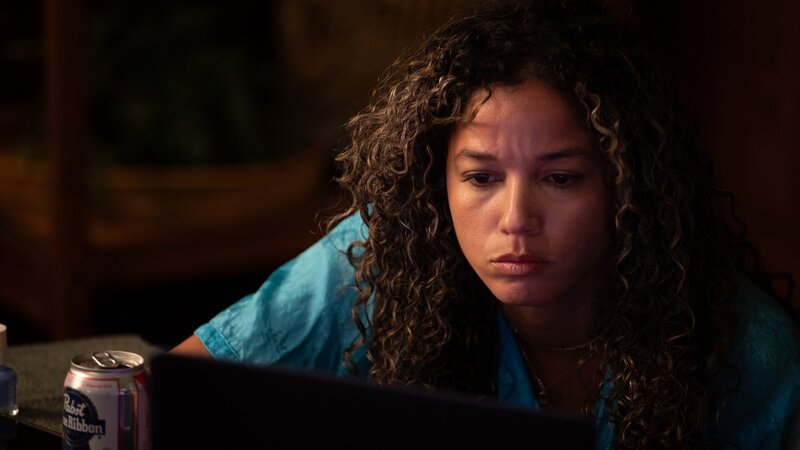
Alisha Wainwright plays Bird Rowe, a newly engaged woman who returns to her rural hometown under the pretense of planning her wedding. Her mother, Carlotta (Christine Lahti), is a free-spirited hippie whose supposed openness doesn't necessarily extend to her relationship with her own daughter. Bird's engagement provides a convenient explanation for the visit, but her actual motivations are more complicated. She's looking for answers about her father and the circumstances surrounding her upbringing, questions that have apparently remained unresolved for most of her life. Unfortunately, getting straightforward information from Carlotta isn't exactly simple. Their relationship is already loaded with resentment, and neither woman seems equipped to address it without making things considerably worse.
The relationship between Bird and Carlotta is the film's foundation, and Roscher approaches it without making either character easy to defend. Bird is manipulative and prone to making decisions that create additional problems. Carlotta, meanwhile, has spent years developing a version of motherhood that allows her to feel comfortable with her choices, regardless of how her daughter experienced them. Their inability to communicate is frustrating, especially when both seem convinced the other person is responsible for everything that's gone wrong. Their disagreements aren't simply the result of one misunderstanding that could be resolved through a heartfelt conversation. They're carrying years of accumulated grievances, and the prospect of finally addressing them isn't nearly as appealing as either might pretend.
Christine Lahti is an inspired choice for Carlotta, a character whose self-image is almost as important as the relationship she's supposedly trying to maintain. The contradiction between her free-spirited personality and her difficulty accepting uncomfortable truths is central to understanding her. Carlotta wants to be perceived as a good mother, but wanting that recognition isn't the same as doing the difficult work necessary to earn it. Roscher finds comedy in that distinction, especially in the uncomfortable gap between what people believe about themselves and how their actions affect those around them. Carlotta's behavior also complicates the familiar expectation that returning home will eventually lead to some overdue understanding between parent and child.
Wainwright has the equally difficult task of making Bird's search for identity understandable without requiring audiences to approve of everything she does. Bird doesn't approach her problems with patience or a healthy understanding of boundaries. She's frustrated, unhappy, and willing to manipulate situations when she believes doing so will bring her closer to the answers she wants. That doesn't make her motivations any less understandable. Growing up without a clear understanding of an absent parent can leave questions that become increasingly difficult to ignore. Bird's situation is further complicated by her experience as a biracial woman raised by a white mother, introducing another dimension to her uncertainty about where she belongs.
Roscher draws from her own experiences growing up biracial, particularly the discomfort of having other people treat racial identity as something they were entitled to question or define. That personal connection gives BIRD IN HAND a more specific perspective than a conventional family drama about an absent father. Bird's search isn't simply about identifying someone missing from her life. She's trying to understand a part of herself that other people have repeatedly interpreted for her. The film examines the frustration of being treated as an unanswered question, particularly when the people making assumptions rarely consider how exhausting those assumptions can become. Identity is personal, but that hasn't stopped the people around Bird from developing their own explanations for who she is.
The film's treatment of race becomes especially interesting through Carlotta's new neighbors, Dennis (James Le Gros) and Leigh (Annabelle Dexter-Jones). The couple has purchased a former plantation and is attempting to reinvent its image, a concept so spectacularly misguided that it almost sounds like the setup for a different movie. Their belief that the property can be repackaged into something more appealing introduces another example of people attempting to control how history is understood. There's an obvious absurdity in treating a plantation's historical associations as an inconvenient branding problem, but the implications go beyond the immediate comedy. The property represents a past that can't simply be revised because acknowledging it makes the present uncomfortable.
That setting gives Roscher a chance to connect Bird's personal search to a larger conversation about historical identity. Bird wants to understand the circumstances of her own existence, while the people around her demonstrate varying degrees of willingness to acknowledge the past. The plantation becomes a pointed example of what happens when individuals decide their preferred interpretation of history matters more than its consequences. It's a provocative setting for a comedy, and the underlying subject is serious enough that the absurdity carries additional weight. Roscher isn't attempting to turn the entire film into a historical examination of slavery. The property's presence makes it impossible to ignore the connection between personal identity and the histories people inherit.
Dennis and Leigh also expand the film's examination of people whose relationships are shaped by self-interest and conflicting expectations. James Le Gros and Annabelle Dexter-Jones bring established independent-film experience to characters whose involvement complicates Bird's already questionable decisions. Dennis and Leigh aren't presented as sensible outsiders who arrive to help everyone resolve their problems. Their own circumstances contribute to the increasingly tangled interpersonal situation. The comedy benefits from a collection of adults confident enough to interfere in one another's lives, despite showing little ability to manage their own. Bird may be the central source of disruption, but she's hardly the only person who can make a bad situation worse.
One of the more appealing elements of BIRD IN HAND is its willingness to let characters behave badly without immediately explaining away their choices. Stories about family dysfunction often tempt writers to assign responsibility neatly, letting one person emerge as the obvious problem while everyone else becomes a victim of their behavior. Roscher avoids making the relationships quite that convenient. Bird has legitimate reasons to feel betrayed or neglected, but those reasons don't automatically excuse the damage she causes. Carlotta's limitations as a mother don't eliminate the possibility that she's also dealing with circumstances Bird doesn't fully understand. The film lets those complications exist without requiring a straightforward verdict on who deserves sympathy.
That willingness to embrace flawed characters also shapes the comedy. BIRD IN HAND belongs to the tradition of independent films that find humor in uncomfortable personal interactions, where the audience's amusement comes partly from recognizing how badly someone is handling an otherwise ordinary situation. The wedding provides a useful framework because marriage is traditionally associated with commitment and the start of a new chapter. For Bird, it becomes an opportunity to revisit everything she hasn't resolved about the chapters that came before. Something is revealing about approaching a major personal commitment while remaining so uncertain about one's own identity. The circumstances invite comedy without making the underlying emotional concerns insignificant.
Bird's relationship with her fiancé, Frank (John Reynolds), adds another perspective to that uncertainty. An engagement should presumably reflect some confidence in the future, yet Bird's behavior suggests she has considerable difficulty deciding what she wants in the present. The wedding plans serve as a practical excuse to return home, but they also expose the distance between the life she presents to others and the questions she's privately trying to answer. Roscher is interested in the contradiction. The familiar human tendency to appear to move forward while remaining preoccupied with something unresolved becomes increasingly uncomfortable in a character who doesn't seem especially interested in the consequences of her decisions.
The surrounding characters reinforce the idea that adulthood doesn't necessarily arrive with emotional maturity. Jeffrey Nordling plays Dale, Carlotta's husband, adding another personality to a household where family relationships are rarely straightforward. K. Todd Freeman appears as Bower, contributing to an ensemble built around the different ways people respond to Bird and her search for answers. The supporting characters help establish the environment she navigates, where the adults around her have their own priorities and limitations. Rather than surrounding Bird with people who exist solely to guide her toward personal growth, Roscher gives her a world where other people's problems can just as easily interfere with her intentions.
The film's rural setting offers a useful contrast to the characters' complicated behavior. Bird returns to an environment that should, in theory, distance her from her everyday life, but familiar places don't necessarily offer emotional security. The idea of home carries different meanings depending on the experiences someone associates with it. For Carlotta, the countryside fits the independent, unconventional identity she's cultivated. For Bird, returning means confronting an upbringing that left her with more questions than answers. The same place can represent freedom to one person and unresolved frustration to another. Roscher uses that disagreement to keep the homecoming from becoming a sentimental exercise in rediscovering one's roots.
BIRD IN HAND also benefits from its connection to Roscher's earlier work. Before making her feature directorial debut, she established herself as a producer on independent productions including MARTHA MARCY MAY MARLENE, CHRISTINE, and JAMES WHITE. Those films share an interest in complicated personal experiences and characters who don't necessarily respond to difficult circumstances in ways that make audiences comfortable. Roscher previously wrote and directed the short WHITE WEDDING, which premiered at Sundance and serves as a companion to this feature. Her experience within independent filmmaking provides useful context for a debut that doesn't seem particularly concerned with making every character likable or ensuring every uncomfortable situation receives a reassuring explanation.
There's an important distinction between a film that explores difficult subject matter and one that allows that subject matter to overwhelm its characters. Roscher's approach keeps the personal relationships central even as the story addresses questions of race and historical responsibility. Bird's uncertainty about her identity isn't treated as an isolated issue that can be explained through a few conversations about heritage. It's connected to how she understands her mother, the information she hasn't received about her father, and the expectations she has developed about her own future. These concerns influence her behavior without becoming a convenient excuse for every mistake. The film recognizes that understanding why someone acts destructively doesn't necessarily make the consequences any easier for everyone involved.
A central frustration in the story is Bird's assumption that finding the right information will provide the clarity she's been missing. There's an understandable desire to believe that a single conversation or long-awaited revelation might finally make an entire life easier to understand. Roscher challenges that expectation by showing that knowledge and emotional understanding aren't necessarily the same. Learning something about your family history doesn't automatically change the people involved or erase the effects of how they treated you. You can gain information without getting the emotional reassurance you wanted. That distinction gives Bird's search a more mature foundation than simply treating the identity of an absent parent as a mystery waiting to be solved.
The film's willingness to incorporate absurdity into these concerns is also significant. Humor can make uncomfortable subjects approachable, but it can just as easily become a way of avoiding them. BIRD IN HAND draws its comedy from the contradictions within its characters, particularly the confidence with which they defend plainly questionable decisions. There's an uncomfortable familiarity in people insisting they have good intentions while disregarding how their actions affect somebody else. The plantation's proposed reinvention is one example, but the same underlying problem exists within Bird's family. Everyone has a preferred account of the past, and those accounts aren't necessarily compatible with what other people experienced.
For all its attention to dysfunction, BIRD IN HAND isn't simply interested in demonstrating how terrible families can be. Its emotional concerns are connected to the possibility of defining yourself without receiving approval from the people who helped shape your life. Bird wants answers, but her deeper problem is the authority she's allowed others to hold over her self-understanding. That's a difficult position to escape, particularly when the people involved are family members whose influence began long before someone was old enough to recognize it. Roscher doesn't approach that situation as a simple lesson about independence. The relationships remain complicated because their histories matter, even when continuing to seek approval from those involved becomes destructive.
BIRD IN HAND is an impressive feature debut from a filmmaker willing to explore uncomfortable ideas through characters who make the experience considerably messier than it needs to be. Roscher brings a personal understanding of racial identity to a story that also says plenty about the strange obligations people attach to family. Wainwright and Lahti are well matched as two women whose relationship has become an exhausting contest over who gets to define the past, and the surrounding ensemble adds enough dysfunction to keep neither as the sole source of conflict. It's an unusual family comedy that understands how complicated the search for belonging can become when everyone around you believes they already know where you fit. Bird comes home expecting answers about the person she's supposed to be. The harder lesson is recognizing that nobody else gets to make that decision for her.
Please visit https://linktr.ee/overlyhonestr for more reviews.
Follow me on Letterboxd, Instagram, Twitter, and YouTube. You can also find my social media accounts on most platforms by searching for 'Overly Honest Reviews'.
I’m always happy to hear from my readers; please don't hesitate to say hello or send me any movie questions.
[photo courtesy of PERSIMMON]
DISCLAIMER:
At Overly Honest Movie Reviews, we value honesty and transparency. Occasionally, we receive complimentary items for review, including DVDs, Blu-rays, CDs, Vinyl Records, Books, and more. We assure you these arrangements do not influence our reviews, as we are committed to unbiased, sincere evaluations. We aim to help you make informed entertainment choices regardless of our relationship with distributors or producers.
Amazon Affiliate Links:
This site also contains Amazon affiliate links. If you purchase through these links, we may receive a commission. This affiliate arrangement does not affect our commitment to honest reviews and helps support our site. We appreciate your trust and support as you navigate these links.


Happy
0 %

Sad
0 %

Excited
0 %

Sleepy
0 %

Angry
0 %

Surprise
0 %
 0
 0

Average Rating