A Bucketful of Independent Cinema
Read Time:11 Minute, 30 Second
MOVIE REVIEW
The Pee Pee Poo Poo Man
 –


Genre: Comedy, Crime, Experimental
Year Released: 2024, 2026 Blu-ray
Runtime: 1h 19m
Director: Braden Sitter Sr.
Writer: Braden Sitter Sr.
Cast: Rishi Rodriguez, Spencer Rice, Paul Bellini, Neal Armstrong, Afroz Khan, Stuart Rosenthal
Where to Watch: available now; order your copy here: www.videovisions.org
RAVING REVIEW: A movie called THE PEE PEE POO POO MAN has made its first important decision before a single frame appears. Nobody can claim they were lured in by an elegant title and blindsided by the subject matter. Writer-director Braden Sitter Sr. takes an actual series of attacks in Toronto and turns it into an especially peculiar crime comedy, with a paranoid young man at the center of a citywide nightmare involving buckets of human waste. The title is a dare, but it's also a useful warning about the kind of humor on offer. Expecting a respectable treatment of the material would be like ordering a salad at a restaurant called Deep-Fried Everything. That's not what this place is serving.
The real incident occurred in 2019, when people in Toronto were attacked with buckets of excrement. Sitter has been clear that his movie takes the basic incident as inspiration rather than trying to reconstruct the perpetrator's actual life. His version follows Miguel (Rishi Rodriguez), an unemployed man whose drug use and increasingly paranoid thinking feed a conviction that he has discovered something important about the world. It's a peculiar route toward public notoriety, and Miguel is a long way from the charming criminal antiheroes that movies usually invite us to root for. The people who cross his path haven't volunteered to become part of whatever mission he believes he's carrying out.
Rodriguez has a difficult assignment because Miguel's behavior is both the source of the film's absurdity and the reason the situation can't be treated as harmless mischief. The character's paranoia opens the door to bizarre associations and an increasingly unstable understanding of his surroundings. Sitter also gives him a life beyond the attacks, which keeps the movie from becoming nothing more than a feature-length compilation of people getting drenched in fake shit. That distinction matters more than the title might suggest. A story consisting only of the same practical joke would say less about the person committing it.
The film's relationship with Toronto is especially important. Instead of treating the city as a generic backdrop, Sitter builds his fiction from ordinary public spaces and the people moving through them. Streets become places where a person can mind their own business one moment and encounter absolute lunacy the next. The scale is deliberately local. This isn't a criminal mastermind holding a metropolis hostage through some elaborate plot. It's one deeply troubled individual making other people's days infinitely worse, often in locations where nothing remarkable was supposed to happen. That modest geographical scale fits the bizarre real incident better than an inflated thriller treatment ever could.
Sitter has described Alan Clarke's ELEPHANT as an inspiration, particularly its repeated incidents arranged with variations rather than a conventional escalating plot. That's an unexpected reference for a film bearing this title, but it helps explain the structure. Repetition is built into the source material itself. The challenge is finding a reason to stay with the surrounding lives instead of treating each new attack as another punchline. THE PEE PEE POO POO MAN mixes Miguel's increasingly disordered perspective with time spent among people in the city. The approach can feel loose, but its digressions are also where the project becomes more recognizably a film rather than an extended internet gag.
The victims and other residents aren't merely targets waiting for the next bucket. The movie allows ordinary conversations and uncomfortable interpersonal situations to occupy space alongside the grotesque material. That choice changes how the attacks register. They interrupt lives that would have carried on without Miguel, and the city doesn't stop existing when he leaves the frame. The contrast offers an understated reminder of how thoroughly an apparently random act can intrude upon somebody else's day. It's also an unusual kind of generosity for a comedy whose marketing knows exactly how much attention its disgusting central attraction will receive.
The presence of Paul Bellini and Neal Armstrong connects the movie to another part of Toronto's creative community. Spencer Rice also appears, bringing a familiar face for viewers who know his work with KENNY VS. SPENNY. These aren't Hollywood stars pretending Toronto is somewhere else. Their participation reinforces the sense that Sitter made a movie among people and places he actually knew. It would be easy to reduce the cast to a collection of recognizable local personalities. More interesting is how naturally the production's community becomes part of its identity. The film is as much a record of a particular independent scene as it is a joke with an astonishingly unpleasant setup.
Miguel's paranoia complicates the comedy because a psychological crisis isn't automatically a joke. His beliefs grow increasingly detached from reality, and the story plays with a sense of distorted significance in everyday things. That makes him unpredictable without requiring the audience to endorse his behavior. The film's interest in his internal confusion introduces discomfort that the title alone doesn't prepare you for. The comedy isn't always aimed at the same target, either. Sometimes it's the outrageous situation; at other points, the surrounding social behavior provides the more revealing observation.
The movie also enjoys moving into surreal territory. Images of altered perception and strange interruptions sit beside the familiar streets of Toronto, creating a contrast between Miguel's private world and the public consequences of his actions. It's an approach that gives Sitter room to experiment with the visual language instead of committing to a single realistic style. At times, that freedom makes the storytelling feel deliberately unruly. It also makes it harder to determine whether an odd moment is designed to advance an idea or simply exists because somebody involved thought it would be funny. With a project this eccentric, those impulses probably never separate cleanly.
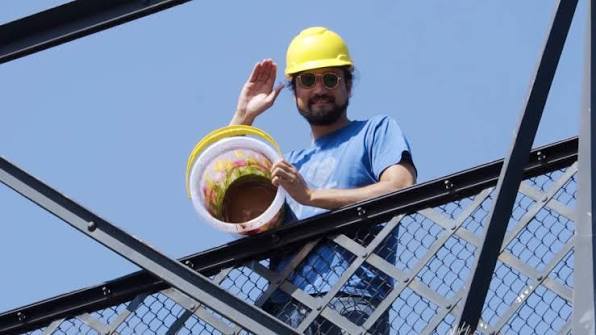
One of the most distinctive production stories involves the material used for the attacks. Sitter has explained that the fake excrement was largely melted chocolate ice cream, sometimes with additions to make it more convincing. That is both reassuring trivia and a profoundly ridiculous logistical detail. Imagine organizing a film shoot around keeping tubs of ice cream at precisely the wrong temperature. It's also a practical solution that suits the entire production. The filmmakers needed something inexpensive and convincing enough for the gag, not an elaborate effects operation. Nobody involved had the luxury of treating a bucket of fake feces as a minor line item.
Sitter financed the production through paid medical studies, explaining in an interview that the eventual budget was around $8,000. The project developed over roughly two years, far beyond the original minimal expenditure. That history doesn't automatically make the film better, and a shoestring budget shouldn't become a universal excuse for storytelling problems. What it does explain is the freedom of a production that was never built around persuading a conventional investor to approve its title. The director could pursue a strange personal obsession, enlist collaborators, and keep going until he had a feature. It's hard to imagine a committee meeting where this particular concept survived without somebody being escorted from the room.
The musical choices deserve attention for a more specific reason than merely giving the comedy additional energy. Sitter and his collaborators use rewritten versions of recognizable songs, turning musical familiarity into another opportunity for bodily-function jokes. There's an inherently stupid pleasure in hearing a familiar melody repurposed for material no respectable recording executive would have requested. The songs also fit the project's handmade identity. Instead of borrowing a recognizable track and expecting it to supply personality on its own, the film makes the act of borrowing part of the joke. How much mileage that approach provides will depend on an audience's tolerance for a gag that announces its immaturity without embarrassment.
The film's chaptered construction gives its separate episodes a framework, but chapter headings alone can't make every excursion feel essential. A loose, observational style comes with a tradeoff. Spending time away from the central crime spree can broaden the movie's world, though not every detour carries the same dramatic force. The tension between Miguel's increasingly bizarre behavior and the more ordinary situations elsewhere is interesting in principle; keeping those parts equally engaging is another matter. The film's running time is modest by feature standards, but unconventional material doesn't automatically become tighter simply because the credits arrive before the ninety-minute mark.
An unforgettable premise can carry a movie only so far. THE PEE PEE POO POO MAN has an instantly recognizable identity, a committed independent production behind it, and a setting that gives the story more texture than its name suggests. Its more wandering impulses also create unevenness in the experience. The idea that a work can be ambitious in its oddness without being consistently successful is hardly a contradiction. Sitter's freedom to pursue whatever interests him is part of the attraction, even when that freedom leads to material that isn't especially disciplined. Not every eccentric diversion becomes more effective simply because it refuses to behave like conventional cinema.
The film has attracted attention beyond its initial Toronto screenings, including festival play and an audience willing to embrace its particular brand of outrageousness. That response makes sense for a production whose specificity is part of its appeal. It couldn't have been designed by asking what the broadest possible audience wanted. Sitter's approach also reminds us that regional cinema doesn't have to mean prestige dramas or carefully photographed landmarks. An independent film can be a portrait of its city while showing the parts visitors are unlikely to encounter in a tourism campaign. Toronto may never put Miguel on a welcome sign, but the movie belongs to the city that inspired it.
The new Video Visions Blu-ray is a fitting home for a production that built its reputation through independent screenings and word of mouth. The label was established by Cartuna founder James Belfer, who was interested in films that might fall outside the usual boutique-release canon. THE PEE PEE POO POO MAN sits comfortably beside that mission. The release is region-free, presented in its original 1.78:1 aspect ratio, and includes English DTS-HD MA 2.0 audio with English SDH subtitles. The limited edition adds a gold-foil slipcover, which might be the most extravagantly inappropriate luxury treatment imaginable for a movie about throwing buckets of shit at strangers.
The more substantial collector attraction is the supplementary material. Video Visions includes deleted scenes, a making-of feature, short films, music videos, and a 32-page booklet. That selection has value beyond giving owners more content to click through. This project's methods and surrounding creative community are integral to understanding how it came to exist at all. A conventional studio comedy can often be discussed without examining the people who found the money or improvised production solutions. Here, the circumstances are part of the film's character. The disc preserves a broader record of that process without pretending that every eccentric choice on screen is flawless.
THE PEE PEE POO POO MAN isn't an argument that every outrageous independent idea automatically deserves to be called a hidden gem. Its loose storytelling and intentionally abrasive subject matter will test some viewers, and the material's appeal depends heavily on whether its peculiar sense of humor connects. But it's difficult to mistake this for a product assembled from somebody else's idea of what a cult movie should look like. Sitter found an awful incident, imagined an even stranger fictional world around it, and made the damn thing happen. Not every choice lands with the same force, but the result has a personality that can't be bought with a larger budget. Toronto has had plenty of screen villains. Few have required this much ice cream.
Please visit https://linktr.ee/overlyhonestr for more reviews.
Follow me on Letterboxd, Instagram, Twitter, and YouTube. You can also find my social media accounts on most platforms by searching for 'Overly Honest Reviews'.
I’m always happy to hear from my readers; please don't hesitate to say hello or send me any movie questions.
[photo courtesy of VIDEO VISIONS, FLEMING ENTERTAINMENT, EH24]
DISCLAIMER:
At Overly Honest Movie Reviews, we value honesty and transparency. Occasionally, we receive complimentary items for review, including DVDs, Blu-rays, CDs, Vinyl Records, Books, and more. We assure you these arrangements do not influence our reviews, as we are committed to unbiased, sincere evaluations. We aim to help you make informed entertainment choices regardless of our relationship with distributors or producers.
Amazon Affiliate Links:
This site also contains Amazon affiliate links. If you purchase through these links, we may receive a commission. This affiliate arrangement does not affect our commitment to honest reviews and helps support our site. We appreciate your trust and support as you navigate these links.


Happy
0 %

Sad
0 %

Excited
0 %

Sleepy
0 %

Angry
0 %

Surprise
0 %
 0
 0


Average Rating