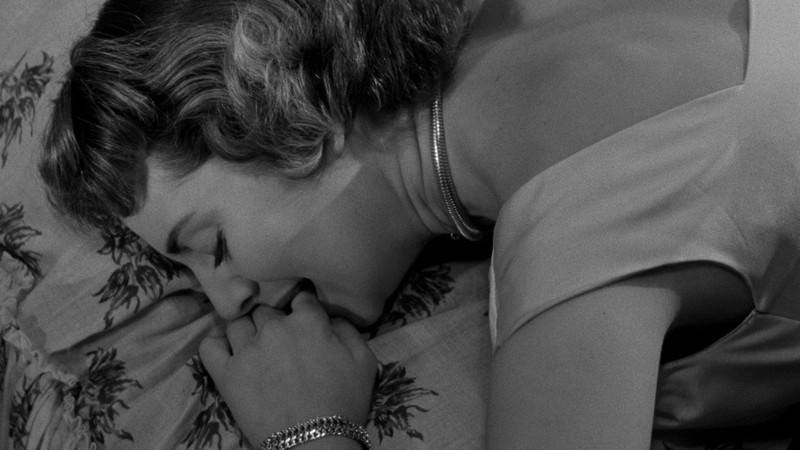
The Work of Walking Away
Read Time:8 Minute, 59 Second
MOVIE REVIEW
A Free Woman (Una donna libera)
 –


Genre: Drama
Year Released: 1954, 2026 Blu-ray
Runtime: 1h 33m
Director: Vittorio Cottafavi
Writers: Oreste Biancoli, Fabrizio Sarazani, based on the play by Malena Sandor
Cast: Françoise Christophe, Pierre Cressoy, Gino Cervi, Elisa Cegani, Christine Carère, Lianella Carell
Where to Watch: available now; order your copy here: www.radiancefilms.co.uk, www.mvdshop.com, or www.amazon.com
RAVING REVIEW: The job Liana finds at an architecture firm in Paris pays poorly and involves copying other people’s drawings. She has an architecture degree, so it is work she knows how to do, and it’s a way to support herself in a city where she arrived on her own. It’s also a long way from designing anything. Vittorio Cottafavi gives this part of A FREE WOMAN room to register. Liana has walked away from the life her family expected her to have, and the film is interested in how much she can actually make a living once she does. A competent woman can end up with very little say over what she does all day, even when she’s the one who went out and got the job.
Françoise Christophe plays Liana, who’s due to marry an engineer when a musician named Gerardo Villabruna gives her a reason to reconsider. There’s a practical case for the marriage that everyone around her understands. She’s educated, he’s established in a profession, and her family can picture how the arrangement will work. Cottafavi is good at making that picture easy to see before Liana has to decide whether she wants to spend the rest of her life inside it. A prospect can look reasonable from every seat in the room except the one occupied by the person who’s expected to say yes. That’s a better starting point for a melodrama than a fiancé so awful that walking away takes no imagination.
Pierre Cressoy’s Gerardo attracts Liana in part because he’s already arranged his life around something he cares about. He travels for his music and expects the people he’s involved with to understand what that requires. His certainty is persuasive when he directs it at a woman who’s been surrounded by people certain on her behalf. Away from that company, there’s a different proposition to consider. Gerardo has a wonderfully clear idea of what an independent life ought to look like for him. When it comes time to leave Amalfi and go on tour, he can explain the choice in terms of work that was there long before Liana and will be waiting for him when he gets back. She has to work out what she’ll be doing in the meantime.
Cottafavi had already made TRAVIATA ’53, an adaptation of the Dumas novel that also inspired Verdi’s opera. In A FREE WOMAN, the musician is part of the story, and the emotional power of the music is part of what makes him persuasive. Tchaikovsky gives Gerardo’s world an appeal that an account of his behavior would struggle to explain. The music makes a life organized around rehearsals and concert dates sound like it’s worth the trouble. Liana can respond to the music without having any reliable way to tell how much of what she hears has anything to do with how Gerardo will treat her. Tchaikovsky keeps his appeal after Gerardo has given Liana reason to doubt him.
It matters that Cottafavi takes the couple to a villa by the sea. An escape from an impending marriage feels different when you’ve put that much distance between yourself and everybody who knows what you’re supposed to be doing. Amalfi gives their affair enough room to feel like a life of its own. The move from Amalfi to Paris makes the difference between having somewhere to go and having somewhere to live. The villa was ready for her when she arrived, as long as she and Gerardo wanted to be there together. In Paris, she has to find a reason to stay that’ll carry her through an ordinary Tuesday.
Christophe has to make Liana recognizable across those changes in circumstance. The woman who takes the job in Paris is the same one who went to Amalfi with Gerardo after calling off her wedding. The part depends on our being able to take both decisions seriously. The film lets Liana be susceptible to a person who says the right thing at the right time and capable of doing the unglamorous work it takes to live somewhere on her own. The performance leaves room for the excitement of doing something on impulse and the concentration it takes to follow through once nobody’s there to make it feel romantic.
Gino Cervi’s Massimo changes the terms again. He’s a wealthy shipowner, and the security he can offer looks different after Liana has seen what her wages will cover. The script by Oreste Biancoli and Fabrizio Sarazani gives that offer real appeal. By the time he enters her life, we know enough about her situation to understand why spending fewer days worrying about money could matter as much as being desired. Cervi also gives the film a man whose position in the world is easy to understand, even if his place in Liana’s life is more complicated. Money can give her some breathing room. Once she has it, the question of what she can do with her days waits for her again.
The screenplay comes from a play by Malena Sandor, and it keeps the dramatic usefulness of a conversation that can change what someone expects to be doing the next morning. Gerardo’s departure for his tour is a plain example. The same conversation that confirms he’s going back to his life makes clear that Liana has to put hers together somewhere else. The changes come fast enough that, at times, there’s more room for the decision than for the ordinary days that follow. That’s where the film’s impatience shows. It can be absorbed in a change of mind, then hurry to the next person who’ll give her a reason to change it again.
There’s another strain of the film in the Franci family. Elisa Cegani plays Liana’s mother, and Christine Carère plays her sister. The family has a longer memory than anybody Liana meets after leaving home. A choice that looks like an impulsive departure to them can come after years of Liana knowing what the next step in her life was supposed to be. That gap in understanding also makes the sister’s presence matter. Liana knows what it feels like to have somebody older and more certain take an interest in how she ought to behave. With her sister, Liana gets to see how easily that same certainty can look like care when you’re the person who feels responsible for somebody else. It complicates Liana in a way no other love affair could.
Cottafavi trusts melodrama to accommodate that kind of contradiction. Liana is entitled to make decisions the people around her dislike, and she can also misjudge someone or hurt somebody she cares about. Christophe plays a woman the audience keeps getting opportunities to judge, often at the exact moment she’s most disappointed with what she's chosen. The next section of her life asks us to spend more time with her anyway. By then, what’s striking about the beginning is how far ahead everybody could see when they thought she was going to marry the engineer. Once Liana calls it off, even getting to the end of the week can take some figuring out. Cottafavi gives that uncertainty a place in her life. For stretches of the film, nobody in the room knows what she’ll do next, and Liana gets to be one of them.
Radiance presents the film in a 2K restoration from the original negative with uncompressed Italian mono audio. The label identifies this as the film’s first home-video release outside Italy and lists the disc for Regions A and B. The restoration also played theatrically at London’s Institute of Contemporary Arts before coming to disc.
The supplements include a 1995 interview with Cottafavi and a new interview with Italian cinema scholar Stephen Gundle. Having the director’s account alongside a historian’s is a good fit for a film whose ideas about work and marriage are easy to recognize today and worth considering in their own period. The booklet pairs new writing by Mariangela Sansone with archival writing by filmmaker Luc Moullet. The 3,000-copy limited edition comes in a full-height Scanavo case with a removable OBI strip and a reversible sleeve featuring original artwork and a new design by Time Tomorrow.
Bonus Materials:
2K restoration from the original negative by Radiance Films
Uncompressed mono audio
Archival interview with director Vittorio Cottafavi (1995)
Interview with Italian film expert Stephen Gundle (2026)
Reversible sleeve featuring original and newly commissioned artwork by Time Tomorrow
Booklet featuring new writing by critic Mariangela Sansone and archival writing by filmmaker Luc Moullet
Limited edition of 3000 copies, presented in full-height Scanavo packaging with removable OBI strip leaving packaging free of certificates and markings
Please visit https://linktr.ee/overlyhonestr for more reviews.
Follow me on Letterboxd, Instagram, Twitter, and YouTube. You can also find my social media accounts on most platforms by searching for 'Overly Honest Reviews'.
I’m always happy to hear from my readers; please don't hesitate to say hello or send me any movie questions.
[photo courtesy of RADIANCE FILMS, MVD ENTERTAINMENT]
DISCLAIMER:
At Overly Honest Movie Reviews, we value honesty and transparency. Occasionally, we receive complimentary items for review, including DVDs, Blu-rays, CDs, Vinyl Records, Books, and more. We assure you these arrangements do not influence our reviews, as we are committed to unbiased, sincere evaluations. We aim to help you make informed entertainment choices regardless of our relationship with distributors or producers.
Amazon Affiliate Links:
This site also contains Amazon affiliate links. If you purchase through these links, we may receive a commission. This affiliate arrangement does not affect our commitment to honest reviews and helps support our site. We appreciate your trust and support as you navigate these links.


Happy
0 %

Sad
0 %

Excited
0 %

Sleepy
0 %

Angry
0 %

Surprise
0 %
 0
 0

Average Rating