Love and Lawlessness in Florida
Read Time:14 Minute, 24 Second
MOVIE REVIEW
Miami Blues
 –


Genre: Crime, Comedy, Drama, Thriller
Year Released: 1990, 2026 4K
Runtime: 1h 37m
Director: George Armitage
Writers: George Armitage (screenplay), based on the novel by Charles Willeford
Cast: Alec Baldwin, Jennifer Jason Leigh, Fred Ward, Nora Dunn, Charles Napier, Paul Gleason, Obba Babatundé, Shirley Stoler, Martine Beswick
Where to Watch: available now; order your copy here: www.radiancefilms.co.uk, www.mvdshop.com, or www.amazon.com
RAVING REVIEW: Alec Baldwin arrives in Miami fresh out of prison, and within minutes, it's obvious that his character has absolutely no business being allowed to walk around unsupervised. George Armitage's MIAMI BLUES takes a career criminal who treats other people's lives as disposable and gives him the confidence of someone who genuinely believes he can get away with anything. The result is a peculiar crime comedy that mixes sudden violence with an almost cheerful disregard for consequences. Released in 1990 and based on Charles Willeford's novel, the film has an unusual personality that makes it difficult to categorize. It's often entertaining because the characters are so unpredictable, though the film's wandering approach to the story doesn't always make the most of the considerable talent involved.
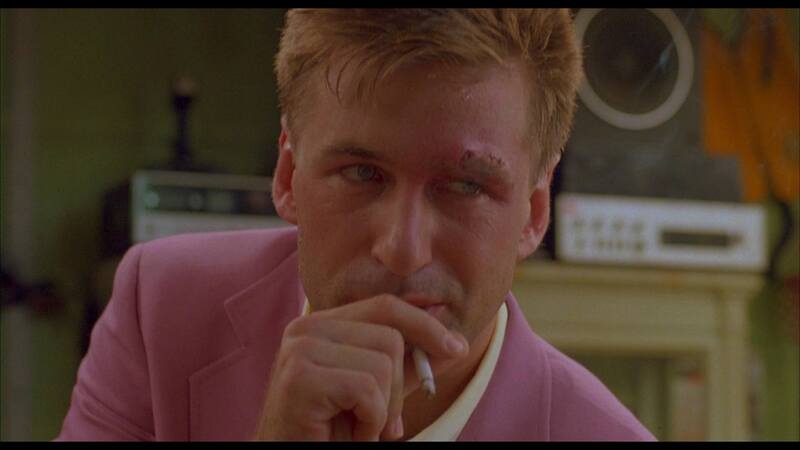
Baldwin plays Frederick J. Frenger Jr., better known as Junior, a recently released convict who wastes virtually no time returning to criminal behavior. After arriving in Miami, he becomes involved in an airport incident that draws the attention of local law enforcement. He also meets Susie Waggoner (Jennifer Jason Leigh), a young sex worker whose hopes for a stable domestic life make her especially vulnerable to someone as manipulative as Junior. Their relationship develops with surprising speed, and the prospect of building a home together becomes part of Junior's increasingly ridiculous attempt to establish a normal existence without actually changing anything about himself.
What makes Junior such an unusual protagonist is the complete absence of hesitation between deciding to do something and doing it. He's impulsive enough to create problems where none existed, and his confidence gives even his most reckless decisions a bizarre sense of inevitability. Baldwin's performance depends on that combination of charm and aggression. Junior can appear friendly and amusing until the situation changes, at which point his behavior becomes genuinely threatening. The transition is essential to the character because the audience has to recognize how easily someone like him could manipulate people who don't immediately understand what they're dealing with.
The film doesn't try to turn Junior into a misunderstood criminal whose actions can be excused by an elaborate personal history. His behavior repeatedly shows he has little concern for anyone beyond himself, no matter how convincingly he pretends otherwise. That creates an interesting challenge for a comedy built around his exploits. The audience can find him entertaining without being asked to admire him, and the humor often comes from the astonishing confidence with which he approaches situations that any reasonable person would recognize as dangerous. His self-assurance is arguably his most useful criminal asset, even when it encourages decisions that threaten to destroy everything he's trying to establish.
Jennifer Jason Leigh gives the film an entirely different personality through Susie, whose aspirations are considerably more ordinary than those of the man she's chosen to trust. She wants a home and a relationship that offers some security, and Junior appears willing to provide the version of that life she's imagined. Susie's optimism becomes especially uncomfortable because the audience understands how much information she's missing. Leigh avoids turning her into someone whose innocence exists exclusively for comic relief. There's a vulnerability to the character that makes her circumstances troubling even when the film surrounds their relationship with absurd situations.
Susie's desire to build a household also gives MIAMI BLUES an unexpected domestic component. Junior moves between criminal activity and the comfortable routines of settling down, as though the two could coexist without eventually creating serious problems. The contrast is funny because he seems unable to recognize the absurdity of his position. He's trying to establish the appearance of an ordinary life while continuing to behave in ways that make that life impossible to maintain. Susie becomes part of his fantasy, although her hopes for the relationship come from a much more sincere place. That difference gives their scenes a sadness that complicates the film's comedic intentions.
Fred Ward plays Sergeant Hoke Moseley, the detective whose investigation brings him into Junior's increasingly chaotic existence. Hoke is a particularly entertaining counterpoint because he's far removed from the glamorous detectives usually associated with crime thrillers. He's a weary, middle-aged police officer whose professional experience hasn't made his personal circumstances especially impressive. Ward gives him an appealingly ordinary quality, suggesting a man who has spent enough time dealing with criminals to understand that the job rarely provides the satisfaction people might imagine. His pursuit of Junior becomes a conflict between two men with very different relationships to the law.
Hoke also has a history beyond this particular film. Charles Willeford introduced him in the 1984 novel MIAMI BLUES, the first of four books featuring the detective. Willeford's approach to crime fiction frequently emphasized the strange behavior of ordinary people, finding humor in circumstances that other writers might have treated with complete seriousness. The character belongs to that tradition, allowing Hoke to exist as a capable investigator without making him an idealized representative of law enforcement. Ward's performance fits the material because he doesn't need to make Hoke especially impressive to give him a distinctive presence.
The screenplay finds another source of humor in the authority people automatically associate with police officers. Junior's willingness to exploit appearances becomes particularly important when his activities bring him into closer contact with Hoke's professional identity. The concept shows how easily confidence and recognizable symbols of authority can influence strangers' behavior. People respond to what they believe they're seeing, often without considering whether the person in front of them deserves that trust. It's a fitting subject for a film whose leading character has turned deception into his preferred method of navigating the world.
George Armitage adapted Willeford's novel after spending years away from directing theatrical features. His earlier career included work within the low-budget filmmaking environment associated with Roger Corman, where directors learned to combine commercial genre material with individual creative interests. Jonathan Demme, who had also worked within that environment, helped bring MIAMI BLUES to the screen as a producer. That connection is significant because the movie shares an interest with Demme's SOMETHING WILD and MARRIED TO THE MOB in finding comedy within situations that contain genuine danger. The personalities are often eccentric, but the threats surrounding them aren't imaginary.
The production's history also includes an interesting casting development. Fred Ward originally acquired the rights to Willeford's novel with the intention of playing Junior, a considerably different proposition from the film that eventually reached theaters. Ward ultimately took the role of Hoke Moseley, leaving Baldwin to portray the unpredictable criminal. It's difficult to separate the finished movie from that casting decision because the contrast between the two actors is so important to its identity. Baldwin brings youthful arrogance to Junior, while Ward's exhausted demeanor provides an effective response to a man who behaves as though consequences happen exclusively to other people.
Armitage's approach to the material also explains why MIAMI BLUES doesn't behave quite like a conventional crime thriller. The story isn't organized exclusively around a carefully developed criminal plan or an escalating series of investigative discoveries. Junior creates complications through his behavior, and the narrative follows the consequences as they begin affecting the people around him. That gives the movie a spontaneous quality, but it can also make the progression feel uneven. The characters often provide more immediate entertainment than the larger structure holding their activities together. For viewers who prefer a tightly organized mystery, that looseness may be one of the film's more frustrating qualities.
Miami itself provides an appropriate environment for a story about people attempting to reinvent themselves. The city offers Junior the chance to start over, though he interprets that opportunity as permission to keep behaving exactly as he did before. The contrast between Florida's sunny surroundings and the violence within them is central to the movie's identity. This isn't a crime story built around shadowy streets and traditional noir imagery. Its characters operate in a bright, recognizable setting where the everyday activities of ordinary people exist alongside Junior's increasingly reckless behavior.
The film's humor also benefits from its refusal to make every criminal encounter an elaborate production. Junior frequently behaves with the casual attitude of someone completing an ordinary errand, regardless of how inappropriate or dangerous his actions might be. That indifference makes his conduct more unsettling than it would be if Baldwin played every moment as a dramatic confrontation. The comedy comes from the difference between what is happening and how Junior chooses to respond. It's an approach that requires considerable confidence from the performer, especially when the character's behavior moves into territory that shouldn't be treated as harmless.
The supporting cast adds to the film's distinctive collection of personalities. Charles Napier appears as another police officer, while Nora Dunn and Paul Gleason contribute to the wider assortment of people whose lives intersect with Junior's activities. Obba Babatundé and Shirley Stoler are among the recognizable performers appearing throughout the production. These supporting roles help establish a world where the people encountered along the way have individual personalities, even when they aren't part of a larger storyline. The movie's interest in eccentric behavior extends well beyond its principal characters, giving otherwise routine interactions an occasionally unexpected quality.
The relationship between Junior and Susie remains the most complicated element because it introduces emotional consequences that the comedy cannot entirely dismiss. Susie believes she's working toward a recognizable version of happiness, and Junior understands enough about those expectations to make himself appear suitable. His deception is troubling because the relationship provides him with benefits he has no intention of earning through honesty. Leigh's performance makes that imbalance difficult to ignore. Whatever amusement comes from Junior's criminal confidence, the reality of someone trusting him gives his behavior consequences beyond the immediate danger of being caught.
Jennifer Jason Leigh received significant recognition for her performance, winning Best Supporting Actress honors from both the New York Film Critics Circle and the Boston Society of Film Critics for work that included MIAMI BLUES. That attention was deservedly directed toward a performer who could give an unusual supporting character a recognizable emotional life. Susie could easily have existed as an uncomplicated joke about someone being deceived by a criminal. Her importance to the film is that she represents an entirely different understanding of the relationship, and the contrast makes Junior's behavior more revealing.
For all its personality, MIAMI BLUES isn't a film whose various elements always fit together comfortably. Its shifts between violence and comedy can be abrupt, and the loosely organized narrative sometimes feels more interested in moving toward another unusual encounter than developing the circumstances already established. The characters make that approach entertaining more often than it might otherwise be, but a strong collection of performances doesn't automatically resolve structural weaknesses. The film's distinctive sensibility is worth appreciating without pretending that every diversion contributes equally to the experience.
Radiance Films' new limited-edition 4K Ultra HD release gives this unusual crime comedy a welcome physical-media presentation. The two-disc edition includes a 4K restoration from the original camera negative, with HDR and Dolby Vision on the UHD disc, alongside a Blu-ray presentation of the feature. Uncompressed stereo PCM audio and English subtitles for the deaf and hard of hearing are also included. This marks the film's first UHD release, making it a significant addition for collectors looking to revisit an overlooked entry from early 1990s American cinema.
The supplements provide useful historical context without relying entirely on promotional material. A 26-minute collection of interviews with Baldwin and Leigh from 2015 gives the release direct contributions from its principal performers. Critic David Jenkins examines the film and Jonathan Demme's involvement in a 2022 feature, while pulp-fiction specialist Maxim Jakubowski discusses Hoke Moseley's place within Willeford's novels. The latter is especially appropriate because the adaptation is often discussed for its eccentric characters, without giving equal attention to the literary background that produced them. A promotional and behind-the-scenes image gallery and the theatrical trailer complete the listed video supplements.
Radiance has also assembled an extensive booklet that adds considerable value to the limited edition. Glenn Kenny contributes new writing, critic Nick Pinkerton interviews George Armitage, and Leila Latif examines Baldwin's work in comedy. Archival material concerning Fred Ward and a collection of reviews provide additional perspectives. The release features a reversible sleeve with original and newly commissioned artwork by Time Tomorrow, plus a removable OBI strip. Limited to 10,000 copies, the American edition is designed for collectors who appreciate releases that provide substantial historical and critical material alongside the film.
The booklet and supplements are particularly relevant because MIAMI BLUES belongs to a period of American filmmaking that produced numerous unconventional crime comedies without always attracting the lasting attention given to more commercially successful titles. Its combination of unusual character relationships and sudden violence anticipates elements that would become more familiar throughout the decade. The film's individuality comes from a collection of creative influences that existed before those later productions became established reference points. Revisiting it helps place that particular strain of American crime comedy within a broader history.
MIAMI BLUES is ultimately a film whose personality is more memorable than its plot mechanics. Baldwin's complete commitment to Junior's reckless behavior gives the movie much of its entertainment value, while Ward and Leigh provide characters who make the consequences of that behavior matter. Armitage's approach can be uneven, and the film's unusual mixture of comedy and criminal violence won't satisfy everyone equally. There's enough originality in its characters and their relationships to make it worth rediscovering, particularly through an edition that treats the production with considerable respect. Junior may believe he's found a place to escape his past and live however he pleases, but Miami has a habit of making his terrible decisions everyone's problem.
Bonus Materials:
4K restoration of the original negative, presented in HDR / Dolby Vision
4K UHD and Blu-ray presentation of the feature
Uncompressed stereo PCM audio
Interviews with Alec Baldwin and Jennifer Jason Leigh (2015, 26 mins)
David Jenkins looks at Miami Blues and Jonathan Demme’s role in the production (2022, 12 mins)
Pulp crime expert Maxim Jakubowski looks at the character of Hoke Moseley in both Miami Blues and Willeford’s novels in which he is a recurrent character (2022, 11 mins)
Behind-the-scenes and promotional image gallery
Trailer
English subtitles for the deaf and hard of hearing
Reversible sleeve featuring original and newly commissioned artwork by Time Tomorrow
Limited edition booklet featuring new writing by Glenn Kenny, an interview with George Armitage by critic Nick Pinkerton, Leila Latif on Alec Baldwin in comedy, an archival feature on Fred Ward and an overview of reviews
Limited edition of 10000 copies, presented in full-height Scanavo packaging with removable OBI strip leaving packaging free of certificates and markings
Please visit https://linktr.ee/overlyhonestr for more reviews.
Follow me on Letterboxd, Instagram, Twitter, and YouTube. You can also find my social media accounts on most platforms by searching for 'Overly Honest Reviews'.
I’m always happy to hear from my readers; please don't hesitate to say hello or send me any movie questions.
[photo courtesy of RADIANCE FILMS, MVD ENTERTAINMENT]
DISCLAIMER:
At Overly Honest Movie Reviews, we value honesty and transparency. Occasionally, we receive complimentary items for review, including DVDs, Blu-rays, CDs, Vinyl Records, Books, and more. We assure you these arrangements do not influence our reviews, as we are committed to unbiased, sincere evaluations. We aim to help you make informed entertainment choices regardless of our relationship with distributors or producers.
Amazon Affiliate Links:
This site also contains Amazon affiliate links. If you purchase through these links, we may receive a commission. This affiliate arrangement does not affect our commitment to honest reviews and helps support our site. We appreciate your trust and support as you navigate these links.


Happy
0 %

Sad
0 %

Excited
100 %

Sleepy
0 %

Angry
0 %

Surprise
0 %
 1
 0

Average Rating