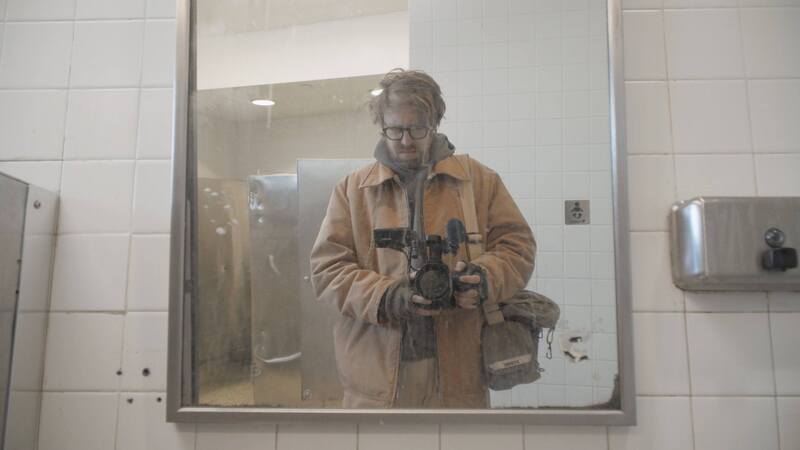
A Good Reason to Look Down
Read Time:7 Minute, 31 Second
MOVIE REVIEW
The History of Concrete
 –


Genre: Documentary, Comedy
Year Released: 2026
Runtime: 1h 41m
Director(s): John Wilson
Writer(s): John Wilson
Cast: John Wilson, Michael Imperioli, Jack Macco
Where to Watch: in select U.S. theaters and available to rent or buy on Apple TV, Prime Video, Fandango at Home, Google Play, and YouTube
RAVING REVIEW: The man who takes chewing gum off New York sidewalks has a machine for the job. John Wilson lets him demonstrate it. The gum has been sitting there long enough for most of us to stop registering it as gum, and the man removing it gets to show what he does about something that bothers practically nobody enough to do anything. THE HISTORY OF CONCRETE can make a whole scene out of that small exchange. The machine works, the man takes pleasure in showing that it works, and there's a spot on the sidewalk you can look at afterward. Wilson's feature is full of people putting more thought into what happens on the ground than the rest of us put into getting across it.
After HOW TO WITH JOHN WILSON ends, concrete makes for a funny choice of subject. It's easy to find and hard to sell as a reason to spend an evening watching a movie. Wilson learns how to improve those odds at a workshop on writing Hallmark movies. The lesson involves recognizable people in a recognizable situation, facing a problem with a resolution the audience can count on. A big-city woman can take a trip to a small town and meet somebody who gives her a reason to stay. You could describe most of the movie before anyone's picked a town. Wilson has a subject so broad that he could walk out his door in any direction and be working on it.
What makes the workshop more than an easy laugh at a familiar formula is the fact that Wilson needs something from it. He has had a television show and now has to explain why this particular movie should exist. In the scenes where he's talking to people who might help get the project made, you get a sense of how strange his method must sound when reduced to a pitch. Saying he'll find out what the movie's about by filming it is a reasonable description of the work. Try putting a dollar figure on that. Wilson lets you hear the business conversation without editing himself into the guy who always knows better. Often, he's the one trying to figure out what would make somebody say yes.
The film does some of the historical work promised by its title. Wilson goes to Rome, where old concrete can be photographed as a reason people cross an ocean. He also spends time around people who work with newer material for a living. The World’s Best Bricklayer competition gives him the chance to film masonry as a timed event. There's something satisfying about watching people for whom a straight line and a good joint are the difference between winning and losing. Usually a building goes up, and the people who know enough to judge the work have moved on by the time the public sees it. Here, Wilson can point the camera at hands and tools and make the whole point of the event how the wall gets made.
The 3D-printed Starbucks in Brownsville, Texas, gives the movie a different way to look at what goes into a building. The walls have visible horizontal ridges from each pass of the printer, and the footage gives you time to see the surface up close. You can recognize the business immediately. The walls are the part you have to get used to, and that's a funny imbalance for a place whose appeal depends in part on knowing what you'll get before you walk in. Wilson gets a good joke out of the building without needing a long speech about it. The camera has already shown the material doing something the sidewalk never called on it to do.
Cori Wapnowska's editing is a big part of why these subject changes work. Wilson's voice takes a moment to get where it's going, giving you time to look around the image before he tells you what he sees in it. Sometimes a word brings a detail into focus a second after you might have noticed it on your own. Sometimes the cut sends you off after the word itself and the sight it brings to mind. The narration depends on how long you're allowed to look. Wilson can sound like a man gathering his thoughts, even when the cut is arranged so precisely that a fraction of a second would change the joke. A passing sign can get the sort of entrance another director would save for an actor.
The other side of that control is how loose he lets a conversation get once he's found somebody worth listening to. Michael Imperioli is the sort of name a person could put near the top of a pitch. In the movie, Wilson talks with him about the concrete outside a window. It's funny how little use that makes of the usual reasons you bring a recognizable actor into a documentary. Imperioli can look at the same stretch of pavement as anybody else and answer in his own time. The scene gets something out of the pause it takes him to do that. Wilson gives the conversation enough room that it plays like something these two men sat down to discuss.
The Hallmark device is funnier when its demands produce footage than when the movie goes back to explaining what a buyer wants. Following another conversation about how to make the project easier to sell can take some of the air out of a scene that has already shown the difficulty. The movie gets more out of the music search. Wilson meets Jack Macco, a liquor sales rep who plays guitar, and follows him long enough to watch him work a room where the audience might be paying more attention to one another than to the stage. Macco has a practical understanding of how much a room wants to hear something it recognizes. He can play a song people know and still find room for one of his own. Watching him do that makes the film's argument about familiarity and getting an audience more plainly than any meeting could.
The feature also has room for a footrace that takes place around a single block in Queens. There's so little to see on a map of the route that spending weeks on it sounds like a joke. Once Wilson is there, the block starts to look like serious equipment. The length of the race comes from how many times people are prepared to go over the same ground. That's a good reason to give it time in a film that could get an easy laugh from the premise and move along. After the trip to Rome and the footage from Brownsville, Wilson finds a use for an ordinary sidewalk that takes a lot longer to get your head around.
The man with the gum machine knows he's succeeded when a spot on the sidewalk looks as ordinary as any other. He could walk away from it and leave nothing anybody would recognize as his work. Wilson can give him something the job itself can't. He can hold the shot long enough for us to see what the guy did, even if getting it right means you can walk by tomorrow without seeing a thing.
Please visit https://linktr.ee/overlyhonestr for more reviews.
Follow me on Letterboxd, Instagram, Twitter, and YouTube. You can also find my social media accounts on most platforms by searching for 'Overly Honest Reviews'.
I’m always happy to hear from my readers; please don't hesitate to say hello or send me any movie questions.
[photo courtesy of MAGNOLIA PICTURES ENTERTAINMENT, BRONXBURGH, CENTRAL PICTURES, PEANUT WORLD PICTURES]
DISCLAIMER:
At Overly Honest Movie Reviews, we value honesty and transparency. Occasionally, we receive complimentary items for review, including DVDs, Blu-rays, CDs, Vinyl Records, Books, and more. We assure you these arrangements do not influence our reviews, as we are committed to unbiased, sincere evaluations. We aim to help you make informed entertainment choices regardless of our relationship with distributors or producers.
Amazon Affiliate Links:
This site also contains Amazon affiliate links. If you purchase through these links, we may receive a commission. This affiliate arrangement does not affect our commitment to honest reviews and helps support our site. We appreciate your trust and support as you navigate these links.


Happy
0 %

Sad
0 %

Excited
0 %

Sleepy
0 %

Angry
0 %

Surprise
0 %
 0
 0


Average Rating