When an Investigation Becomes an Obsession
Read Time:14 Minute, 44 Second
MOVIE REVIEW
Sharky's Machine
 –


Genre: Action, Crime, Drama, Thriller, Neo-Noir
Year Released: 1981, 2026 4K
Runtime: 2h 2m
Director: Burt Reynolds
Writer: Gerald Di Pego, based on the novel by William Diehl
Cast: Burt Reynolds, Rachel Ward, Vittorio Gassman, Brian Keith, Charles Durning, Henry Silva, Bernie Casey, Earl Holliman, Richard Libertini, Darryl Hickman, Joseph Mascolo
Where to Watch: available December 8, 2026; pre-order your copy here: www.toyrobotvideo.com, www.mvdshop.com, or www.amazon.com
RAVING REVIEW: Burt Reynolds spent much of the late 1970s and early 1980s making movies that capitalized on his considerable popularity, often relying on his natural charisma and an easygoing attitude toward the action happening around him. SHARKY'S MACHINE finds him doing something considerably different. In this 1981 crime thriller, Reynolds trades much of his familiar comedic persona for a hardened Atlanta detective investigating a criminal organization with ties to local politics. The film has an impressive supporting cast and a surprisingly dark approach to its material, with an underlying romance that complicates what might otherwise have been a straightforward police investigation. There's plenty to appreciate in Reynolds' ambitions, but the sprawling screenplay and uneven pacing keep the finished movie from being as consistently compelling as its strongest moments suggest.
Reynolds plays Tom Sharky, an Atlanta narcotics detective whose unconventional methods result in a disastrous drug operation and a demotion to the vice squad. His new assignment initially seems like a punishment designed to keep him away from serious police work. An investigation into a high-end prostitution operation quickly reveals something more substantial. Working alongside a group of detectives with distinct personalities, Sharky begins uncovering connections between organized crime and influential figures in the city. What starts as an investigation into an illegal business gradually becomes a much more dangerous confrontation with individuals determined to protect their interests.
The demotion effectively introduces the character because Sharky isn't particularly interested in following rules that interfere with what he considers necessary police work. He's capable and experienced, but his willingness to disregard procedure creates problems that extend beyond the criminals he's pursuing. Reynolds doesn't present him as an especially refined investigator, either. Sharky belongs to a tradition of screen detectives who rely on determination and personal judgment, often putting themselves in situations where their behavior is almost as unpredictable as the people they're investigating. That approach was well established by the time the film arrived, but Reynolds gives the character enough individuality to distinguish him from a straightforward imitation of Clint Eastwood's Harry Callahan.
The title refers to the collection of detectives Sharky assembles around him, a group whose collective abilities become essential to understanding the conspiracy's scope. Brian Keith plays Papa, while Charles Durning appears as Friscoe, and Bernie Casey portrays Arch. Richard Libertini adds another personality as Nosh. The ensemble gives the film an appealing sense of camaraderie, with the officers bringing different attitudes to their work. Reynolds gives the supporting performers room to establish their characters, creating a team that feels more interesting than a collection of anonymous detectives existing solely to assist the leading man.
Charles Durning is particularly well suited to the film's mixture of police frustration and occasional comedy. Friscoe's personality contributes to the sense that these officers have spent years dealing with a profession that rarely rewards patience. Brian Keith brings a different kind of authority to Papa, giving the group someone whose experience can provide perspective on Sharky's impulsiveness. Bernie Casey's Arch offers another contrast, with his interest in philosophy distinguishing him from some of the more abrasive personalities. These differences make the team worth spending time with, although the screenplay doesn't always give every member an equally substantial role in the investigation.
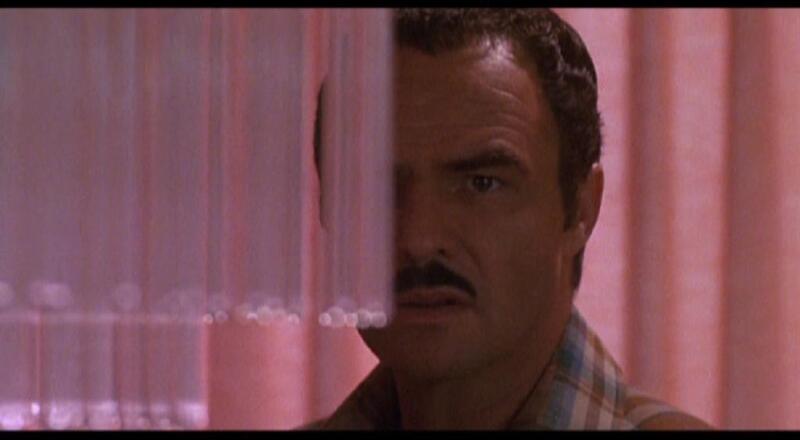
The film takes an interesting turn when Sharky's surveillance work brings him into contact with Dominoe, a high-priced escort played by Rachel Ward. Their relationship develops under circumstances that are uncomfortable for reasons extending beyond the obvious dangers of the investigation. Sharky becomes personally invested in a woman he initially observes from a distance, creating a connection built partly on an image of her he has constructed himself. It's a choice that introduces psychological complications, since his professional responsibility becomes increasingly difficult to separate from his personal desires.
That relationship gives SHARKY'S MACHINE a connection to older films concerned with romantic obsession and the distance between observation and genuine understanding. The premise recalls elements of Alfred Hitchcock's REAR WINDOW and VERTIGO, along with the detective's fascination with an idealized woman in Otto Preminger's LAURA. These comparisons help explain why the film spends considerable time on surveillance and Sharky's changing feelings about Dominoe. Reynolds pursues something more complicated than a conventional romantic subplot, using the detective's position as an observer to examine how easily attraction can develop into imagined intimacy.
The problem is that the extended attention devoted to this relationship also affects the film's momentum. At more than two hours, SHARKY'S MACHINE has room to develop its conspiracy and examine the personal consequences of Sharky's involvement, but the balance between those subjects isn't always comfortable. The surveillance passages ask the audience to spend considerable time with a relationship under unusual constraints. The idea behind those sequences is understandable, particularly given the film's interest in obsession. The amount of time devoted to them occasionally interrupts the urgency established by the criminal investigation.
Rachel Ward's performance has the added responsibility of making Dominoe more than the object of Sharky's fascination. The character occupies a dangerous position within a world where powerful men view women as possessions, and her connection to the investigation makes her particularly vulnerable. Ward's presence gives the romantic material an identity separate from the film's more aggressive police encounters. The screenplay's greater interest in Sharky's perspective, though, limits how independently Dominoe can be understood. Her importance to the story is clear, but the relationship might have benefited from giving her more room outside the detective's increasingly personal interpretation of their connection.
Vittorio Gassman plays Victor, a criminal figure whose influence helps establish the larger danger facing Sharky and his team. Gassman's presence brings a different kind of personality to the film's criminal organization, emphasizing the comfortable authority of someone accustomed to getting what he wants. The connection between organized crime and public influence is essential to the story because the investigation gradually exposes a system that has become much larger than an ordinary prostitution case. The premise lets Reynolds explore how criminal interests can be protected through relationships with people who hold legitimate political power.
Henry Silva makes a memorable addition as Billy Score, one of the film's most threatening figures. Silva had a long career portraying intimidating criminals, and his particular screen presence fits the film's interest in violence that can emerge with very little warning. Billy represents a more immediate physical danger than the broader network of corruption surrounding the investigation. The distinction matters because the film needs recognizable threats operating at different levels. Powerful men may run the larger organization, but someone has to carry out the violence needed to protect it.
SHARKY'S MACHINE becomes especially aggressive when that violence intrudes upon the investigation. Reynolds doesn't approach the story with the same easygoing attitude associated with some of his most commercially successful pictures. The film contains a degree of brutality that places it closer to the police thrillers of the 1970s than to the comedic action movies audiences frequently associated with him. That seriousness is an important part of its identity, even when the screenplay shifts between grim criminal activity and more familiar Reynolds humor. The tonal variation gives the production personality, but it can also make certain transitions feel abrupt.
The decision to set the film in Atlanta adds another interesting element. American crime cinema has frequently returned to New York, Los Angeles, and San Francisco, while SHARKY'S MACHINE takes advantage of a Southern city undergoing considerable economic and architectural development. Its urban environment becomes important to the film's portrayal of wealth and corruption, with modern buildings existing alongside a criminal world that operates through older forms of intimidation. The Atlanta setting also allows Reynolds to move away from the rural Southern environments that had become familiar through several of his earlier films.
Cinematographer William A. Fraker brings considerable experience to the production, having previously worked on ROSEMARY'S BABY and BULLITT. His involvement is particularly well suited to a film that combines character-driven suspense with substantial action sequences. The urban setting requires a different visual approach than Reynolds' more familiar comedy vehicles, and the material offers opportunities to contrast the city's public appearance with the activities behind closed doors. Fraker's experience with crime-oriented filmmaking contributes an important technical foundation to the director's ambitions.
Music is another defining characteristic of SHARKY'S MACHINE, with a soundtrack that draws heavily on jazz and popular vocal performances. Chet Baker, Sarah Vaughan, Joe Williams, Julie London, and Randy Crawford are among the artists associated with the film's music. The selections give the production an identity that differs considerably from the aggressive electronic scores or conventional orchestral arrangements frequently used in action thrillers. That musical approach is especially appropriate for a story incorporating romantic longing and the private emotional lives of characters who otherwise occupy a world dominated by violence.
The soundtrack's relationship with the film is more than period decoration. Jazz has a long association with American crime cinema, particularly through film noir, and its use here connects Reynolds' production with an older tradition of stories about disillusioned detectives. The familiar musical language contrasts with the more contemporary setting and the film's aggressive action. It also contributes to the unusual mixture of influences that make SHARKY'S MACHINE difficult to classify exclusively as an action movie. Reynolds is working with the conventions of several different kinds of crime storytelling, which helps explain both the film's ambitions and some of its structural problems.
The source material comes from William Diehl's 1978 novel, adapted for the screen by Gerald Di Pego. Diehl had worked as a journalist and photographer before turning to fiction, and SHARKY'S MACHINE was his debut novel. Its success established him as a thriller writer, eventually leading to additional books including PRIMAL FEAR. The story's literary background helps explain the number of supporting characters and overlapping criminal interests involved in the film. Translating that scope into a feature-length screenplay creates challenges, especially when the adaptation also devotes considerable attention to Sharky's personal involvement with Dominoe.
Reynolds' involvement as director is particularly interesting when considered alongside the rest of his filmmaking career. SHARKY'S MACHINE was his third feature as a director, following GATOR and THE END. Those earlier productions showed his willingness to work behind the camera, but this project gave him a broader crime story and the chance to pursue a distinctly different tone. The contrast with the comedic vehicles that made him an enormous commercial attraction is significant. He wasn't abandoning the screen personality audiences recognized, but he placed it in a production that demanded a more serious take on his familiar confidence.
The film's production history includes an interesting connection to director John Boorman, who was attached to the project before leaving because of commitments associated with EXCALIBUR. Reynolds ultimately assumed the directing responsibilities, creating a version of the film closely associated with his own screen presence. That history offers an intriguing glimpse at how different SHARKY'S MACHINE might have been under another filmmaker. Boorman's interests and visual sensibilities differed considerably from Reynolds's, and the final production reflects the leading actor's particular understanding of American crime cinema.
One of the film's most famous technical achievements involves a remarkable high-fall stunt performed by veteran stuntman Dar Robinson. The sequence became notable for the considerable height involved and remains an important part of the production's legacy. It's an example of the elaborate practical stunt work that characterized major action filmmaking before computer-generated imagery became routine. The physical demands of that work are worth recognizing, particularly because the achievement required considerable planning and precision. Its place within the film also demonstrates how determined Reynolds was to deliver substantial action alongside the more character-oriented material.
For physical-media collectors, Toy Robot Video's new 4K Ultra HD edition offers a chance to revisit the film through a fresh restoration from the original camera negative. The two-disc release includes both 4K UHD and Blu-ray presentations, with the distributor listing 5.1 surround audio. The restoration is particularly significant for a movie whose production combines extensive location photography with elaborate action sequences. Bringing a title like SHARKY'S MACHINE to UHD also helps preserve an example of American studio filmmaking that hasn't always received the same attention as the most frequently discussed crime thrillers of its period.
The supplemental material is an appealing part of the release, particularly because Toy Robot Video has assembled several newly produced interviews. Screenwriter Gerald Di Pego appears in LET'S GET DI PEGO, providing a direct connection to the screenplay and its literary origins. Actor and stunt performer Dan Inosanto is featured in THE RELUCTANT STUNTMAN, an especially relevant addition given the importance of physical action to the production. Robert Duncan McNeill contributes GET ON THE BUS, while filmmaker Adam Rifkin discusses Reynolds in MY HERO, BURT REYNOLDS. These interviews offer different entry points into the film's creative history.
A new 2K scan of the theatrical trailer is included alongside the original teaser, a television spot, and a behind-the-scenes stills gallery. The release also comes with a slipcover, making it an attractive package for collectors interested in the physical presentation. The variety of interviews is particularly welcome because the film's reputation has often been discussed primarily through Reynolds' involvement. Hearing from people involved in different parts of the production can broaden that conversation, particularly around the screenplay and the work required to bring its more demanding sequences to the screen.
The new edition also arrives at a time when reassessing Reynolds' filmmaking career offers opportunities to look beyond the enormous popularity of his most familiar movies. His talent as a performer was often associated with his willingness to entertain audiences through comedy and physical action. SHARKY'S MACHINE shows an interest in material with a much darker edge. That ambition deserves recognition, even if the film doesn't consistently balance its romantic concerns with the larger crime story. It reveals a filmmaker willing to take a recognizable public image and place it in a considerably less comfortable environment.
SHARKY'S MACHINE has enough distinctive qualities to make it worth revisiting, especially for viewers interested in the evolution of American police thrillers. Reynolds gives the story a tougher personality than audiences might expect from his most popular films, and the supporting cast supplies an impressive collection of recognizable performers. The film's romantic obsession and extended surveillance passages give it an identity beyond conventional police action, although those same elements contribute to a runtime that occasionally feels unnecessarily stretched. The ambition is apparent, even when the pacing and sprawling narrative interfere with the experience. Reynolds clearly wanted to make something more substantial than another entertaining vehicle for his established persona, and SHARKY'S MACHINE remains an interesting example of what happened when he took that chance.
Bonus Materials:
NEW 4K scan and restoration from the original camera negative
NEW Let's Get Di Pego, interview with screenwriter Gerald Di Pego
NEW The Reluctant Stuntman, interview with actor/stuntman Dan Inosanto
NEW Get on the Bus, interview with actor Robert Duncan McNeill
NEW My Hero, Burt Reynolds, interview with filmmaker Adam Rifkin
NEW 2K scan of the theatrical trailer
Teaser trailer
TV Spot
Behind-the-Scenes stills gallery
Please visit https://linktr.ee/overlyhonestr for more reviews.
Follow me on Letterboxd, Instagram, Twitter, and YouTube. You can also find my social media accounts on most platforms by searching for 'Overly Honest Reviews'.
I’m always happy to hear from my readers; please don't hesitate to say hello or send me any movie questions.
[photo courtesy of TOY ROBOT VIDEO, MVD ENTERTAINMENT]
DISCLAIMER:
At Overly Honest Movie Reviews, we value honesty and transparency. Occasionally, we receive complimentary items for review, including DVDs, Blu-rays, CDs, Vinyl Records, Books, and more. We assure you these arrangements do not influence our reviews, as we are committed to unbiased, sincere evaluations. We aim to help you make informed entertainment choices regardless of our relationship with distributors or producers.
Amazon Affiliate Links:
This site also contains Amazon affiliate links. If you purchase through these links, we may receive a commission. This affiliate arrangement does not affect our commitment to honest reviews and helps support our site. We appreciate your trust and support as you navigate these links.


Happy
0 %

Sad
0 %

Excited
100 %

Sleepy
0 %

Angry
0 %

Surprise
0 %
 1
 0

Average Rating