Childhood Ends Behind Closed Doors
Read Time:5 Minute, 49 Second
MOVIE REVIEW
What Tomorrow Brings
 –
– 

Genre: Drama, Family
Year Released: 2026
Runtime: 1h 37m
Director(s): Matthew Engelbert
Writer(s): Matthew Engelbert, Joely Engelbert, Phoebe Engelbert
Cast: Joely Engelbert, Phoebe Engelbert, Jessica Grace, Grace Bydalek, Emmanuel Morgan, Hugh Entrekin, Caden Martel
Where to Watch: on digital platforms July 24, 2026
RAVING REVIEW: Clara spends so much of WHAT TOMORROW BRINGS pretending she has answers that the smallest moments of uncertainty become the most revealing. She can comfort her younger sister, smooth over an awkward conversation, and act as though another unpaid bill is only a temporary inconvenience. None of that means she knows how to keep a household running while finishing high school and carrying grief she’s never been allowed to process. The movie understands the cruelty of expecting a teenager to become dependable simply because every adult around her has stopped being dependable.
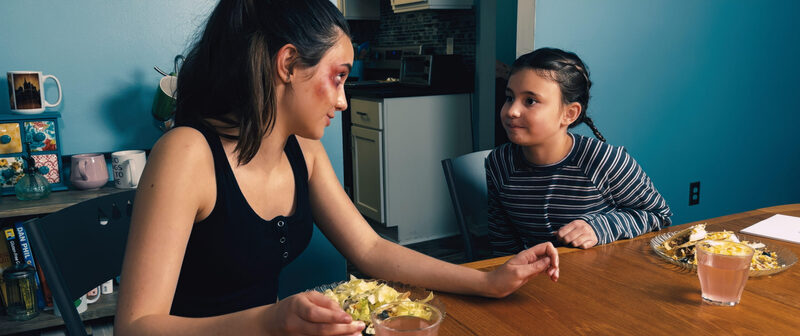
Joely Engelbert plays Clara with a guarded determination that keeps the character from becoming a collection of tragic circumstances. Clara is scared, angry, embarrassed, and exhausted, though she rarely has the freedom to express any of it. Her instinct is to protect Ruby from every painful truth, even when maintaining that protection requires another lie or sacrifice. Joely is most convincing when Clara’s composure begins to crack around the edges. A pause before answering, an attempt to redirect a question, or a smile held a little too long says more than some of the movie’s heavier dialogue.
The relationship between Clara and Ruby gives WHAT TOMORROW BRINGS its strongest focal point. Phoebe Engelbert brings an open, unaffected presence to Ruby, whose trust in her older sister is both comforting and quietly devastating. Their real-life connection helps the shared affection feel immediate without turning every scene into an emotional showcase. Some of the movie’s best stretches simply let them talk, joke with each other, or create a brief pocket of normalcy inside a home that has become unstable. Those moments make the accumulating problems matter because the sisters feel like people worth worrying about rather than devices built to trigger sympathy.
Matthew Engelbert filmed the feature on an iPhone 15 Pro Max and often lets scenes unfold in extended takes rather than cutting between every response. That approach fits a story about someone trapped inside responsibilities she can’t escape. The camera stays close enough to show the discomfort while giving the actors room to find their own timing. It also exposes the limits of the production. Interior lighting can look flat, sound quality shifts between locations, and several compositions have the functional appearance of coverage captured with whatever space was available. The visuals aren't fatal, though they occasionally pull attention away from moments that need complete emotional focus. When you film an entire movie on a cellphone, this is to be expected.
Conversations sometimes continue after their point has landed, while dialogue spells out fears the performances have already communicated. Clara’s troubles also arrive in such steady succession. A broken car, financial pressure, household problems, school demands, relationship strain, and the threat of outside intervention all have a place in her life. The film is strongest when it trusts one problem to sit in the room rather than immediately adding another.
Its handling of the mother is more complicated. WHAT TOMORROW BRINGS wants to acknowledge severe depression without ignoring the damage done when children are left to survive the consequences. That balance is difficult; certain developments push the story toward an emotional extreme that reframes much of what came before, followed by a closing that reaches for reassurance with surprising speed. That turn isn’t dishonest, but it is abrupt. Faith and hope become part of the response, while some of the anger, confusion, and practical fallout receive less room than they deserve.
Grace Bydalek provides a needed energy as Lindsay, an adult who recognizes that Clara’s situation can’t be solved through determination alone. Her scenes introduce the uncomfortable possibility that accepting help could also threaten the sisters’ ability to remain together. Emmanuel Morgan and Caden Martel help establish the portion of Clara’s life that should involve friendship and ordinary teenage exasperation, though those relationships are thinner than the family aspect. The supporting characters often serve a clear narrative purpose instead of developing lives beyond Clara’s crisis. Given how much the movie is already carrying, that narrow focus is understandable, even when it makes the surrounding world feel less complete.
The family-led production gives the movie a lot of sincerity. Matthew, Joely, and Phoebe Engelbert share writing credit, and the film often feels as if it were created through close discussion of how these sisters would speak to one another and what they would hide. That intimacy produces details that are hard to fake. It can also make the screenplay protective of its emotional intentions, emphasizing the message until there’s little room for uncertainty. Viewers are rarely left to decide how a scene feels because the dialogue, music, and narrative direction tend to guide them toward the same conclusion.
WHAT TOMORROW BRINGS offers up the most affecting moments by staying beside two sisters who have been forced into roles neither should have to deal with. Joely Engelbert carries the story with enough restraint to keep its darkest turns from becoming empty provocation. Phoebe Engelbert gives the movie the warmth it needs without softening the danger surrounding Ruby. The technical limitations, crowded hardships, and tonal shifts keep the drama from reaching the depth it’s aiming for. Even so, the bond at its center holds. This is an uneven film with a sincere reason for existing, and its compassion for young people asked to survive adult failures remains difficult to dismiss.
@whattomorrowbringsmovie
@therealjoelyengelbert
@arielzoeyandeli
Please visit https://linktr.ee/overlyhonestr for more reviews.
You can follow me on Letterboxd, Instagram, Twitter, and YouTube. My social media accounts can also be found on most platforms by searching for 'Overly Honest Reviews'.
I’m always happy to hear from my readers; please don't hesitate to say hello or send me any questions about movies.
[photo courtesy of BUFFALO 8]
DISCLAIMER:
At Overly Honest Movie Reviews, we value honesty and transparency. Occasionally, we receive complimentary items for review, including DVDs, Blu-rays, CDs, Vinyl Records, Books, and more. We assure you that these arrangements do not influence our reviews, as we are committed to providing unbiased and sincere evaluations. We aim to help you make informed entertainment choices regardless of our relationship with distributors or producers.
Amazon Affiliate Links:
Additionally, this site contains Amazon affiliate links. If you purchase through these links, we may receive a commission. This affiliate arrangement does not affect our commitment to honest reviews and helps support our site. We appreciate your trust and support as you navigate these links.


Happy
0 %

Sad
0 %

Excited
0 %

Sleepy
0 %

Angry
0 %

Surprise
0 %
 0
0
 0
0

Average Rating