Devotion Slips Quietly Into Possession
Read Time:7 Minute, 6 Second
MOVIE REVIEW
Celeste in the Summer
 –
– 


Genre: Drama, Romance, Science Fiction
Year Released: 2026
Runtime: 12m
Director: Hobby Holmes
Writer: Hobby Holmes
Cast: Alice McMillan, Freddy Carter, Andrew Ashong
Where to Watch: shown at the 2026 HollyShorts Film Festival
RAVING REVIEW: The sun in CELESTE IN THE SUMMER hangs over a day that refuses to end, bathing gatherings, conversations, and affectionate glances in the same warmth. Hobby Holmes allows that comfort to settle before exposing the unease beneath it. Perfection is easy to admire when nobody has asked who controls it.
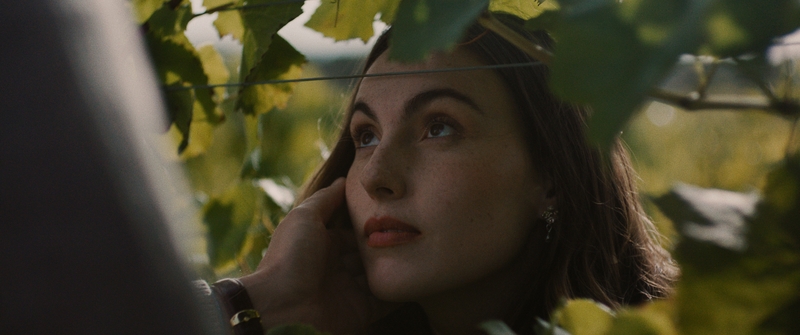
Michael and Celeste appear to be living inside a memory preserved at its most flattering. Friends surround them, stretches of summer ahead without interruption, and nothing seems capable of disturbing their picturesque understanding of their world. The illusion begins weakening once Celeste starts questioning details Michael would rather leave undisturbed. His attention resembles devotion, but its meaning changes when her curiosity threatens the world he expects them to share.
CELESTE IN THE SUMMER wastes little of its 12-minute runtime explaining the mechanics behind that world. Holmes trusts composition, sound, repetition, and the actors’ reactions to communicate what exposition would only make less interesting. The science-fiction element arrives through disruption rather than extravaganza, turning a disagreement into a larger question about memory, identity, and ownership.
Holmes spent years directing music through Mahogany Sessions, and that experience is evident in how confidently the short uses that result. Scenes aren’t organized around obtuse exchanges or information delivered for the audience’s convenience. Music carries emotional changes while small interruptions reveal that the peaceful surface requires maintenance. The score doesn’t just accompany the story. It helps define the invisible structure holding Michael and Celeste in place.
That approach also keeps the concept from overwhelming the relationship. Some shorts become demonstrations of a clever premise, racing toward a final disclosure meant to reorganize everything that came before it. CELESTE IN THE SUMMER is less interested in surprising viewers than in watching affection become threatening once it refuses to accept change. The disturbing part isn’t simply that the environment may be artificial. It’s that Michael considers Celeste’s satisfaction less important than preserving his own idea of her.
Freddy Carter avoids presenting Michael as a monster. His restraint is essential because the character sees himself as protective, loving, and frightened of losing something. Concern slowly takes on the weight of entitlement as Celeste pushes against the limits surrounding her. Carter allows tenderness and possession to occupy the same expression, making Michael’s behavior more unsettling than straightforward cruelty would have been. He doesn’t believe that he’s destroying their relationship. He believes he’s saving it from Celeste’s uncertainty. Control often arrives disguised as care, particularly when one person insists that only they understand what’s best for someone else.
Alice McMillan has the more difficult role because Celeste must gradually recognize the nature of her confinement without turning every realization into a dramatic announcement. McMillan builds that awareness through watchfulness. Her uncertainty doesn’t immediately become fear, and her resistance doesn’t emerge as an abrupt change in personality. Curiosity gives way to discomfort, then to the recognition that even her ability to question the world may be treated as a malfunction.
Celeste’s growing awareness shifts the meaning of the short. Sunlight begins to look oppressive. Faces become part of the enclosure, and the social rituals surrounding the couple take on the quality of events performed because they’ve always happened that way; what first appeared spontaneous starts feeling rehearsed, not necessarily by the people inside the day, but by the person determined to keep it intact.
The presence of friends makes the situation more potent than placing Michael and Celeste alone in a fabricated environment. Their relationship exists within a functioning world containing music, food, conversation, and apparent history. Those details create the impression of a complete life while raising a more troubling question about whether Celeste has ever been allowed to experience anything outside Michael’s preferred version of happiness.
Holmes doesn’t provide a major reinvention of the more standard genre material, and the twist becomes somewhat predictable once the rules begin revealing themselves. His distinction lies in where he places the emotional emphasis. Michael’s mistake isn’t limited to creating or maintaining an impossible world. He’s confused between remembering someone and knowing them. His version of Celeste is valuable because she remains attached to a particular moment, while the real measure of her personhood is the ability to change beyond anything he intended.
That gives CELESTE IN THE SUMMER relevance beyond its speculative premise. Relationships can become prisons without futuristic technology when one person demands that another remain unchanged. Michael wants reassurance rather than mutual understanding. Celeste’s independence frightens him because it creates a future he can’t arrange in advance.
The short’s compressed structure supports its escalating tension, though it leaves Celeste’s life slightly underdeveloped. McMillan communicates what Celeste feels as the truth emerges, but there’s limited space to establish who she understands herself to be before that discovery. We recognize her desire for autonomy without learning much about the identity she hopes to claim once the surrounding design falls away.
Michael consequently becomes the more psychologically defined character, even though Celeste provides the story’s morality. His fear, reasoning, and need for control are shown through the structure itself. Her existence is initially presented as part of his mystery, which risks repeating the very imbalance the short is criticizing. A little more time devoted to Celeste’s perspective would have made her awakening feel like the beginning of a life rather than primarily the collapse of his fantasy.
The limited runtime also means the relationship must move quickly from tenderness into confrontation. Carter and McMillan make that transition believable, but another moment, exchange, or dive into what this all means before the situation deteriorates would have given their attachment greater history. The film tells us that this reality represents something Michael can’t bear to lose. It provides fewer opportunities to understand what Celeste once found meaningful within it.
Holmes wisely resists filling those spaces with illustrative discussion. CELESTE IN THE SUMMER depends on uncertainty, and spelling out every single aspect would reduce its emotional pull into more of a technical one. The unanswered details reinforce Celeste’s experience because she’s also trying to determine which memories, sensations, and relationships can be trusted.
The short ends before it can harden into a lecture. Its final moments may be predictable, but inevitability suits a story about someone trying to prevent change through control. Michael has built a condition that can’t last because genuine connection requires the possibility of refusal. A person who can’t leave can never really choose to stay.
Summer is supposed to pass. By denying that, Holmes turns warmth into confinement and nostalgia into a locked room. CELESTE IN THE SUMMER doesn’t completely escape the familiar machinery of its genre, but McMillan and Carter give that an emotional pulse. Its world is beautiful enough to tempt the eye and controlled enough to make remaining there unbearable.
Please visit https://linktr.ee/overlyhonestr for more reviews.
You can follow me on Letterboxd, Instagram, Twitter, and YouTube. My social media accounts can also be found on most platforms by searching for 'Overly Honest Reviews'.
I’m always happy to hear from my readers; please don't hesitate to say hello or send me any questions about movies.
[photo courtesy of REBEL YEAH!]
DISCLAIMER:
At Overly Honest Movie Reviews, we value honesty and transparency. Occasionally, we receive complimentary items for review, including DVDs, Blu-rays, CDs, Vinyl Records, Books, and more. We assure you that these arrangements do not influence our reviews, as we are committed to providing unbiased and sincere evaluations. We aim to help you make informed entertainment choices regardless of our relationship with distributors or producers.
Amazon Affiliate Links:
Additionally, this site contains Amazon affiliate links. If you purchase through these links, we may receive a commission. This affiliate arrangement does not affect our commitment to honest reviews and helps support our site. We appreciate your trust and support as you navigate these links.


Happy
0 %

Sad
0 %

Excited
0 %

Sleepy
0 %

Angry
0 %

Surprise
0 %
 0
0
 0
0

Average Rating