Revenge Is Only the Beginning
Read Time:7 Minute, 50 Second
TV SERIES REVIEW
Sword of the Demon Hunter: Kijin Gentosho (Kijin Gentôshô)
 –


Genre: Historical Fantasy, Action, Supernatural, Drama, Anime
Year: 2025, 2026
Runtime: 12h (24 episodes)
Director: Kazuya Aiura
Writer: Deko Akao (Series Composition); based on the novels by Motoo Nakanishi
Cast: Taku Yashiro, Reina Ueda, Saori Hayami, Ai Kayano, Saya Aizawa, Seiichiro Yamashita, Hiromu Mineta, Koji Yusa
Where to Watch: available on Blu-ray in the UK on October 26, 2026, or in the US on October 27; pre-order your copy here: www.amazon.com
RAVING REVIEW: Living for centuries sounds like an incredible deal until you realize everyone you care about has an expiration date, and you're the unfortunate bastard who has to keep on going forever. SWORD OF THE DEMON HUNTER takes an anime premise involving supernatural creatures and extraordinary abilities. It starts with a swordsman seeking revenge, then becomes a personal examination of time, loss, and what happens when someone becomes so consumed by the past that moving forward feels impossible. Based on Motoo Nakanishi's novels, this 24-episode series combines fantasy with an unexpectedly thoughtful story about humanity. It has plenty of demon hunting, but the battles matter less than the people caught between them.
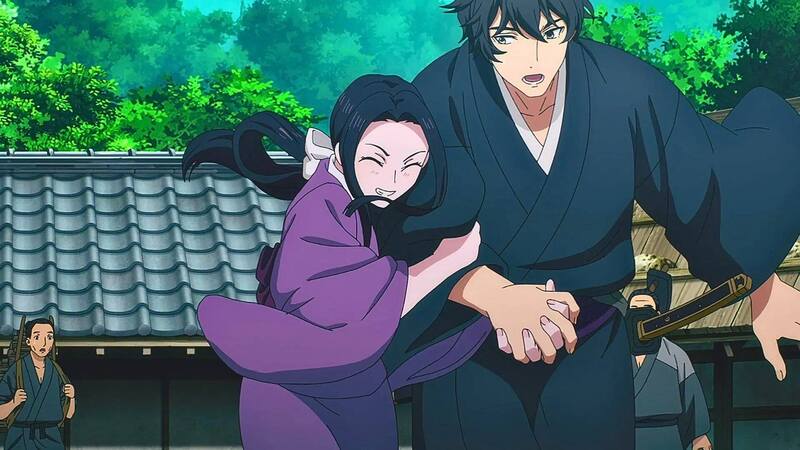
The story begins in Japan's Edo period, following siblings Jinta and Suzune as they escape their abusive father and find refuge in the mountain village of Kadono. Their arrival offers the possibility of a better life, and Jinta eventually trains to become the guardian of the village's shrine maiden. He takes the responsibility seriously, especially given his feelings for the young woman he's sworn to protect. Unfortunately, his encounter with a powerful demon introduces a disturbing prophecy involving a future Demon God, setting events in motion that will fundamentally alter his existence.
The extended premiere spends nearly an hour establishing these relationships, and that extra time helps solidify expectations. Rather than throwing Jinta into an endless series of supernatural confrontations, the opening introduces the people, responsibilities, and emotional attachments that give his journey meaning. Jinta and Suzune's relationship is vital to the series because it shows how love and loyalty can become complex as circumstances change. People make decisions others can’t understand or accept.
As the narrative expands, Jinta becomes Jinya, a wandering swordsman whose extraordinary circumstances stretch his journey across generations. His search for answers and his determination to confront the future he's been warned about give the series its overarching direction. The series wisely refuses to make every episode another straightforward step toward an inevitable confrontation. Instead, his travels introduce smaller stories involving supernatural encounters, personal tragedies, ordinary people, and the complicated relationships between humans and demons.
While certain detours contribute directly to the larger narrative, others initially seem like detours into the lives of people Jinya encounters along the way. These stories provide different perspectives on love, regret, obsession, and the decisions people make when confronted with circumstances beyond their control. The series doesn't assume every demon is an irredeemable monster, nor does it suggest humanity guarantees moral superiority. Sometimes the distinction matters far less than how individuals behave.
Time also adds emotional weight to these encounters. People who might initially seem like temporary supporting characters become reminders that Jinya's existence works differently from everyone else's. Relationships change, communities evolve, and the world keeps moving whether he's ready to accept it. It's an interesting approach to immortality because the story isn't particularly concerned with presenting extraordinary longevity as some fantastic reward. The consequences become apparent through the ordinary experiences he's forced to watch from an increasingly unusual perspective.
Taku Yashiro's performance as Jinya helps maintain that emotional continuity. The character carries himself with the restraint expected of a wandering swordsman. The performance doesn't reduce him to another perpetually serious anime protagonist whose entire personality consists of looking intimidating while carrying a weapon. Frustration lies beneath his composure, and the contrast between his outward determination and the more complicated feelings driving him grows increasingly important as the story develops.
The supporting characters also help prevent the series from becoming too absorbed in Jinya's suffering. Figures such as Ofuu, Naotsugu Miura, and Natsu introduce relationships and personal concerns that extend beyond his original mission. Their presence gives the narrative opportunities to explore companionship, responsibility, and the possibility of finding meaning in circumstances that weren't part of someone's original plans. Those interactions are often more interesting than confrontations with supernatural enemies because they challenge Jinya in ways swinging a sword can't resolve.
SWORD OF THE DEMON HUNTER makes effective use of its historical setting. The progression through different periods of Japanese history isn't just a convenient excuse to introduce new costumes and locations. Changes in society, traditions, and everyday life constantly remind us that the world Jinya once understood is gradually becoming something else. For someone whose identity is so closely tied to earlier experiences, adapting to those changes carries an added burden. The historical developments also create an interesting contrast with the supernatural material, allowing ancient beliefs and extraordinary creatures to exist alongside a society undergoing its own transformation.
The music supports the series, with compositions from Ryuichi Takada, Keiichi Hirokawa, and Kuniyuki Takahashi helping establish the production's blend of historical drama and supernatural fantasy. The opening and closing themes also change during the season, accompanying the narrative's progression into a new stage. These choices help distinguish the show's evolution without disconnecting it from the emotional foundation established in its earliest episodes.
I also appreciate that the series allows its protagonist to exist beyond revenge. His original motivation remains important, but the people he encounters and the experiences accumulated throughout his travels gradually complicate the idea that his entire existence can be defined by one objective. It's a more interesting direction than simply introducing progressively stronger opponents until the inevitable final confrontation. Jinya's circumstances create plenty of opportunities for violence. Questions about why he keeps fighting give those confrontations real importance.
Covering a story that stretches across generations means some relationships and developments get more attention than others, and the transitions between individual stories occasionally leave you wanting more time with certain characters. The series can also become so invested in its mythology that the immediate emotional impact takes a temporary back seat. These aren't overwhelming problems, but they show how difficult it is to adapt a sprawling literary narrative into a single television season.
For physical-media collectors, Acorn Media International's Blu-ray release brings all 24 episodes together on two discs, with a runtime of about 720 minutes. The set includes both the original Japanese-language presentation with English subtitles and an English-dubbed version, so viewers can choose the version that suits their preferences. Supplemental material includes clean opening and closing animations, along with Japanese promotional videos. While I watched with subtitles, I will admit that anime is one of the few exceptions where I think dubs are okay.
SWORD OF THE DEMON HUNTER begins with a young man whose world is shaped by family, duty, and the promise of a future he believes he understands. Its real achievement is showing how dramatically those ideas can change when someone is forced to endure more than any ordinary person was ever meant to. The series offers exciting supernatural encounters, compelling supporting characters, and enough historical intrigue to make the journey worthwhile, even when the animation doesn't fully deliver on the potential of its action sequences.
But what stayed with me about the series is its understanding that continuing to live isn't necessarily the same thing as having something to live for. Jinya's sword can defeat demons, but it can't prevent the world from changing, preserve every relationship, or undo the decisions that brought him to this point. For a story that initially presents itself as another supernatural revenge adventure, that's a considerably more interesting burden to place on its hero.
Please visit https://linktr.ee/overlyhonestr for more reviews.
Follow me on Letterboxd, Instagram, Twitter, and YouTube. You can also find my social media accounts on most platforms by searching for 'Overly Honest Reviews'.
I’m always happy to hear from my readers; please don't hesitate to say hello or send me any movie questions.
[photo courtesy of ACORN MEDIA INTERNATIONAL, YOKOHAMA ANIMATION LAB, FUTABASHA, MAINICHI BROADCASTING SYSTEM (MBS)]
DISCLAIMER:
At Overly Honest Movie Reviews, we value honesty and transparency. Occasionally, we receive complimentary items for review, including DVDs, Blu-rays, CDs, Vinyl Records, Books, and more. We assure you these arrangements do not influence our reviews, as we are committed to unbiased, sincere evaluations. We aim to help you make informed entertainment choices regardless of our relationship with distributors or producers.
Amazon Affiliate Links:
This site also contains Amazon affiliate links. If you purchase through these links, we may receive a commission. This affiliate arrangement does not affect our commitment to honest reviews and helps support our site. We appreciate your trust and support as you navigate these links.


Happy
0 %

Sad
0 %

Excited
0 %

Sleepy
0 %

Angry
0 %

Surprise
0 %
 0
 0

Average Rating