Revolution, Delusion, and the Death of Certainty
Read Time:6 Minute, 18 Second
MOVIE REVIEW
The Year Before the War (Gads pirms kara)
 –
– 

Genre: Drama, Historical Thriller, Surrealist Fantasy
Year Released: 2021, 2026
Runtime: 1h 35m
Director(s): Dāvis Sīmanis
Writer(s): Dāvis Sīmanis, Tabita Rudzāte, Uldis Tīrons
Cast: Petr Buchta, Inga Siliņa, Ģirts Ķesteris, Lauris Dzelzītis
Where to Watch: premieres exclusively on IndiePix Unlimited on June 5, 2026
RAVING REVIEW: THE YEAR BEFORE THE WAR opens like a warning disguised as a hallucination. Before the film introduces philosophy, war, nationalism, or revolution, it establishes a sense of instability. Ice cracks. Bodies drift through frozen landscapes. Crowds gather with the energy of people unknowingly approaching catastrophe. Dāvis Sīmanis doesn’t frame pre-World War I Europe as a world on the verge of collapse in a historical sense. He presents it as a civilization already infected long before the first trench is dug.
That approach gives the film an uneasy atmosphere from the start. Rather than constructing a straightforward historical drama, Sīmanis builds something closer to a wandering political nightmare, moving through Europe in fragments, symbols, encounters, and interruptions. The result often feels like silent-era expressionism colliding with theater and historical satire. Sometimes it’s hypnotic. Sometimes it’s frustratingly opaque. Nearly all of it feels intentionally disorienting.
The story follows a Latvian doorkeeper who drifts through a rapidly destabilizing Europe in 1913 while crossing paths with historical figures including Freud, Lenin, Trotsky, Stalin, Hitler, Kafka, and Mata Hari. That could easily become gimmicky or unbearably self-important, especially given how many modern historical allegories rely on audiences recognizing famous names rather than engaging with meaningful ideas. Sīmanis mostly avoids that trap by treating these figures less like realistic portrayals and more like distorted ideological ghosts haunting the edges of a dying continent.
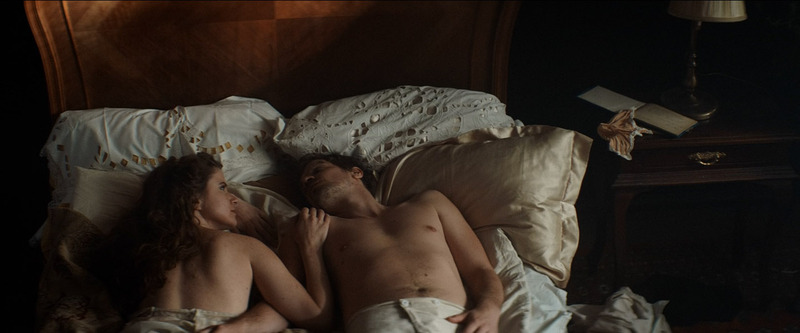
Shot largely in black-and-white with carefully controlled compositions, THE YEAR BEFORE THE WAR frequently looks stunning without relying on prestige-drama aesthetics. Sīmanis and cinematographer Andrejs Rudzāts create imagery that feels cold and slightly unreal, even during moments grounded in physical environments. Faces emerge from shadows like fragmented memories. Streets feel trapped between centuries. Rooms appear either too large or too cramped, depending on the scene's state. The visual language constantly reinforces the sense that Europe itself is psychologically unraveling before the audience’s eyes.
What makes the film so interesting is how little interest it has in historical reassurance. There’s no comforting sense that viewers are safely looking backward at mistakes already understood and resolved. Sīmanis approaches 1913 as a moment when dangerous ideologies, social anxieties, nationalism, and intellectual extremism compete for control of the future, while ordinary people barely understand the machinery swallowing them. Hans becomes less of a traditional protagonist and more of a wandering observer trapped inside forces larger than himself. He moves through revolutions, political circles, and surreal encounters without ever controlling his own direction.
Hans repeatedly shifts between names, roles, and environments as if his sense of self is dissolving alongside the old European order. Sīmanis clearly wants the character to represent the confusion of individuals caught between collapsing traditions and emerging extremism. At times, the metaphor works beautifully, particularly when he appears detached from the historical madness surrounding him, even as he is gradually consumed by it.
At other times, though, the film’s symbolism starts to overwhelm its core emotion. THE YEAR BEFORE THE WAR occasionally becomes so committed to allegory, references, and abstraction that the human dimension begins slipping away. Certain scenes feel less like dramatic storytelling and more like intellectual exercises designed to provoke interpretation rather than engagement. Freud’s appearances, especially, risk becoming almost like caricatures, and there are moments when the dialogue leans so heavily into symbolic significance that the film starts to sound more impressed by its ideas than invested in making them resonate.
Sīmanis clearly understands the traditions he draws on, particularly German expressionism, Soviet montage-era aesthetics, and early twentieth-century avant-garde experimentation. Rather than merely referencing those influences, he uses them to reinforce the film’s thematic obsession with historical fragmentation and ideological distortion. THE YEAR BEFORE THE WAR often feels like it exists outside time itself, as though the audience is watching Europe remember itself incorrectly while still moving toward inevitable destruction.
Petr Buchta gives the film exactly the kind of performance it needs. Hans isn’t written as a psychologically transparent character, so Buchta has to carry much of the emotional ambiguity through presence rather than dialogue. He spends much of the film looking overwhelmed, exhausted, uncertain, or emotionally disconnected, which fits the movie’s larger themes about identity erosion and helplessness. The performance works best when the film allows silence and visual storytelling to dominate rather than forcing Hans into overtly symbolic exchanges.
What ultimately keeps the film afloat is the sense that it’s wrestling with something genuinely difficult instead of simply decorating itself with historical imagery. Beneath the surrealism and stylization, THE YEAR BEFORE THE WAR is fundamentally about societies preparing themselves emotionally for catastrophe long before violence arrives. The film repeatedly returns to ideas surrounding radicalization, public anxiety, false certainty, and the seductive nature of revolutionary identity. Watching it today inevitably evokes uncomfortable parallels, even when the film avoids direct commentary on the present. Being made before the current administration's term, this would have felt a little out of place back in 2021, but with hindsight and the current collapse of perceived democracy in the US, you can’t help but see it.
THE YEAR BEFORE THE WAR succeeds far more often than it fails because Sīmanis approaches history as something unstable, frightening, and almost psychologically contagious rather than safely preserved inside textbooks. The film doesn’t present Europe’s collapse into war as a historical lesson with obvious moral conclusions. Instead, it depicts a civilization slowly surrendering to paranoia, extremism, ego, and ideological performance, while ordinary individuals lose their identities as they try to survive the surrounding chaos.
That perspective gives the film an unsettling relevance that lingers long after it ends. THE YEAR BEFORE THE WAR may not always be easy to follow at times, but it remains absorbing because it feels driven by genuine artistic conviction rather than calculated prestige. Sīmanis creates a fantasy that refuses comfort, coherence, or simplification, choosing instead to immerse viewers in a fractured world already preparing for self-destruction.
Please visit https://linktr.ee/overlyhonestr for more reviews.
You can follow me on Letterboxd, Instagram, Twitter, and YouTube. My social media accounts can also be found on most platforms by searching for 'Overly Honest Reviews'.
I’m always happy to hear from my readers; please don't hesitate to say hello or send me any questions about movies.
[photo courtesy of INDIEPIX FILMS]
DISCLAIMER:
At Overly Honest Movie Reviews, we value honesty and transparency. Occasionally, we receive complimentary items for review, including DVDs, Blu-rays, CDs, Vinyl Records, Books, and more. We assure you that these arrangements do not influence our reviews, as we are committed to providing unbiased and sincere evaluations. We aim to help you make informed entertainment choices regardless of our relationship with distributors or producers.
Amazon Affiliate Links:
Additionally, this site contains Amazon affiliate links. If you purchase through these links, we may receive a commission. This affiliate arrangement does not affect our commitment to honest reviews and helps support our site. We appreciate your trust and support as you navigate these links.


Happy
0 %

Sad
0 %

Excited
0 %

Sleepy
0 %

Angry
0 %

Surprise
0 %
 0
0
 0
0

Average Rating