The Truth Is Bigger Than the Mystery
Read Time:8 Minute, 55 Second
MOVIE REVIEW
Disclosure Day
 –


Genre: Science Fiction, Mystery, Thriller, Drama
Year Released: 2026
Runtime: 2h 25m
Director: Steven Spielberg
Writers: David Koepp, Steven Spielberg (Story)
Cast: Emily Blunt, Josh O'Connor, Colin Firth, Eve Hewson, Colman Domingo, Wyatt Russell, Henry Lloyd-Hughes, Elizabeth Marvel
Where to Watch: available now; order your copy here: www.amazon.com
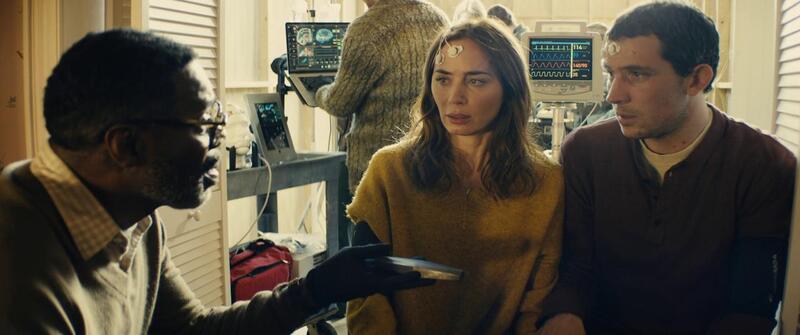
RAVING REVIEW: Steven Spielberg has spent a considerable portion of his career imagining what might happen if humanity discovered that it wasn't alone in the universe. What's interesting about his return to the subject with DISCLOSURE DAY is that the discovery itself has already been made. The people in positions of authority know considerably more than the rest of us, and the movie concerns itself with who gets to decide when everyone else is entitled to that information. It's a premise that gives Spielberg room to revisit some of his familiar interests from a different perspective, and I can appreciate the ambition behind a science fiction movie that wants to address something more complicated than our fascination with extraterrestrial life.
Emily Blunt plays Margaret Fairchild, a television meteorologist whose ability to communicate with her audience takes a rather unexpected turn during a live broadcast. She begins producing sounds that she can't explain, and the implications extend well beyond the embarrassment of something going wrong on television. A profession built around interpreting information and making it understandable to the public becomes an amusingly appropriate occupation for someone experiencing something that defies her own understanding. There's also a frightening vulnerability in the circumstances, given that Margaret has an audience witnessing something happening to her before she's had the chance to comprehend it herself.
Josh O'Connor plays Daniel Kellner, a cybersecurity specialist whose professional knowledge has put him in possession of information that certain individuals would prefer never became public. The distinction between the two characters is important because Margaret's experiences are involuntary, whereas Daniel has made a conscious decision to put himself in danger. His actions carry consequences for people who haven't necessarily volunteered to participate in his plans. The screenplay connects their circumstances to events from their childhoods, giving the pursuit a personal significance beyond Daniel's desire to expose an enormous deception. Their respective journeys provide the framework for the mystery, with the audience having to determine how much of what each character understands about their own life can be trusted.
Putting these two people at the center of the story also allows Spielberg to explore how we communicate. Margaret has spent years talking to people she'll never meet through a camera, and Daniel works in a field in which protecting or restricting access to information is part of the job. Their occupations represent different relationships with the dissemination of knowledge. Neither possesses the authority ordinarily associated with decisions that affect the entire planet, which is precisely why their involvement matters. The film places that responsibility in the hands of individuals outside the institutions that have appointed themselves the guardians of the truth.
David Koepp's screenplay occupies an interesting position within Spielberg's body of work. The two previously collaborated on JURASSIC PARK, THE LOST WORLD: JURASSIC PARK, and WAR OF THE WORLDS, movies in which humanity's understanding of its place in nature is challenged in dramatic ways. DISCLOSURE DAY shares some of that fascination with the limits of human knowledge, particularly the dangerous assumption that possessing scientific information gives someone the right to control another living thing. The difference here is that access to the information itself drives the conflict. Daniel's ability to make what he knows available to the world is potentially more consequential than his ability to escape the people pursuing him.
There's a recognizable political dimension to that conflict without the movie needing to associate its conspiracy with a specific political party. The relationship between private enterprise and government secrecy raises questions about accountability that exist independently of the science fiction premise. When responsibilities are distributed between public institutions and private organizations, the public can have an extraordinarily difficult time determining who is actually responsible for a particular decision. The organization pursuing Daniel benefits from the secrecy surrounding its activities, and the possibility of public scrutiny threatens its position. Spielberg gives the audience a fairly clear moral orientation here, placing our sympathies with those attempting to expose the deception.
The structure of the movie is more complicated than that moral position. Much of the running time is devoted to the pursuit of Margaret and Daniel, with the significance of their connection emerging as additional information becomes available. That approach creates competing demands on the screenplay. A chase requires an immediate sense of danger, whereas investigating the characters' pasts requires opportunities to consider what has happened to them. There's a considerable amount of information to absorb, and each explanation has to serve both the developing relationships and the larger mystery. The amount of material being handled makes the story more elaborate than its fundamental question requires.
Colin Firth's Noah Scanlon represents the opposition to Daniel's efforts, and his casting is an interesting departure from the associations many viewers have with Firth. His character occupies a position from which deception can be treated as a necessary part of conducting business. The personal convictions of an individual working within such an organization become particularly relevant when the supposed justification for secrecy is the protection of humanity. Someone has to enforce that secrecy, and the harm inflicted in its name becomes increasingly difficult to reconcile with the purported reason for maintaining it. The character gives a recognizable human presence to an antagonist that might otherwise be represented almost exclusively by armed personnel and institutional resources.
Margaret's unusual capacity to experience other people's emotions takes the movie in a direction that distinguishes it from a more conventional conspiracy thriller. Spielberg's interest in empathy becomes part of the science fiction concept, with the possibility of understanding someone else's emotional experience extending beyond ordinary communication. Imagine what such an ability would mean for the relationships we maintain with people around us. We regularly make decisions based on assumptions about what other people are thinking, and even our closest relationships depend on how honestly we can communicate. Margaret's circumstances introduce a fascinating complication to that process because she has access to feelings that someone might be unwilling or unable to express.
The difficulty with extending that idea to humanity as a whole is that understanding another person's suffering doesn't necessarily compel someone to act compassionately. Knowledge and behavior are separate things, and the ability to recognize harm has never guaranteed that people will refrain from causing it. DISCLOSURE DAY approaches empathy with a degree of optimism that's consistent with Spielberg's interest in finding humanity within extraordinary circumstances. It's an admirable sentiment, though the implications of that optimism deserve careful examination when the movie deals with institutions that have deliberately deprived people of the ability to make informed decisions. The possibility of greater understanding is compelling enough without treating it as an uncomplicated remedy for human conflict.
Spielberg also reunited with cinematographer Janusz Kamiński and composer John Williams, collaborators whose contributions have helped define much of his filmmaking career. Williams' involvement is particularly relevant given the importance music has played in Spielberg's previous encounters with extraterrestrial life. In CLOSE ENCOUNTERS OF THE THIRD KIND, music becomes a means of establishing communication when spoken language is inadequate. DISCLOSURE DAY returns to the limitations of speech through Margaret's experiences, albeit with a very different dramatic purpose. The sounds emerging from a person whose livelihood depends on speaking intelligibly introduce physical unease to a concept that could easily have been approached exclusively through visual effects.
It would be difficult to separate DISCLOSURE DAY from the movies Spielberg made earlier in his career, but the comparison that interests me most extends outside his science fiction work. THE POST dealt with the consequences of publishing information that powerful people were determined to suppress. Its conflict revolved around the responsibility that comes with access to that information, particularly when making it public carried significant personal risks. DISCLOSURE DAY expands the potential audience for such a revelation to everyone on Earth. The scale is considerably different, though the ethical question of knowledge ownership is remarkably similar.
I appreciate that Spielberg remains interested in making original science fiction movies with substantial ideas behind them, especially when he could easily revisit one of the numerous properties associated with his career. DISCLOSURE DAY has enough going on beneath its extraterrestrial premise to warrant a discussion that extends beyond the mechanics of its mystery. Its appeal as a thriller and its ambitions as a statement about humanity don't always require the same kind of storytelling, and bringing those interests together makes for a particularly demanding undertaking. For all the attention given to the possibility of life somewhere beyond our planet, the question Spielberg leaves us considering concerns the people who are already here. What responsibility do we have to each other when we possess a truth that could change somebody else's life? That's a question worth considering whether or not we ever establish contact with another civilization.
Please visit https://linktr.ee/overlyhonestr for more reviews.
Follow me on Letterboxd, Instagram, Twitter, and YouTube. You can also find my social media accounts on most platforms by searching for 'Overly Honest Reviews'.
I’m always happy to hear from my readers; please don't hesitate to say hello or send me any movie questions.
[photo courtesy of UNIVERSAL PICTURES, AMBLIN ENTERTAINMENT, DENTSU, NEW ZEALAND FILM COMMISSION, QUÉBEC FILM & TV PRODUCTION TAX CREDIT]
DISCLAIMER:
At Overly Honest Movie Reviews, we value honesty and transparency. Occasionally, we receive complimentary items for review, including DVDs, Blu-rays, CDs, Vinyl Records, Books, and more. We assure you these arrangements do not influence our reviews, as we are committed to unbiased, sincere evaluations. We aim to help you make informed entertainment choices regardless of our relationship with distributors or producers.
Amazon Affiliate Links:
This site also contains Amazon affiliate links. If you purchase through these links, we may receive a commission. This affiliate arrangement does not affect our commitment to honest reviews and helps support our site. We appreciate your trust and support as you navigate these links.


Happy
0 %

Sad
0 %

Excited
0 %

Sleepy
0 %

Angry
0 %

Surprise
0 %
 0
 0


Average Rating