Revenge Comes With Complications
Read Time:8 Minute, 38 Second
MOVIE REVIEWS
Ten Women in Black (Ten Dark Women) (Kuroi jûnin no onna)
 –
– 


Genre: Dark Comedy / Crime / Drama
Year Released: 1961, 2026 Blu-ray
Runtime: 1h 43m
Director(s): Kon Ichikawa
Writer(s): Natto Wada
Cast: Fujiko Yamamoto, Mariko Miyagi, Tamao Nakamura, Kyôko Kishida, Eiji Funakoshi, Keiko Kishi, Jūzō Itami
Where to Watch: available now; order your copy here: www.radiancefilms.co.uk, www.mvdshop.com, or www.amazon.com
RAVING REVIEW: Kaze's greatest talent isn't keeping a wife and nine mistresses. It's somehow managing to act genuinely confused that any of them might eventually become angry about the arrangement. Eiji Funakoshi plays that bewilderment so well in TEN WOMEN IN BLACK that some of the movie's funniest moments come from watching a man encounter the completely predictable consequences of his own behavior and react as though everyone else has suddenly become unreasonable.
That gives Kon Ichikawa's 1961 dark comedy a wonderfully strange foundation. Television producer Kaze has built an entire personal life around women putting up with him, and the women know far more about one another than he'd like. Eventually, his wife Futaba and the nine mistresses reach roughly the same conclusion about what should be done with him, and murder begins sounding like a reasonable group activity.
Reasonable is doing a lot of work there, because TEN WOMEN IN BLACK operates in a world where nearly everyone approaches outrageous situations with surprising calm. That's a big part of what makes it funny. Ichikawa doesn't need people screaming every punchline or constantly reminding us how ridiculous the situation has become when a perfectly composed conversation about killing someone can be far funnier.
Natto Wada's screenplay also refuses to make Kaze into some irresistible romantic figure whose appeal explains why ten women keep returning to him. He's charming enough when necessary, but there's something almost aggressively ordinary about him. The question of why all these women tolerate this relationship becomes part of the joke, especially when Kaze appears considerably less interested in examining himself than in figuring out why everybody has become so difficult.
Funakoshi understands exactly how far to push that quality. He doesn't present Kaze as an obvious monster, which would make everything considerably simpler, and he isn't secretly lovable enough to excuse his behavior. He's selfish, careless, strangely passive, and so accustomed to having women rearrange their lives around him that their resentment almost registers as an inconvenience.
The women are considerably more interesting when they're together. Fujiko Yamamoto gives Futaba a level of control that makes her particularly effective opposite Kaze. At the same time, Mariko Miyagi, Tamao Nakamura, Kyôko Kishida, Keiko Kishi, and the rest of the ensemble continually shift the balance between solidarity and competition. These women may share a problem, but that doesn't erase jealousy, desire, resentment, or the fact that several of them still want the exact man they're discussing getting rid of.
That's where Wada's writing becomes sharper than the basic revenge setup suggests. TEN WOMEN IN BLACK isn't simply cheering as a group of mistreated women decides they've had enough, nor does it turn them into hysterical villains because they've crossed an obvious line. Their situation is messier than that, and the movie recognizes how thoroughly Kaze's relationships have pushed them to see one another as rivals, even as they try to work together.
I'd like the individual women to have more room to emerge from the group. With ten women occupying the premise, some inevitably register far more strongly than others, and several can start to feel like additional pieces of the same joke rather than people with equally defined relationships to Kaze. At 103 minutes, there isn't enough space to give everyone the same attention, but another layer of distinction could have made the ensemble considerably stronger.
That weakness matters because the movie's ideas about gender and dependence are far more interesting than the murder plot's mechanics alone. These women have jobs, personalities, and lives beyond Kaze, yet their relationships with him keep pulling them into the same ridiculous orbit. The contradiction gives the comedy something uncomfortable underneath it, because recognizing that he's terrible for them apparently isn't enough to make walking away easy.
The workplace adds another layer. Kaze is a television producer surrounded by the machinery and personalities of a rapidly expanding entertainment business, and Ichikawa repeatedly finds comedy in the artificiality surrounding him. People create stories professionally while maintaining elaborate fictions in their personal lives, and relationships can begin feeling as interchangeable as whatever happens to be scheduled next.
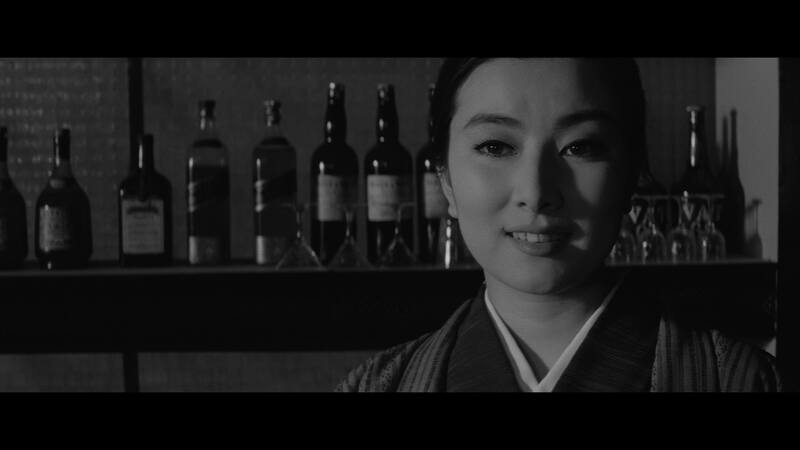
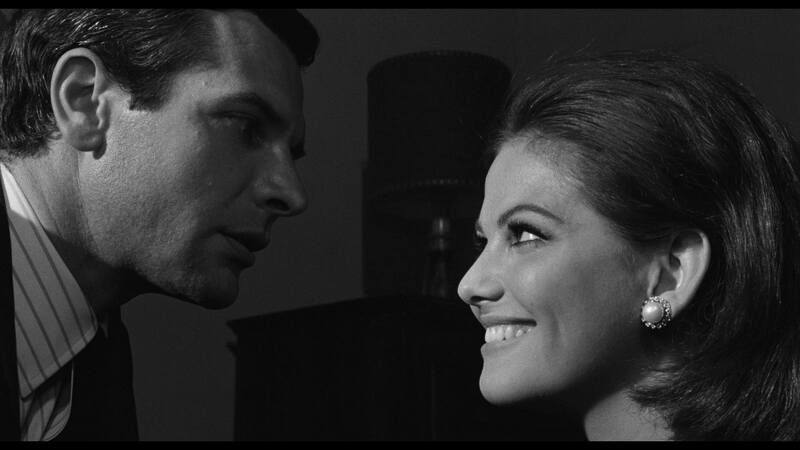
Ichikawa makes all of this look far better than a comedy about an overextended philanderer and ten angry women necessarily needs to look. Setsuo Kobayashi's black-and-white photography is gorgeous, using deep shadows, severe compositions, reflective surfaces, and unusual framing to occasionally make the movie resemble a noir that wandered into the wrong story. Rather than fighting the comedy, that seriousness makes the absurdity funnier.
The visual choices are especially effective whenever the movie becomes slightly unreal. Ichikawa can move from fairly conventional conversation into something more stylized without warning, and the movie doesn't always signal exactly how seriously we're supposed to take what we're seeing. Yasushi Akutagawa's music contributes to that instability, letting scenes feel playful, uneasy, or oddly romantic even when the behavior underneath is anything but.
That constant shifting won't work equally well for everyone. TEN WOMEN IN BLACK can be very funny, but it isn't structured around a steady stream of obvious jokes, and portions become closer to melodrama before snapping back toward satire. At times, the movie's momentum softens because the shifting relationships matter more than pushing the story forward.
I felt that looseness most in the final third. The original setup is so immediately entertaining that almost anything following it has to work harder, and some of the later complications don't have quite the same wicked simplicity. The movie never completely loses its personality, but it occasionally feels as though Wada and Ichikawa have several different ideas they want to explore and aren't interested in choosing only one.
Maybe that's also why it has aged as well as it has. The easiest version of this story would turn the women into a collection of stereotypes and Kaze into either a lovable womanizer or a cartoon villain. In contrast, TEN WOMEN IN BLACK keeps making everybody a little harder to categorize. More than sixty years later, the basic frustration of watching somebody repeatedly mistreat people while remaining baffled that they're upset hasn't exactly become difficult to recognize.
Radiance's Blu-ray gives this lesser-known Ichikawa film an especially welcome return. The 4K restoration by Kadokawa Pictures brings tremendous clarity to Kobayashi's photography without stripping away the texture that makes the monochrome presentation so attractive. At the same time, the uncompressed mono track keeps dialogue and Akutagawa's score clean and balanced. This isn't the sort of restoration where spectacle is the selling point; the benefit is appreciating just how carefully constructed an already stylish movie was.
The release also includes Shunji Iwai's feature-length documentary THE KON ICHIKAWA STORY, which makes the disc particularly useful for anyone whose familiarity with Ichikawa begins and ends with his more widely available work. Having Natto Wada included in that larger discussion is especially appropriate here, because TEN WOMEN IN BLACK is difficult to separate from the sharp perspective her screenplay brings to Kaze and the women surrounding him.
There are funnier comedies and cleaner satires, but few feel quite like this one. TEN WOMEN IN BLACK can be elegant and ridiculous within minutes of itself, sympathetic toward its women without pretending they're always rational, and merciless toward Kaze without reducing him to a cartoon. Even when the movie wanders, there remains something deliciously funny about watching a man maintain ten relationships and somehow conclude that the real mystery is why all these women have become so upset with him.
That obliviousness gives the movie its most durable joke. Kaze creates an impossible situation, benefits from it for as long as everyone else allows him to, and then seems genuinely offended when the arrangement becomes inconvenient for him. TEN WOMEN IN BLACK may not develop every woman enough to make the entire ensemble equally memorable, but it understands exactly who deserves to be the punchline.
Bonus Materials:
4K restoration by Kadokawa Pictures
Original uncompressed mono audio
The Kon Ichikawa Story: a feature-length documentary directed by Shunji Iwai, featuring Ichikawa and his wife and screenwriter, Natto Wada
Trailer
New and improved English subtitle translation
Reversible sleeve featuring artwork based on original posters
Limited edition booklet featuring new writing by Yuka Kimbara
Please visit https://linktr.ee/overlyhonestr for more reviews.
You can follow me on Letterboxd, Instagram, Twitter, and YouTube. You can also find my social media accounts on most platforms by searching for 'Overly Honest Reviews'.
I’m always happy to hear from my readers; please don't hesitate to say hello or send me any questions about movies.
[photo courtesy of RADIANCE FILMS, MVD ENTERTAINMENT]
DISCLAIMER:
At Overly Honest Movie Reviews, we value honesty and transparency. Occasionally, we receive complimentary items for review, including DVDs, Blu-rays, CDs, Vinyl Records, Books, and more. We assure you these arrangements do not influence our reviews, as we are committed to unbiased, sincere evaluations. We aim to help you make informed entertainment choices regardless of our relationship with distributors or producers.
Amazon Affiliate Links:
This site also contains Amazon affiliate links. If you purchase through these links, we may receive a commission. This affiliate arrangement does not affect our commitment to honest reviews and helps support our site. We appreciate your trust and support as you navigate these links.


Happy
0 %

Sad
0 %

Excited
0 %

Sleepy
0 %

Angry
0 %

Surprise
0 %
 0
0
 0
0

Average Rating