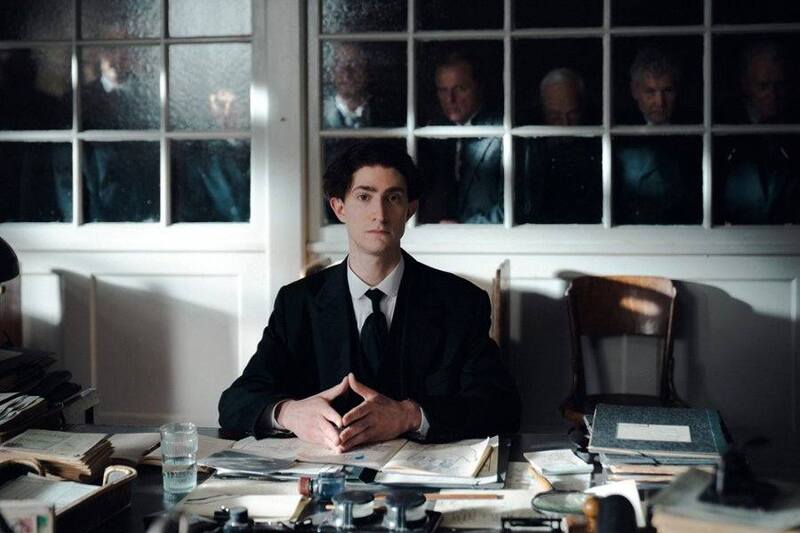
Searching for the Man Behind the Myth
Read Time:7 Minute, 54 Second
MOVIE REVIEW
Franz
 –
– 

Genre: Biography, Drama, History
Year: 2025, 2026 Blu-ray
Runtime: 2h 7m
Director: Agnieszka Holland
Writers: Marek Epstein, Agnieszka Holland
Cast: Idan Weiss, Peter Kurth, Jenovéfa Boková, Katharina Stark, Sebastian Schwarz, Carol Schuler, Sandra Korzeniak, Ivan Trojan
Where to Watch: available October 20, 2026. Pre-order your copy here: www.kinolorber.com or www.amazon.com
RAVING REVIEW: Franz Kafka spent much of his life struggling to make sense of the world around him, only to become one of the twentieth century's most studied and discussed writers. His work explored alienation, oppressive authority, and the absurdity of everyday existence, often leaving readers with more questions than answers. It's fitting, then, that director Agnieszka Holland's FRANZ approaches his life with a comparable uncertainty, though the results are far more frustrating than the filmmaker probably intended.
Rather than follow a biographical drama structure, Holland moves between periods of Kafka's life, occasionally jumping forward to examine how the modern world remembers him. Scenes from his childhood, career, relationships, and literary pursuits are presented alongside contemporary museum exhibits and tourist attractions. The film aims to explore both the man who lived and the cultural figure he became, but its scattered approach makes it hard to fully invest in either.
One of the film's more interesting decisions is its commercialization of Kafka's legacy. Holland takes us into a world where the famously private writer has become a tourist attraction, his personal possessions displayed for strangers and his name attached to products that have little connection to the actual man. A particularly amusing sequence involves Kafka-themed burgers, an absurd marketing concept made even stranger by the writer's vegetarianism. These moments raise worthwhile questions about how society turns important historical figures into recognizable brands, often stripping away the very qualities that made them interesting.
The problem is that Holland keeps returning to these observations without developing them much further. The contrast between Kafka's desire for privacy and the public's fascination with every detail of his existence is immediately understandable. Yet the film repeatedly interrupts its historical narrative to reinforce this point. Some transitions are clever, particularly when modern museum visitors seem to intrude upon Kafka's private life. Others interrupt scenes that were beginning to build an emotional connection, forcing the audience to adjust to another shift in perspective.
Idan Weiss gives a convincing performance as Kafka, capturing his nervous energy, social discomfort, and difficulty expressing himself outside his writing. He's especially effective in quieter exchanges, letting small gestures and uncomfortable pauses convey feelings Kafka struggles to articulate. Weiss also avoids portraying the writer as an endlessly miserable intellectual, finding moments of humor and occasional warmth beneath his anxious exterior. It's a thoughtful interpretation that frequently deserves more breathing room than Holland's restless direction allows.
Peter Kurth makes an equally strong impression as Hermann Kafka, the writer's domineering father. Their difficult relationship provides some of the film's most compelling material, especially in scenes where Hermann's aggression overwhelms his son's attempts to establish independence. Kurth doesn't need elaborate speeches to communicate his authority; his physical presence and impatience are enough to make the household uncomfortable. These interactions help explain Kafka's complicated relationship with authority and his persistent feelings of inadequacy without reducing his literary achievements to a single childhood experience.
The relationship between father and son is also one of the few areas where Holland's unusual storytelling consistently strengthens the material. Childhood memories carry forward into adulthood, with seemingly ordinary experiences becoming reminders of earlier humiliation and fear. A haircut, a family gathering, or an uncomfortable conversation can reveal years of accumulated resentment. These connections are far more effective than the film's elaborate attempts to illustrate Kafka's imagination because they let viewers recognize the emotional consequences of his upbringing.
Unfortunately, several other relationships receive considerably less attention. Kafka's romantic difficulties, including his complicated involvement with Felice Bauer and his connection with Milena Jesenská, appear in brief encounters that establish his reluctance to commit and his tendency to retreat into correspondence. Carol Schuler and Jenovéfa Boková provide capable performances, but their characters frequently disappear before their relationships can develop beyond another illustration of Kafka's personal anxieties. The same problem affects his friendships, although Sebastian Schwarz brings some welcome energy to Max Brod, the friend whose decision to preserve Kafka's manuscripts would eventually secure his literary legacy.
Holland also incorporates passages inspired by Kafka's writing, occasionally allowing the exaggerated cruelty and absurdity of his fictional worlds to interrupt the historical material. Some of these sequences are visually striking, especially when they expose the uncomfortable relationship between institutional authority and individual suffering. However, the film spends surprisingly little time examining Kafka's writing process. We see the circumstances surrounding his creativity and hear about the significance of his work, but rarely develop a meaningful understanding of how his ideas took shape. For a biography of someone whose literary imagination transformed modern fiction, that absence becomes increasingly noticeable.
Visually, FRANZ has plenty to admire. The production design convincingly recreates the streets, offices, and domestic spaces of early twentieth-century Prague. At the same time, cinematographer Tomasz Naumiuk finds interesting ways to make familiar locations appear imposing or uncomfortable. Holland frequently uses unusual camera movements, abrupt framing changes, and exaggerated perspectives to reflect Kafka's unease. These choices can be effective, although their constant presence eventually becomes distracting. When nearly every sequence draws attention to its presentation, the genuinely inventive moments struggle to stand out.
At 127 minutes, the film also struggles to justify how much material it tries to cover. The fragmented structure isn't inherently a problem, and a conventional chronological biography probably wouldn't have been the most interesting way to approach Kafka. However, unconventional storytelling still needs a sense of purpose, and Holland sometimes seems more interested in finding another unusual way to present information than in determining whether it adds anything meaningful. Individual scenes can be fascinating, funny, or surprisingly moving, but the connections between them don't always hold together well enough to sustain the whole experience.
What's particularly disappointing is how often the film approaches a genuinely revealing moment, then abandons it. A conversation with his father might expose something painful about Kafka's childhood, or an exchange with a romantic partner might briefly reveal his desire for companionship. Just as those interactions begin to deepen our understanding, Holland changes direction. The constant movement creates an impression of intellectual activity without always delivering the emotional understanding that would make these discoveries matter.
I appreciate Holland's refusal to treat Kafka as an untouchable literary monument. Her willingness to explore his awkwardness, humor, contradictions, and occasional selfishness makes him considerably more interesting than the familiar image of a permanently tormented genius. The film also recognizes the irony of trying to explain someone whose work so often challenged the possibility of finding straightforward explanations. Holland clearly respects her subject, and even the more excessive creative decisions reflect an effort to approach familiar biographical material differently.
The October 20 Blu-ray and DVD release from Cohen Media Group gives audiences another opportunity to experience Holland's unconventional portrait. The listed supplemental material includes a director interview and trailers, with the interview potentially offering additional insight into the creative decisions behind such an unusual production. Because so much of the film depends on its shifting visuals and carefully recreated historical environments, it should benefit from a high-quality physical presentation.
FRANZ left me admiring individual pieces considerably more than the finished film. Weiss and Kurth deliver strong performances, the production is frequently impressive, and Holland introduces several worthwhile ideas about personal identity, artistic legacy, and the strange ways society remembers its cultural figures. Yet the relentless experimentation sometimes keeps the audience at a distance from the very person we're supposed to understand. Holland doesn't need to explain every mystery surrounding Kafka, but giving us a little more uninterrupted time with him would have made this ambitious biography much more rewarding.
Please visit https://linktr.ee/overlyhonestr for more reviews.
Follow me on Letterboxd, Instagram, Twitter, and YouTube. You can also find my social media accounts on most platforms by searching for 'Overly Honest Reviews'.
I’m always happy to hear from my readers; please don't hesitate to say hello or send me any movie questions.
[photo courtesy of COHEN MEDIA GROUP, KINO LORBER]
DISCLAIMER:
At Overly Honest Movie Reviews, we value honesty and transparency. Occasionally, we receive complimentary items for review, including DVDs, Blu-rays, CDs, Vinyl Records, Books, and more. We assure you these arrangements do not influence our reviews, as we are committed to unbiased, sincere evaluations. We aim to help you make informed entertainment choices regardless of our relationship with distributors or producers.
Amazon Affiliate Links:
This site also contains Amazon affiliate links. If you purchase through these links, we may receive a commission. This affiliate arrangement does not affect our commitment to honest reviews and helps support our site. We appreciate your trust and support as you navigate these links.


Happy
0 %

Sad
0 %

Excited
0 %

Sleepy
0 %

Angry
0 %

Surprise
0 %
 0
0
 0
0

Average Rating