History Unfolds in the Rearview Mirror
Read Time:7 Minute, 42 Second
MOVIE REVIEW
The Drive
 –
– 

Genre: Short, Drama, Historical
Year: 2025, 2026
Runtime: 12m
Director: David Arrow
Writer: David Arrow
Cast: Amber Paul, Allen Guy Wilcox, Blair Newman, Victoria Spitalieri, Rivers Duggan, Andrew Arrow, Candice Clarke
Where to Watch: shown at the 2026 Monadnock International Film Festival and Santa Cruz Film Festival
RAVING REVIEW: Where were you when you heard President John F. Kennedy had been assassinated? Were you even alive? I wasn’t, but for generations of Americans, that question has remained so easy to answer, even as people dissected and debated the details of November 22, 1963, for more than sixty years. Most people weren't in Dallas that afternoon, and they didn't witness the shooting or the chaos that followed. They learned what happened while going about their ordinary lives, only to discover that the day would stay with them forever. David Arrow's twelve-minute short THE DRIVE approaches the assassination through one of those personal experiences, focusing on how an event hundreds of miles away could suddenly change everything for someone going about their day. While I wasn’t alive for this specific footnote in history, I can compare it to hearing about when Diana, Princess of Wales, passed away, or seeing that second plane hit the Twin Towers on 9/11. These are moments that stay with you for life.
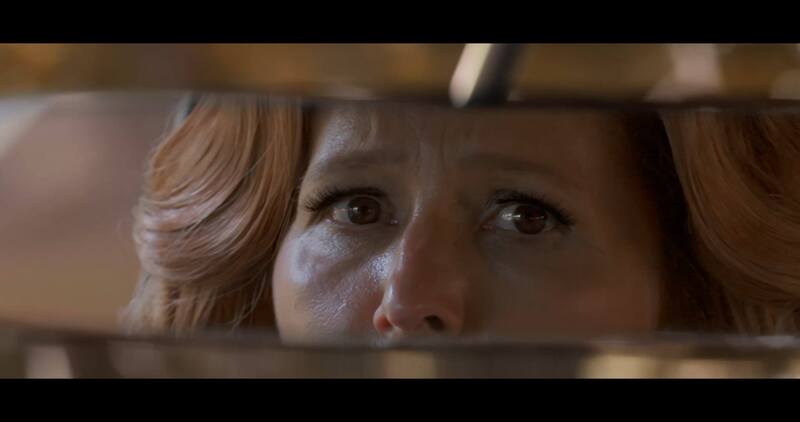
The film follows Liz (Amber Paul), a mother making her school carpool rounds on an otherwise ordinary November afternoon. The moment feels all too familiar, all too ordinary. Picking up kids, driving through the neighborhood, and managing the conversations from the back seat. Nothing about the afternoon suggests that it will become a memory she carries forever. That sense of normalcy is so important because Arrow isn't interested in the moments of the assassination itself. Instead, he places us alongside someone whose understanding of the world is about to change. At the same time, everyday responsibilities keep demanding her attention, and her reaction matters less to her than to the kids in the car with her.
Amber Paul gives a wonderfully restrained performance as Liz, carrying much of the film through facial expressions and small changes in her behavior. It's particularly difficult to portray someone processing devastating information while staying composed for the children around her. Paul understands that Liz can't simply abandon her responsibilities or surrender to her emotions. She has to keep driving, answer questions, and maintain some semblance of normality even as the magnitude of what she's heard begins to register. The film follows her attempt to balance those two competing demands.
Arrow also makes effective use of the limited information ordinary Americans had at the time. Today, news of a major national tragedy reaches millions almost instantly through phones, social media, and nonstop television coverage. In 1963, information traveled differently, and people frequently depended on radio broadcasts, or even conversations with strangers, to understand what was happening. THE DRIVE uses that uncertainty to build its atmosphere, letting the news develop through Liz's limited perspective rather than giving viewers information her character couldn't possibly have. This thoughtful approach respects both the historical setting and the emotional experience of those living through it. Even more, Liz understands the magnitude of what’s happened and doesn’t want to dump it on the children.
The confined setting becomes particularly important as the afternoon progresses. The entire film basically unfolds inside Liz's station wagon, where the children's conversations continue as the atmosphere grows increasingly uncomfortable. Their relative innocence contrasts with the growing concern visible in the front seat. They have their own interests, expectations, and plans, with little understanding of what's happening around them.
Cinematographer Mark Raker deserves recognition for making such a confined “stage” so engaging. Rather than treating the car as just a mode of transportation between locations, the camerawork uses the windows, mirrors, and carefully framed close-ups to convey what the characters don't discuss. The focus on Paul's expressions is especially valuable, letting the audience recognize shifts in her emotional state without dialogue explaining them.
The sound design also helps shape the experience. Radio broadcasts become an essential link between Liz and the unfolding tragedy, while the other vehicles and everyday movement emphasize the disconnect between catastrophe and routine. Hearing devastating news while the world around you keeps functioning feels unsettling. The music reinforces the changing emotional atmosphere. Paul's performance is expressive enough that she doesn't always need the additional musical emphasis to communicate what she's feeling, though.
The supporting characters remain relatively thin, functioning primarily through their relationships to Liz and the events surrounding her. That approach makes sense given the film's focus, but a little more time establishing those relationships might have strengthened the emotional fallout. The suspense around the other vehicles also gets considerable attention for such a brief story, occasionally making the narrative feel more concerned with withholding information than with exploring the characters' reactions. Neither issue undermines the film, but they prevent an otherwise carefully constructed experience from feeling quite as complete as it could. I’d be interested to know if this was always perceived as a short, or if Arrow had a larger world built around these interactions.
What I appreciate most about THE DRIVE is its recognition that tragedies extend far beyond where they occurred. Kennedy's assassination is frequently discussed through the political consequences, investigative controversies, and the cultural fascination surrounding his death. Those discussions matter, but they can also overshadow the millions of individual experiences that shaped the national response. Arrow approaches the subject through an ordinary person's reaction, showing how quickly the familiar can become inseparable from history. As I write this, I wonder if an anthology of these moments could be used to make a feature from this.
The film also raises an interesting question. How do people protect children from events they haven't even had time to process? Liz's responsibility as a mother doesn't disappear just because something devastating happens. Her concern remains the safety and well-being of the children in her care, even as her own sense of security begins to deteriorate. That conflict shapes Paul's performance, especially because so much of it stays unspoken. The film understands that adults often have to keep functioning in moments when they'd much rather stop and take in what they've just learned.
Arrow and Paul’s familiarity with each other's creative instincts suited a production that relies so heavily on performance choices and precise visual storytelling. Paul never pushes for an audience reaction, and Arrow gives her the space to establish the character's feelings through behavior rather than explanation. The result is a partnership that benefits the material without drawing unnecessary attention to itself.
THE DRIVE has already qualified for consideration at the 99th Academy Awards. That recognition is understandable, given how much the filmmakers work within such a restricted setting and runtime. The film shows clear respect for history. Its strength lies in its interest in the people who experienced the consequences without ever becoming part of the larger narrative. It isn't trying to explain why the assassination happened or revisit the countless theories surrounding it. Its concerns are smaller, more focused, and ultimately more personal.
We've seen the assassination of John F. Kennedy depicted so many times that certain images have become inseparable from the event itself. THE DRIVE reminds us that most Americans weren't standing in Dealey Plaza, watching the motorcade, or participating in the decisions that followed. They listened to radios, looked for answers, and tried to understand how something so terrible could happen on an otherwise ordinary afternoon. Arrow captures a small portion of that experience with sensitivity and impressive technical control, while Paul gives the story the emotional foundation it needs.
Please visit https://linktr.ee/overlyhonestr for more reviews.
Follow me on Letterboxd, Instagram, Twitter, and YouTube. You can also find my social media accounts on most platforms by searching for 'Overly Honest Reviews'.
I’m always happy to hear from my readers; please don't hesitate to say hello or send me any movie questions.
[photo courtesy of 4 A FILMS]
DISCLAIMER:
At Overly Honest Movie Reviews, we value honesty and transparency. Occasionally, we receive complimentary items for review, including DVDs, Blu-rays, CDs, Vinyl Records, Books, and more. We assure you these arrangements do not influence our reviews, as we are committed to unbiased, sincere evaluations. We aim to help you make informed entertainment choices regardless of our relationship with distributors or producers.
Amazon Affiliate Links:
This site also contains Amazon affiliate links. If you purchase through these links, we may receive a commission. This affiliate arrangement does not affect our commitment to honest reviews and helps support our site. We appreciate your trust and support as you navigate these links.


Happy
0 %

Sad
0 %

Excited
0 %

Sleepy
0 %

Angry
0 %

Surprise
0 %
 0
0
 0
0

Average Rating