The Silence Before the Scream
Read Time:10 Minute, 37 Second
MOVIE REVIEW
The Screaming Skull
 –
– 

Genre: Horror, Mystery, Thriller
Year: 1958, 2026 Blu-ray
Runtime: 1h 8m
Director: Alex Nicol
Writer: John Kneubuhl (based on the story by Francis Marion Crawford)
Cast: Peggy Webber, John Hudson, Alex Nicol, Russ Conway, Tony Johnson
Where to Watch: available October 19, 2026. Pre-order your copy here: www.eurekavideo.co.uk
RAVING REVIEW: I would've loved to experience the ridiculous promotional gimmicks that accompanied horror movies in the 1950s. THE SCREAMING SKULL opens by informing audiences that its frightening contents could potentially kill them, then generously promises to cover their burial expenses should they die from shock. They even display a coffin to sell it. It's a wonderful example of the theatrical nonsense filmmakers once used to convince people their latest low-budget horror picture was something they absolutely had to see. Alex Nicol's 1958 film makes an enormous promise before the story even begins. While I doubt anyone genuinely feared for their life, I can appreciate the enthusiasm behind such an outrageous sales pitch.
Released by American International Pictures in August 1958, THE SCREAMING SKULL belongs to an era when independent distributors frequently relied on outrageous advertising to compete with bigger Hollywood productions. William Castle became particularly famous for these promotional stunts, although he certainly wasn't the only filmmaker or producer willing to try something unusual. Castle's MACABRE, released the same year, offered audiences an insurance policy against death by fright, while THE SCREAMING SKULL went with the considerably more personal promise of a free funeral. Neither film was likely to send anyone to an early grave, but the campaigns made moviegoing feel like an event. I miss that kind of imagination in theatrical promotion, especially when so much modern advertising seems designed to make every release look practically identical.
The actual story is considerably quieter than its sensational introduction suggests. Jenni Whitlock (Peggy Webber) has recently married Eric (John Hudson), a widower who brings his new wife to the secluded country estate he previously shared with his first wife, Marion. Unfortunately, Marion died under tragic circumstances after an accident involving a decorative pond on the property. Her presence continues to hang over the household, particularly as Jenni discovers that the groundskeeper, Mickey (Alex Nicol), believes Marion's spirit still wanders the estate. Before long, strange occurrences begin making Jenni question whether she's experiencing something supernatural or losing her grip on reality.
That uncertainty provides the film with its strongest material, and Peggy Webber deserves much of the credit for making it engaging. Jenni arrives at the estate hoping to begin a happy marriage, but she quickly finds herself surrounded by reminders of a woman she never knew. Webber portrays her as emotionally vulnerable without making her seem foolish, an important distinction considering how frequently the story depends on her questioning her own experiences. Her growing anxiety feels particularly believable when she attempts to explain what she's witnessing to people who seem unwilling or unable to understand her concerns.
A familiar psychological element runs through the story, recalling Alfred Hitchcock's REBECCA and George Cukor's GASLIGHT. Both films explore how a woman's sense of security can deteriorate when she's surrounded by people and circumstances that make her question her understanding of reality. THE SCREAMING SKULL operates on a considerably smaller budget and lacks the sophistication of those productions, but the influence is unmistakable. The estate's isolation, the deceased first wife, and Jenni's growing uncertainty create a recognizable Gothic framework that Nicol approaches with surprising patience.
John Hudson's Eric is an interesting character, though his performance doesn't always give the story the complexity it could've used. He initially seems like a concerned husband trying to help his new wife adjust to unfamiliar surroundings, yet his responses to Jenni's distress often carry an unsettling quality. Hudson maintains a controlled demeanor that suits the material, but his delivery can also feel rather stiff. The film occasionally suffers because the husband-and-wife conversations lack the emotional intimacy needed to make their relationship fully convincing.
Nicol also appears as Mickey, the estate's groundskeeper, whose strange behavior and attachment to Marion create another source of discomfort for Jenni. He's presented as an outsider in the household, someone whose understanding of the property's history differs significantly from the other characters'. Nicol gives Mickey an awkward physical presence that makes his appearances memorable, though the characterization reflects unfortunate attitudes toward intellectual disabilities common in films of the period. It's one of those elements that feels especially dated today, and it deserves acknowledgment without ignoring the character's importance to the story.
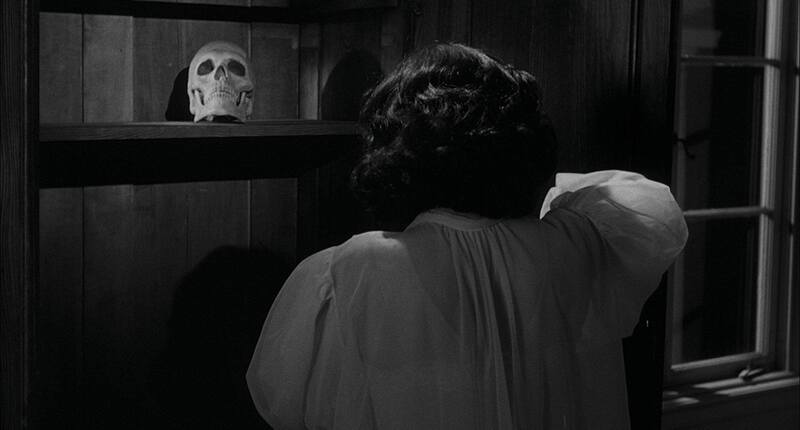
Visually, THE SCREAMING SKULL benefits enormously from cinematographer Floyd Crosby, whose black-and-white photography gives the modest production an unexpectedly polished appearance. Crosby, who won an Academy Award for his work on TABU: A STORY OF THE SOUTH SEAS, understands how much can be accomplished through careful lighting and composition. The estate's gardens, shadowed interiors, and isolated pathways provide plenty of opportunities for unsettling imagery. Rather than filling every scene with obvious threats, the photography often obscures parts of the frame, letting the audience anticipate something emerging from the darkness.
Sound design is equally important, especially the strange cries and unexplained noises that disturb Jenni throughout her stay. Nicol understands that an unexpected sound can be considerably more effective than revealing whatever supposedly caused it. Several scenes depend on the character's reaction to something she hears rather than anything the audience can clearly see. These moments remain effective because they let the viewer share Jenni's uncertainty, even when the surrounding production shows its age.
Unfortunately, the film doesn't always know when to stop repeating those techniques. Jenni hears something disturbing, investigates, becomes frightened, and then struggles to convince someone else that her experience was real. The pattern becomes increasingly familiar, and at only 68 minutes, the repetition is especially noticeable. What initially creates an uncomfortable atmosphere eventually slows the story, especially when the characters return to conversations that offer little new information. A tighter screenplay could've preserved the uncertainty while giving the narrative considerably more momentum.
The titular skull also works better as an ominous object than as the source of the film's larger scares. The premise encourages the audience to anticipate something genuinely horrifying, particularly after that wonderfully excessive opening warning. Instead, much of the terror comes from fairly traditional haunted-house devices and psychological manipulation. Some of the more direct horror imagery hasn't aged particularly well, and the film occasionally becomes unintentionally amusing when it attempts to deliver its biggest shocks. I don't consider that a fatal flaw for a 1950s B-movie, but it does limit the suspense's effectiveness.
What keeps THE SCREAMING SKULL interesting is the way it combines supernatural uncertainty with the more recognizable fears surrounding marriage, trust, and emotional instability. Jenni isn't simply frightened by an old house or the possibility of encountering a ghost. She's entering a marriage in which her husband's past remains physically present in nearly every room, and her attempts to establish a place for herself are repeatedly complicated by Marion's memory. Beneath the film's inexpensive horror devices lies a genuinely uncomfortable idea, even if the screenplay doesn't explore it as thoroughly as it could.
The film also marks an interesting moment in American horror history, arriving as theatrical audiences became increasingly accustomed to science-fiction monsters, radioactive creatures, and elaborate promotional campaigns. THE SCREAMING SKULL is relatively traditional by comparison, relying on haunted-house imagery and Gothic melodrama rather than contemporary scientific anxieties. Its modest production values place it firmly within the period's independent filmmaking practices, when distributors like American International Pictures kept films circulating through neighborhood theaters and drive-ins long after their initial releases.
That history makes Eureka Entertainment's upcoming Blu-ray particularly appealing. Arriving October 19, 2026, as part of the Eureka Classics collection, the film is receiving its first UK Blu-ray release in a limited edition of 2,000 copies. The 1080p presentation retains the original 1.85:1 aspect ratio and English mono audio, with optional English subtitles. It's encouraging to see a smaller genre title get this kind of attention, especially given how often older low-budget horror films have circulated through inferior home-video presentations.
The supplementary material is another reason this edition deserves consideration. Eureka includes a new introduction from horror novelist Stephen Laws and SHROUDED IN MYSTERY, a video essay by film and literature scholar Mary Going examining the film's relationship to the Gothic horror tradition. The collector's booklet is particularly interesting, featuring research from Jon Towlson and Christopher Stewardson that places THE SCREAMING SKULL within the theatrical distribution practices of the late 1950s. Rather than treating the movie as an isolated curiosity, the booklet examines the advertising campaigns, double-feature bookings, and exhibition strategies that helped small productions reach audiences nationwide.
Towlson's examination of the film's notorious burial guarantee is especially entertaining. Unlike William Castle, who arranged insurance coverage for his similar promotional stunt, the producers of THE SCREAMING SKULL apparently never secured an actual policy to support their promise. It was an extraordinary gamble that depended on audiences enjoying the joke rather than testing the offer. Stewardson's research into the film's original theatrical circulation provides another fascinating perspective, documenting how it traveled through American theaters and continued appearing on double bills well beyond its initial 1958 release. These historical details add considerable value to a movie whose reputation has often been reduced to its unusual opening gimmick.
I wouldn't place THE SCREAMING SKULL among the great horror films of the 1950s, and I certainly wouldn't recommend it to someone looking for relentless scares. The performances are uneven, the narrative becomes repetitive, and its most ambitious moments occasionally exceed what the production could convincingly accomplish. Nevertheless, Peggy Webber gives the film a sympathetic lead, Floyd Crosby's photography elevates the atmosphere, and Nicol demonstrates a respectable understanding of how uncertainty can make a simple location feel threatening.
More importantly, films like this deserve to remain accessible because they represent an important part of horror's history beyond the major studio productions and universally recognized classics. Not every forgotten B-movie is an undiscovered treasure, but many offer worthwhile performances, creative decisions, or historical connections worth revisiting. THE SCREAMING SKULL has enough of those qualities to make its modest shortcomings easier to forgive, particularly when presented alongside the kind of contextual material Eureka has assembled.
As for that promised free burial, I suspect everyone watching this new edition will survive the experience without much difficulty. You might laugh at a few scares, grow impatient with some repeated encounters, or find yourself more interested in the film's theatrical history than its actual mystery. I enjoyed it for what it is, an imperfect but appealing piece of low-budget Gothic horror that still has some atmosphere left in its aging bones. Eureka's limited edition gives it a welcome opportunity to reach another generation of horror fans. For collectors interested in the stranger corners of American genre filmmaking, that's reason enough to dig it up again.
Please visit https://linktr.ee/overlyhonestr for more reviews.
Follow me on Letterboxd, Instagram, Twitter, and YouTube. You can also find my social media accounts on most platforms by searching for 'Overly Honest Reviews'.
I’m always happy to hear from my readers; please don't hesitate to say hello or send me any movie questions.
[photo courtesy of EUREKA ENTERTAINMENT]
DISCLAIMER:
At Overly Honest Movie Reviews, we value honesty and transparency. Occasionally, we receive complimentary items for review, including DVDs, Blu-rays, CDs, Vinyl Records, Books, and more. We assure you these arrangements do not influence our reviews, as we are committed to unbiased, sincere evaluations. We aim to help you make informed entertainment choices regardless of our relationship with distributors or producers.
Amazon Affiliate Links:
This site also contains Amazon affiliate links. If you purchase through these links, we may receive a commission. This affiliate arrangement does not affect our commitment to honest reviews and helps support our site. We appreciate your trust and support as you navigate these links.


Happy
0 %

Sad
0 %

Excited
0 %

Sleepy
0 %

Angry
0 %

Surprise
0 %
 0
0
 0
0

Average Rating