A Nation Built From Smaller Stories
Read Time:7 Minute, 23 Second
MOVIE REVIEWS
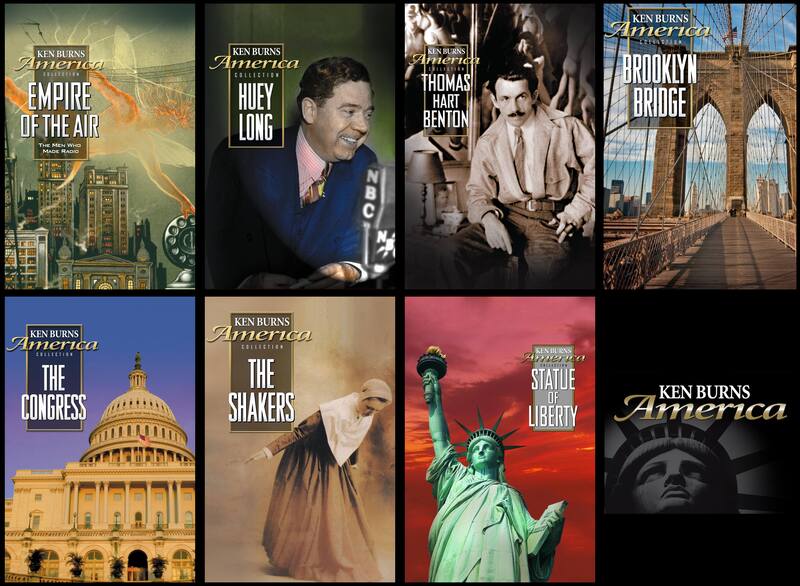
Ken Burns' America Collection
 –
– 

Genre: Documentary
Year Released: 1981–1992, 2026
Runtime: 9h 18m
Directors: Ken Burns, Amy Stechler Burns
Where to Watch: available now; order your copy here: www.moviezyng.com or www.amazon.com
RAVING REVIEW: Putting more than nine hours of early Ken Burns documentaries into one box makes something obvious. The style people now associate so strongly with his name didn’t just appear with THE CIVIL WAR. You can watch it becoming structured across KEN BURNS’ AMERICA COLLECTION. Photographs become active parts of the storytelling, letters and firsthand accounts provide emotional detail, narration gives history its shape without turning into a lecture, and monumental moments in time are approached through individual people. The techniques grew more sophisticated as Burns’ career progressed, but the underlying ideas were already there.
The seven documentaries also make a more unique collection than their subjects might initially suggest. BROOKLYN BRIDGE and THE STATUE OF LIBERTY examine structures that eventually became inseparable from how America presents itself to the world. THE CONGRESS tackles an institution rather than a building. At the same time, THE SHAKERS moves toward community, design, labor, and an American religious movement that existed largely outside the usual history books. THOMAS HART BENTON and HUEY LONG turn toward individuals, and EMPIRE OF THE AIR examines technological change through the people fighting to shape it. That variety keeps the experience from feeling like one giant history lesson. I really wish school had used documentaries more; I think I would have been much more interested.
BROOKLYN BRIDGE may be the most interesting piece to watch with Burns’ later career in mind because it already shows his fascination with the relationship between ambition and American identity. The bridge is obviously an engineering achievement, but treating it as just a collection of facts misses why anyone cares. The documentary looks at what people were willing to risk, endure, and imagine to build something that seemed almost impossible. Once the bridge stops being just an object and starts representing human determination, you can see Burns discovering the storytelling approach he would return to again and again.
THE STATUE OF LIBERTY pushes that idea even further because its subject carries meanings far beyond the monument itself. The history of its construction matters, but the more interesting question is what liberty means to different people and whether the symbol has always lived up to the country behind it. Oddly, this may be even more impactful today than when it first came out. Burns clearly appreciates the monument without using that appreciation as an excuse to avoid examining its contradictions, and that keeps the film from becoming an hour-long patriotic postcard.
That willingness to let admiration coexist with criticism becomes even more important in HUEY LONG. Long practically demands a documentary built around contradictions because his reputation changes depending on which part of his career you emphasize. He could present himself as a champion of ordinary people while consolidating enormous political power, and Burns doesn’t need to level those competing truths into a verdict. The personality is so large that the documentary could have been overwhelmed by him, yet the better moments examine why people were drawn to that personality in the first place.
THE CONGRESS has a tougher assignment because institutions rarely come with the personality of someone like Long. Government procedure can become numbing quickly, but the documentary understands that Congress becomes more interesting when viewed as an ongoing argument over what representative government is supposed to accomplish. There’s inevitably more here than in some of the other selections, and I wouldn’t call it the easiest entry to “just watch.” The historical perspective makes many of its questions about power, compromise, representation, and public frustration feel surprisingly familiar to what some modern-day politicians are speaking on.
THE SHAKERS goes in the opposite direction and becomes one of the collection’s more absorbing films. Their beliefs, craftsmanship, architecture, and pursuit of simplicity give Burns plenty of historical content without requiring the kind of events that usually dominate documentaries about America. That smaller scale is part of its appeal. A country’s history isn’t only presidents, wars, and elections, and the film makes a convincing case that understanding communities such as the Shakers tells us something important about the ideas people tried to build their lives around.
THOMAS HART BENTON benefits from that same interest in finding larger American ideas inside one life. Benton’s commitment to realism and his clashes with changing artistic styles provide more than enough conflict without forcing the documentary to manufacture any. His paintings themselves become evidence of history, revealing how he saw workers, landscapes, communities, and the country around him. Even viewers with little interest in art history can find something in the tension between sticking to your instincts and watching culture decide those instincts have gone out of fashion.
EMPIRE OF THE AIR may be the easiest selection to underestimate based solely on its description. By focusing on Lee de Forest, Edwin Howard Armstrong, and David Sarnoff, it gives technological history human stakes. Innovation becomes tangled with ego, competition, business, and the question of who actually gets remembered for changing the world. The documentary also captures how radical mass communication once seemed, something that’s easy to forget now that instant access to practically anyone and all of human history is a part of daily life.
Watching these documentaries together reveals one of Burns’ greatest strengths while also exposing a limitation that’s followed his work for decades. He’s exceptionally good at convincing you that whatever subject he chose deserves your attention. The narration, archival material, music, carefully framed photographs, and interviews can turn bridges, furniture, politics, paintings, or even radio patents into pieces of a much larger American story. That deliberate approach can become almost too easy over nine hours, especially when you watch several documentaries close together.
Seven discs provide plenty of material, and keeping the documentaries in their original 1.33:1 presentation is absolutely the right decision. These are historically significant documentaries about historically significant subjects, and the package would have been more exciting with restored high-definition presentations, new retrospective content, or more archival extras to make it feel like a definitive preservation project rather than another way to own the films.
That criticism matters to me, because the documentaries themselves deserve better than being treated as just more catalog titles. There’s real value in seeing Burns before THE CIVIL WAR transformed his public profile and before massive multi-part productions became almost synonymous with his name. These films show the smaller stories that helped him develop the style and the tools he would later use on much larger projects.
KEN BURNS’ AMERICA COLLECTION works because its definition of American history is so broad. A bridge, a statue, a community, Congress, a painter, and radio shouldn’t really fit this well together. Yet Burns finds the people beneath each subject and uses them to connect national history to individual ambition, belief, failure, ego, creativity, and sacrifice. Some entries are more engaging than others, and the presentation feels less ambitious than the documentaries it contains, but it still offers an extraordinary amount of worthwhile material.
I’m recommending the collection much more strongly for what’s on the discs than for the discs themselves. KEN BURNS’ AMERICA COLLECTION captures an important stretch of his own development while offering seven very different ways of asking the same basic question. What exactly do we mean when we talk about America?
Please visit https://linktr.ee/overlyhonestr for more reviews.
You can follow me on Letterboxd, Instagram, Twitter, and YouTube. You can also find my social media accounts on most platforms by searching for 'Overly Honest Reviews'.
I’m always happy to hear from my readers; please don't hesitate to say hello or send me any questions about movies.
[photo courtesy of MOVIE ZYNG, AV ENTERTAINMENT, PBS]
DISCLAIMER:
At Overly Honest Movie Reviews, we value honesty and transparency. Occasionally, we receive complimentary items for review, including DVDs, Blu-rays, CDs, Vinyl Records, Books, and more. We assure you that these arrangements do not influence our reviews, as we are committed to unbiased, sincere evaluations. We aim to help you make informed entertainment choices regardless of our relationship with distributors or producers.
Amazon Affiliate Links:
This site also contains Amazon affiliate links. If you purchase through these links, we may receive a commission. This affiliate arrangement does not affect our commitment to honest reviews and helps support our site. We appreciate your trust and support as you navigate these links.


Happy
0 %

Sad
0 %

Excited
0 %

Sleepy
0 %

Angry
0 %

Surprise
0 %
 0
0
 0
0



Average Rating