A Strange Relic Worth Preserving
Read Time:7 Minute, 41 Second
MOVIE REVIEWS
Cyclops (Kikuropusu) [Visual Vengeance Collector's Edition] (Blu-ray)
 –
– 

Genre: Horror, Science Fiction, Body Horror
Year Released: 1987, 2026 Visual Vengeance Blu-ray
Runtime: 52m
Director(s): Jōji “George” Iida
Writer(s): Jōji Iida, Hisashi Saito
Cast: Kai Atō, Mayumi Hasegawa, Yoshimasa Kondō, Kazuhiro Sano, Nobuo Takahashi
Where to Watch: available now; order your copy here: www.mvdshop.com or www.amazon.com
RAVING REVIEW: Jōji “George” Iida’s 1987 directorial debut has an interesting science-fiction premise underlying everything, but the storytelling is rarely easy to follow. Characters show up, medical experiments are discussed, motivations remain fuzzy, and stretches of exposition somehow manage to explain plenty without making the situation clearer. Then the movie reaches its final act and finally shows what all that patience was buying. Flesh gets pulled apart, bodies mutate, fluids start flowing, and an unassuming low-budget production suddenly becomes exactly the sort of practical-effects showcase that earns a cult movie another life almost four decades later. The majority of the film’s runtime may be anything but coherent, but that’s part of the joy in discovering an experience as wild as this.
That uneven division is practically the entirety of CYCLOPS from start to finish. A secret group of researchers have been experimenting with human evolution, using embryos and human hosts to produce a new lifeform. After one experiment ends in disaster, their attention shifts toward another potential subject. Somewhere within all of this are Miyuki Takamori (Mayumi Hasegawa), her brother Tooru (Kazuhiro Sano), the mysterious Michio Sonezaki (Kai Atō), and enough questionable science to guarantee that nobody involved is headed toward a pleasant afternoon.
The idea is better organized than the movie explaining it. Iida and co-writer Hisashi Saito scatter pieces of information through conversations that don’t always establish relationships or objectives with enough clarity. CYCLOPS ultimately has 52 minutes to work with, so it’s surprising how often that time can feel underused. The early scenes progress without creating much urgency. Scenes begin and end abruptly, and supporting characters barely seem to have reason to exist. The dramatic stakes have to be pulled together from bits of information rather than from a story that naturally draws us through them. It isn’t mysterious in a controlled way. Sometimes it’s simply difficult to tell why a particular scene matters.
The film’s low-budget vibes make some of that easier to accept. This never feels like a production trying to disguise what it can and can’t afford. Locations are simple; the scientific equipment looks as if someone pieced it together from what was left after a garage sale rather than precise scientific machinery; and the performances range from appropriately serious to oddly detached. There’s also an occasional weirdness that works in its favor. The music can feel almost cheerfully disconnected from what’s happening, while certain interactions have a casualness that makes the surrounding medical horror seem even stranger. CYCLOPS doesn’t seem comfortably in any one mood or genre, and that instability gives it a personality even during the slower stretches.
Hasegawa provides the most consistent performance as Miyuki. The screenplay doesn’t give her enough room to become a particularly developed character, but she brings enough vulnerability to keep the experiment from becoming entirely abstract. Atō has the more memorable appearance as Sonezaki, using his physical presence and oversized sunglasses to make you start asking questions long before the film becomes interested in answering them. Sano’s Tooru is tied more directly to the scientific side of the story, although the limited runtime leaves nearly everyone feeling closer to a function than a fully developed person. CYCLOPS probably wouldn’t still be discussed if those limitations were all it had to offer. Its reputation becomes considerably easier to understand once the practical effects take over.
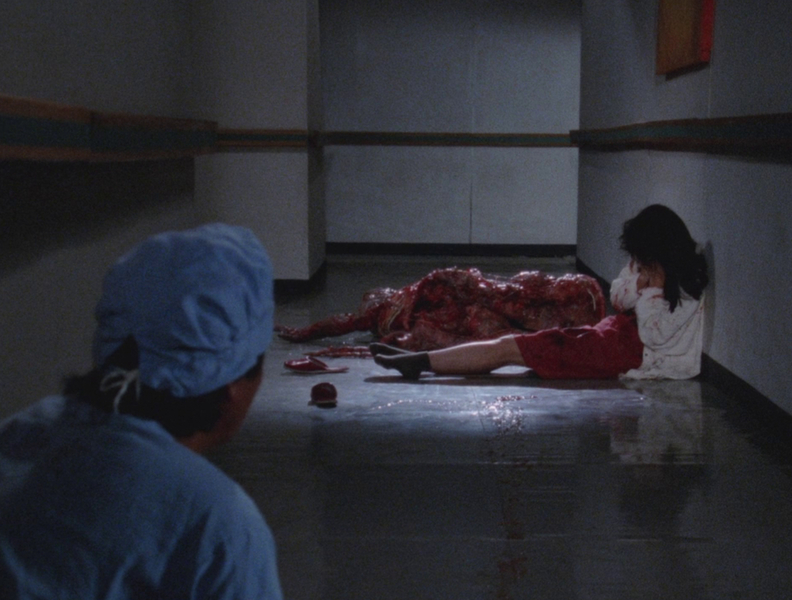
The last act of the film is when it stops talking about biological horror and starts putting it directly in front of the camera. Effects artists Yûichi Matsui and Shuichi Kokumai work with rubber, slime, tissue, bodies, tendrils, wounds, and mutations that look as if you could reach through the screen and touch them (or vice versa). These things sag, drip, stretch, and occupy physical space within the same screen as the actors. That imperfection is part of why they remain so unpleasant to look at. The material feels wet enough that you can almost imagine the cleanup afterward.
Iida also understands when to stop being restrained. The escalation becomes increasingly ridiculous, but the movie has spent enough time holding back that the excess feels earned. Its most elaborate sequence piles one transformation onto another without pretending the production has resources it doesn’t. Instead, creativity becomes the resource. The camera gets close enough to appreciate the craftsmanship, while editing keeps the sequence moving before any effect has the time to betray how it was made.
There’s an obvious temptation to see the parallels in CYCLOPS to David Cronenberg, especially THE FLY and VIDEODROME, or to the monstrosities of THE THING. The similarities are evident, particularly in the fascination with bodies that change and mutate. CYCLOPS has its own scrappiness, though. It belongs to a particular corner of late-1980s Japanese filmmaking, where a short runtime and limited means could invite the attempt at something peculiar. Iida would go on to a much longer career in Japanese horror and science fiction, which makes seeing this early effort particularly interesting. The filmmaking is unrefined, but the attraction to mutation, identity, and bodies behaving badly is impossible to miss.
That historical value is one reason Visual Vengeance’s Collector’s Edition feels so worthwhile. The new transfer comes from the original 16mm film elements, preserving the grain and low-budget texture rather than attempting to make CYCLOPS resemble some new digital production. For a movie that spent years circulating in obscurity, encountered through questionable VHS copies and unreliable downloads, simply having a legitimate presentation with English subtitles gives the film a far better opportunity to be judged on its own merits.
The release also understands that a 52-minute movie needs more surrounding it. A new interview with Iida gives the director a chance to look back on the production. A video essay examining his career situates CYCLOPS within a body of work that stretched well beyond this debut. Another feature focuses on the Japanese direct-to-video market of the era, which is especially useful for understanding why something this short existed in the first place. Justin Decloux and Patrick Macias provide a commentary track, and the package adds photo galleries, liner notes, a mini-poster, reversible VHS artwork, and the assortment of physical extras that Visual Vengeance has made part of its identity.
None of that turns CYCLOPS into a better-written movie. Its first half remains awkward at best, the characters remain thin, and the narrative feels like connective material built to get an effects crew to the part everybody really wanted to make. Those weaknesses are easier to forgive than they would be over a full two hours, although the short runtime also makes the lethargic setup more noticeable.
What survives is the enthusiasm behind the mess. CYCLOPS eventually reaches a point where budget stops being the first thing you notice and imagination takes over. I wouldn’t call the journey there particularly graceful, and anyone coming for a coherent science fiction narrative may wonder why so much of the movie feels unfinished. Horror fans interested in practical effects have a much better reason to stick around. The final stretch is disgusting, inventive, and handmade in a way that modern effects rarely attempt to imitate. Visual Vengeance hasn’t uncovered a forgotten masterpiece. It has preserved a strange, flawed piece of Japanese horror history whose best argument for survival is written in rubber, slime, and an enormous amount of fake blood.
Please visit https://linktr.ee/overlyhonestr for more reviews.
You can follow me on Letterboxd, Instagram, Twitter, and YouTube. My social media accounts can also be found on most platforms by searching for 'Overly Honest Reviews'.
I’m always happy to hear from my readers; please don't hesitate to say hello or send me any questions about movies.
[photo courtesy of VISUAL VENGEANCE, MVD ENTERTAINMENT]
DISCLAIMER:
At Overly Honest Movie Reviews, we value honesty and transparency. Occasionally, we receive complimentary items for review, including DVDs, Blu-rays, CDs, Vinyl Records, Books, and more. We assure you that these arrangements do not influence our reviews, as we are committed to providing unbiased and sincere evaluations. We aim to help you make informed entertainment choices regardless of our relationship with distributors or producers.
Amazon Affiliate Links:
Additionally, this site contains Amazon affiliate links. If you purchase through these links, we may receive a commission. This affiliate arrangement does not affect our commitment to honest reviews and helps support our site. We appreciate your trust and support as you navigate these links.


Happy
0 %

Sad
0 %

Excited
100 %

Sleepy
0 %

Angry
0 %

Surprise
0 %
 1
1
 0
0



Average Rating