History Never Stood a Chance
Read Time:12 Minute, 31 Second
MOVIE REVIEW
Zipang (Jipangu)
 –


Genre: Action, Adventure, Fantasy, Comedy
Year Released: 1990, 2026 Blu-ray
Runtime: 1h 59m
Director: Kaizō Hayashi
Writers: Kaizō Hayashi, Noriyuki Kurita
Cast: Masahiro Takashima, Narumi Yasuda, Bengal, Shirō Sano, Kenya Sawada, Yukio Yamato, Mikijirō Hira, Haruko Wanibuchi, Mikio Narita
Where to Watch: available November 17, 2026. Pre-order your copy here: www.toyrobotvideo.com, www.mvdshop.com, or www.amazon.com
RAVING REVIEW: What happens when a filmmaker decides that samurai sword fights, supernatural mythology, modern weaponry, and outrageous comedy all belong in the same adventure? In Kaizō Hayashi's ZIPANG, the answer is a wildly imaginative journey through an alternate version of Japan where historical accuracy has been politely escorted out of the building. This movie takes the familiar ingredients of a period adventure and gleefully rearranges them until the result barely resembles anything conventional. Outlaws clash with bounty hunters, mysterious warriors emerge from ancient legends, and an elaborate search for a mythical kingdom of gold becomes an excuse for some wonderfully eccentric filmmaking. It's excessive by design, and much of the entertainment comes from seeing just how far Hayashi is willing to push an idea before introducing something even stranger.
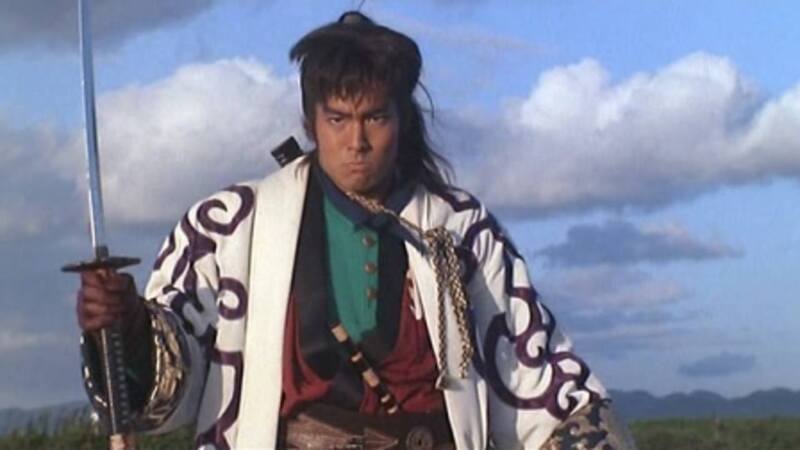
Masahiro Takashima stars as Jigoku Gokurakumaru, an outlaw swordsman whose considerable reputation is matched by his apparent inability to avoid trouble. Accompanied by a collection of oddball companions, he navigates a world where practically everyone seems interested in capturing him or getting their hands on the same legendary treasure. Jigoku possesses an assortment of specialized swords, each with its own purpose, turning his arsenal into something resembling an unusually lethal collection of gadgets. It's an amusing exaggeration of the almost mythical abilities granted to heroic swordsmen in traditional adventure stories. The character isn't simply a wandering fighter who happens to be exceptionally talented. He's a larger-than-life troublemaker whose personality seems perfectly suited to a world where the ordinary rules of combat no longer apply.
Narumi Yasuda plays Yuri the Pistol, a bounty hunter who enters the story determined to collect the reward on Jigoku's head. She's an especially entertaining addition to a film already overflowing with unconventional personalities. Armed with a gun and entirely willing to confront a supposedly formidable swordsman, Yuri immediately complicates the familiar division between heroic warrior and romantic interest. Her confidence establishes a dynamic in which Jigoku can't simply rely on being the most outrageous person in the room. The attraction developing between them adds a romantic dimension to their rivalry, but Yuri's identity as a determined bounty hunter remains central. She's not simply waiting for the outlaw to recognize her value. She pursues him because she fully intends to get what she came for.
Their relationship is part of the film's broader effort to make competing genres share the same space. At times, ZIPANG resembles a playful revision of a samurai adventure. Elsewhere, its fantastical elements push it toward the extravagant mythology of martial arts cinema and illustrated fantasy stories. There's even something of a Western in the relationship between an outlaw and a gunslinging pursuer. Hayashi doesn't bother making these influences fit into a historically convincing world. Instead, he creates a world where their incompatibility becomes part of the joke. The constant mixing of styles is entertaining because the movie isn't embarrassed by its own absurdity. It understands that a ridiculous premise can still support an engaging adventure when approached with imagination and conviction.
Jigoku's band of companions contributes enormously to that personality. Bengal appears as Togizo the Squire, while Shirō Sano portrays Bunshichi the Puppetmaster. The supporting group also includes people whose talents seem better suited to an eccentric traveling performance than an organized criminal operation. That is precisely what makes the ensemble appealing. They don't have the polished professionalism of a conventional band of cinematic heroes. Their different abilities and personalities give the adventure a pleasantly unruly quality, suggesting a group that has accumulated members through one improbable escapade after another. Rather than stopping to explain every relationship, the film lets the characters' behavior establish the peculiar world they inhabit.
The swordplay deserves attention because its inventiveness goes beyond the number of enemies Jigoku encounters. His numbered weapons make combat into an exercise in finding the appropriate instrument for the occasion, as though an enormous fight were simply another job requiring the correct tool. It's an inherently funny concept, especially for a character who can dispatch opponents spectacularly. The approach also creates opportunities for action that feels playful without becoming entirely inconsequential. There's a difference between treating violence as a serious expression of character and building an extravagant fantasy around impossible fighting skills. ZIPANG is firmly interested in the latter, and its more ridiculous confrontations are all the better for refusing to disguise that intention.
The film's historical setting is equally flexible. Although the story draws on recognizable figures and traditions associated with Japan's feudal past, it cheerfully introduces technology that has no business appearing alongside them. The resulting anachronisms are too deliberate to be mistaken for careless production errors. Modern devices and improbable weapons turn the period setting into a fictional playground where anything sufficiently amusing can become part of the action. This distinction matters because the movie's historical references aren't invitations to judge it by the standards of a serious period drama. Hayashi borrows familiar imagery and then sees what happens when he refuses to obey the expectations attached to it.
That creative freedom becomes even more pronounced as the search for the legendary kingdom grows beyond an ordinary treasure hunt. The golden sword at the center of the adventure carries a significance that different characters understand in different ways. To Jigoku and his companions, the promise of treasure provides an obvious attraction. Other figures approach the object through ambitions connected to power or ancient mythology. As these interests collide, the story shifts from a relatively familiar pursuit of riches toward a stranger kind of fantasy. The transition is one of ZIPANG's defining characteristics. Hayashi isn't content to deliver a series of fights surrounding an uncomplicated prize. The treasure opens the door to a mythology with its own peculiar history.
Mikijirō Hira's King of Zipang looms more ominously within that mythology. His kingdom represents the destination so many characters pursue, but the promise of gold carries darker implications than simple financial reward. Haruko Wanibuchi appears as the Queen, bringing another important figure into a story that becomes increasingly concerned with the connections between power and devotion. These characters broaden the adventure beyond the outlaw's personal ambitions. The fantasy material introduces an older world whose rules and emotional conflicts aren't necessarily compatible with the restless comedy surrounding Jigoku. That contrast accounts for some of the movie's most unusual shifts in tone, moving from gleeful nonsense toward a more earnest interest in love and separation.
Those tonal changes also reveal the film's weaknesses. ZIPANG can become so enthusiastic about introducing another idea that its narrative direction grows less clear. What begins as a brisk succession of encounters gradually accommodates a more elaborate supernatural story, and the change in emphasis doesn't always produce a seamless progression. Certain characters and plot developments are more interesting as individual concepts than as parts of a tightly organized narrative. The film's willingness to wander is charming until it begins interrupting its own momentum. Not every detour adds enough to justify the attention it receives, especially when the earlier action has set such a high bar for invention.
Demanding strict discipline from a movie like this would miss much of the point. Hayashi's approach is closer to an imaginative collection of genre possibilities than a conventional adventure constructed around a single dramatic problem. The movie can be comically exaggerated one moment and surprisingly sincere the next because both approaches belong to its exaggerated understanding of heroic storytelling. Its romantic elements may require a greater investment in the characters than the frantic opening provides. They also keep the production from becoming nothing more than an extended exhibition of weapons and fights. Real emotional concerns lie beneath the foolishness, even when the film's eagerness to entertain makes them compete for attention.
Hayashi's background makes the unusual creative direction more interesting. His earlier TO SLEEP SO AS TO DREAM demonstrated an affection for older forms of Japanese filmmaking and the possibilities of constructing a movie around their visual language. ZIPANG takes that interest in cinema's history somewhere considerably louder. Rather than approaching tradition with solemn reverence, it treats the conventions of samurai adventures as material to stretch and rearrange. It's easy to see why the result stands apart from more straightforward action productions of its period. The film doesn't merely borrow an established genre. It enjoys testing the limits of what audiences might accept within it, provided the next extravagant invention is entertaining enough.
The production design reinforces this refusal to settle into any single tradition. Costumes and environments establish a period identity, only to be interrupted by details from an entirely different era or imaginative framework. The world feels assembled from several varieties of adventure fiction, each contributing something to the overall appearance. That combination lets the elaborate fantasy elements sit beside the more recognizable imagery of samurai cinema without requiring an elaborate explanation. What could have become visual confusion instead gives the film its unusual character. Not every design choice needs to support realism when the entire production is built around the pleasure of impossible combinations.
The music contributes another distinctive element. Yōko Kumagai and Hidehiko Urayama are credited with the score, and the soundtrack also includes X Japan's "Endless Rain." That musical association is worth noting because ZIPANG belongs to a period when Japanese popular culture was increasingly willing to bring contemporary influences into stories that draw on historical imagery. The combination suits a film that has already abandoned the expectation that its setting must dictate every creative decision. It also helps separate Hayashi's adventure from a traditional costume drama, giving the production a broader popular-entertainment identity without pretending its historical influences have disappeared.
For anyone interested in Japanese genre filmmaking, the comparison with Hong Kong martial arts fantasies is understandable. Both traditions have produced movies that treat combat as an opportunity for invention, incorporating impossible weapons and supernatural complications without apologizing for their extravagance. ZIPANG shares that enthusiasm, although its specific Japanese references and Hayashi's visual interests give it a personality of its own. The film also recalls the kind of fantasy adventure in which characters can encounter a new variety of danger every few minutes without stopping to question whether it belongs in the same story. That freedom can be exhilarating, as long as the viewer accepts that narrative restraint isn't a priority.
Toy Robot Video's Blu-ray release brings this eccentric production to a North American physical-media audience. The single-disc edition presents the film in Japanese with English subtitles, a 1.85:1 image, and mono audio. At approximately 119 minutes, this is the longer presentation listed by the distributor, rather than the shortened international version that has circulated in some contexts. That distinction matters for a movie whose substantial narrative diversions have fueled differing opinions about its pacing. The Blu-ray lets you approach Hayashi's adventure as a complete work, including the stranger directions that distinguish it from a more streamlined action feature.
The bonus materials are modest but relevant. A newly recorded commentary by Jasper Sharp and Joe Hickinbottom serves as the main supplemental feature, accompanied by theatrical trailers and a stills gallery. Sharp's established work on Japanese cinema makes his involvement an appropriate choice for a film whose combination of popular entertainment and unusual formal interests deserves historical discussion. The edition doesn't attempt to overwhelm collectors with an enormous assortment of supplements. Its appeal rests primarily on making the film available in a modern presentation, with enough additional context to reward viewers interested in exploring the filmmaker and the production's place within Japanese genre history.
There's a particular pleasure in seeing films like ZIPANG receive renewed attention because they resist the neat categories that often determine what gets remembered. It's not a traditional samurai epic, despite borrowing many of the genre's most familiar elements. It isn't simply a supernatural fantasy, although its mythology eventually becomes central to the adventure. Even calling it an action comedy feels insufficient, given how much energy the movie spends reshaping its own story. None of that makes it inaccessible. Its appeal is often immediate and uncomplicated. Unusual characters confront outrageous circumstances, and Hayashi finds another way to make the situation even more ridiculous.
ZIPANG doesn't maintain the same level of excitement throughout its entire running time, and its willingness to pursue every imaginative possibility occasionally leaves the central adventure struggling for attention. Those flaws are inseparable from the creative personality that makes it worth discovering. Hayashi has assembled a film where a swordsman with numbered weapons can share the screen with a pistol-wielding bounty hunter, ancient legends, and technology that belongs centuries in the future. The result is messy in ways that a more disciplined production might have avoided, but it also possesses an enthusiasm that can't be manufactured through careful adherence to genre expectations. Sometimes an adventure's greatest strength is its refusal to behave, and ZIPANG seems perfectly happy to cause trouble.
Please visit https://linktr.ee/overlyhonestr for more reviews.
Follow me on Letterboxd, Instagram, Twitter, and YouTube. You can also find my social media accounts on most platforms by searching for 'Overly Honest Reviews'.
I’m always happy to hear from my readers; please don't hesitate to say hello or send me any movie questions.
[photo courtesy of TOY ROBOT VIDEO, MVD ENTERTAINMENT]
DISCLAIMER:
At Overly Honest Movie Reviews, we value honesty and transparency. Occasionally, we receive complimentary items for review, including DVDs, Blu-rays, CDs, Vinyl Records, Books, and more. We assure you these arrangements do not influence our reviews, as we are committed to unbiased, sincere evaluations. We aim to help you make informed entertainment choices regardless of our relationship with distributors or producers.
Amazon Affiliate Links:
This site also contains Amazon affiliate links. If you purchase through these links, we may receive a commission. This affiliate arrangement does not affect our commitment to honest reviews and helps support our site. We appreciate your trust and support as you navigate these links.


Happy
0 %

Sad
0 %

Excited
0 %

Sleepy
0 %

Angry
0 %

Surprise
0 %
 0
 0

Average Rating