Innocence Questions Everything Around Her
Read Time:6 Minute, 13 Second
MOVIE REVIEW
Marlowe Limited Edition Blu-ray
 –
– 

Genre: Mystery/Thriller, Neo-Noir
Year Released: 1969, 2026 Arrow Video Blu-ray
Runtime: 1h 36m
Director(s): Paul Bogart
Writer(s): Stirling Silliphant, based on Raymond Chandler’s THE LITTLE SISTER
Cast: James Garner, Gayle Hunnicutt, Carroll O’Connor, Rita Moreno, Sharon Farrell, Bruce Lee, Jackie Coogan, William Daniels
Where to Watch: available now, order your copy here: www.arrowvideo.com, www.mvdshop.com, or www.amazon.com
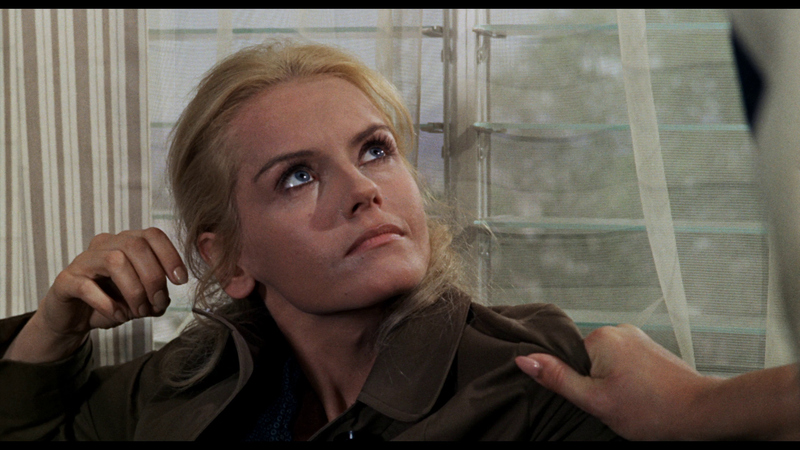
RAVING REVIEW: MARLOWE has the appeal of a movie caught between inheritance and reinvention. It carries the name of one of detective fiction’s great private eyes, borrows its bones from Raymond Chandler’s THE LITTLE SISTER, dresses itself in late-sixties Los Angeles, and then hands the role to James Garner, an actor whose natural portrayal works both for and against the material. The result isn’t one of the essential Philip Marlowe films, and it never quite shakes the feeling that it’s living in the shadow of stronger noir predecessors and more adventurous revisionist detective stories that would arrive soon after. There’s enough charm and curiosity here to make MARLOWE an enjoyable, if uneven, piece of transitional noir.
The case begins with Orfamay Quest, a young woman from Kansas who hires Philip Marlowe to find her missing brother. That job quickly gives way to blackmail, murder, gangsters, suspicious cops (shocker), a television star with secrets, and corpses turning up with ice picks where ice picks don’t belong. It’s standard Chandler territory with a wide outline, but Paul Bogart’s film moves through it with less menace than attitude. MARLOWE isn’t trying to recreate the danger of 1940s noir. It’s more interested in placing a hard-boiled detective inside a world of television studios, strip clubs, and fading old Hollywood. That gives the film personality, even when the mystery itself isn’t as gripping as it should be.
Garner is the main reason the movie remains watchable. His role as Marlowe isn’t a tightly wound cynic. He’s relaxed and lightly amused by the trouble he keeps walking into. That interpretation may disappoint anyone looking for a sharper, more wounded version of Chandler’s detective, but Garner understands how to make intelligence look casual. Marlowe’s toughness comes less from physical intimidation than from stubbornness and timing. He’s not the most dangerous man in the room, and MARLOWE is often better when it recognizes that. His version of the character survives because he keeps reading people a half-second faster than they expect.
Gayle Hunnicutt brings a cool touch to Mavis Wald, the television actress whose image is tied to the case’s darker corners. Sharon Farrell gives Orfamay the necessary mix of innocence and calculation, making her more tricky than she first appears. Carroll O’Connor, removed from the role that would soon define him for television audiences, gives the police side of the story an abrupt energy. Jackie Coogan’s presence adds another old Hollywood vibe, while William Daniels slips easily into the film’s collection of men who seem perfect only from a distance.
Rita Moreno, though, gives MARLOWE a jolt that makes it work. Her role as Dolores Gonzáles could have been treated as pure noir dressing, but Moreno brings an intelligence and confidence that make her scenes stand apart. She understands the movie’s blend of sadness, sexuality, performance, and survival better than almost anyone else in the cast. The film doesn’t always give her enough space, but she makes an impression because she plays Dolores as someone who has seen through the world around her and kept moving anyway.
Then there’s Bruce Lee, whose appearance has become one of MARLOWE’s main selling points. His role as Winslow Wong is brief, but it’s impossible to ignore. Lee’s office-demolishing scene is both thrilling and oddly funny, partly because the movie seems aware that his physical presence belongs to a different level. He enters, wrecks the space, and leaves the film with a feeling it doesn’t quite know how to match afterward.
MARLOWE is interesting because it places Chandler’s private eye in a Los Angeles where television has replaced old studio films as the dominant image-making machine. That should give the film a satirical edge, especially with the blackmail plot centered on a TV star whose public persona can’t survive a private scandal. MARLOWE touches on image, performance, celebrity, and corruption without turning those ideas into something as pointed as they could have been.
What it does have is texture. The clothes, interior design, music, and studio craftsmanship give MARLOWE an appealing period quality. It’s a movie that looks backward and sideways at the same time, aware of noir tradition but dressed in a different moment. That makes it more interesting than a simple remake or imitation would have been.
The Arrow Video release gives MARLOWE another chance to be seen for what it is. Not a lost classic, but an enjoyable bridge between eras. It points toward Garner’s later detective persona in THE ROCKFORD FILES, gives Bruce Lee an early American film appearance that still jumps off the screen, and lets Rita Moreno steal attention whenever the film is smart enough to hand it to her. It’s flawed, occasionally underpowered, and not as stylish or dangerous as its premise promises, but it has enough personality to keep the case alive.
MARLOWE works best when expectations are kept in check. This isn’t the Marlowe you reach for when you want the definitive screen version of Chandler’s detective. It’s the one you watch to see a familiar character loosened up, dropped into a changing Los Angeles, and filtered through Garner’s relaxed vibes. The film could use a harder edge, but its cast, curiosity, and easygoing charm carry it farther than the material might otherwise. It’s a solid, imperfect detective picture with a few standout moments, a few missed opportunities, and just enough cool to make the trip worthwhile.
Please visit https://linktr.ee/overlyhonestr for more reviews.
You can follow me on Letterboxd, Instagram, Twitter, and YouTube. My social media accounts can also be found on most platforms by searching for 'Overly Honest Reviews'.
I’m always happy to hear from my readers; please don't hesitate to say hello or send me any questions about movies.
[photo courtesy of ARROW VIDEO, MVD ENTERTAINMENT]
DISCLAIMER:
At Overly Honest Movie Reviews, we value honesty and transparency. Occasionally, we receive complimentary items for review, including DVDs, Blu-rays, CDs, Vinyl Records, Books, and more. We assure you that these arrangements do not influence our reviews, as we are committed to providing unbiased and sincere evaluations. We aim to help you make informed entertainment choices regardless of our relationship with distributors or producers.
Amazon Affiliate Links:
Additionally, this site contains Amazon affiliate links. If you purchase through these links, we may receive a commission. This affiliate arrangement does not affect our commitment to honest reviews and helps support our site. We appreciate your trust and support as you navigate these links.


Happy
0 %

Sad
0 %

Excited
100 %

Sleepy
0 %

Angry
0 %

Surprise
0 %
 1
1
 0
0

Innocence Questions Everything Around Her
Read Time:6 Minute, 17 Second
MOVIE REVIEW
Goat Girl (The goat girl) (La niña de la cabra)
–
Genre: Drama
Year Released: 2025, 2026 Outsider Pictures
Runtime: 1h 35m
Director(s): Ana Asensio
Writer(s): Ana Asensio
Cast: Alessandra González, Juncal Fernández, Lorena López, Javier Pereira, Enrique Villén
Where to Watch: showing June 19, 2026, at New York's Cinema Village, with other cities to follow
RAVING REVIEW: GOAT GIRL really explores the deepest ideas in the confusion adults leave behind when they expect children to accept the world without explanation. Writer/director Ana Asensio’s sophomore feature has a clear affection for childhood wonder, but it’s not interested in treating that curiosity as empty or pure. Elena, played by Alessandra González, is eight years old, preparing for her First Communion in 1988 Madrid, and trying to understand death, faith, class, prejudice, family tension, and the rules adults enforce with very little patience. That’s a lot for one film to carry, and GOAT GIRL is most successful when it lets those ideas thrive through Elena’s emotion, her questions, and the uncomfortable silences that follow.
Elena is grieving her grandmother, being consumed by Catholic teachings she doesn’t know how to process, and forming a friendship with Serezade, a Roma girl whose affinity for her goat becomes both a source of fascination and fear. What matters isn’t only that Elena meets someone different from the world her family and school have defined as acceptable. It’s through this friendship that we begin to see how much of her childhood has already been shaped by ideas she never chose. She has been handed beliefs about religion, class, outsiders, obedience, death, sin, and what someone else's idea of what she should be. The film understands that children often notice the absurdity of adult behavior before they have a true understanding of how to challenge it.
GOAT GIRL has plenty of meaningful ideas running beneath its surface, including racism, classism, religious guilt, and emotional neglect. Although it sometimes handles them so gently that they feel more seen than developed. There are moments when the film’s restraint works beautifully, especially when Elena weighs what she’s been told against what she sees for herself. At other times, that same restraint keeps the story from gaining enough traction to continue moving forward.
González gives GOAT GIRL the core connection that makes the film work. Child performances in films like this can easily feel too self-aware or even too aware of the camera, but her work has a unique simplicity. Elena doesn’t come across like a young adult written to deliver theme-heavy observations. She feels like a child whose questions are disorderly, sincere, frightened, and sometimes funny because she’s trying to assemble a level of morality from pieces that don’t fit. Juncal Fernández brings an open, grounded presence as Serezade, and the friendship between the two girls gives the film something that can’t be forced. Their connection works best in the small ideas, the curiosity, the way Elena is drawn toward a life that her surroundings have taught her to view with suspicion.
The adults surrounding Elena are intentionally flawed without becoming villains. Lorena López and Javier Pereira help create a family space where love, frustration, distance, and carelessness all coexist. Elena’s parents aren’t presented as monsters, but they’re part of a larger world that expects children to behave while giving them very little honesty in return. Enrique Villén’s priest offers a different perspective on the film’s depiction of Catholicism as both sacred and deeply confusing to a child. GOAT GIRL doesn’t mock faith, but it does question the way fear and shame can be wrapped in religious language and passed down as truth.
Asensio isn’t chasing nostalgia for its own sake. The period details help define the boundaries around Elena’s life, from the social expectations placed on children to the casual prejudices that adults treat as normal. The film is at its sharpest when it shows how ordinary these lessons can appear from the outside. A child can be taught cruelty without anyone raising their voice. A family can pass along anxiety without saying it out loud. A school or church can make exclusion feel like tradition.
Elena’s journey is less about rebellion in the dramatic sense and more about the small rupture that happens when a child begins to recognize contradiction. She’s told what is right, but the people telling her don’t always behave with kindness. She’s taught what is sinful, but the world around her is filled with casual injustice. She’s expected to perform faith, manners, and obedience, while her grief and confusion are treated as inconveniences.
GOAT GIRL is a modest film, and that modesty can be disarming. It doesn’t force its emotions, but it also doesn’t always reach the depth it reaches for. Its best scenes are tender, observant, and funny in the way childhood can be funny before it becomes painful. González and Fernández make the central friendship easy to invest in, and Asensio’s affection for these girls is never in doubt.
The result is a film that works as a gentle memory. GOAT GIRL has sincerity, warmth, and a meaningful perspective on how children inherit prejudice and fear before they’re old enough to understand either one. It’s also a little light in places where it could have cut deeper. For viewers drawn to quiet coming-of-age stories with social and religious undertones, there’s enough here to appreciate. For those hoping the film’s darker ideas will build into something more, it may feel charming but limited. That balance is what keeps GOAT GIRL interesting, imperfect, and easy to respect, even when it doesn’t quite become as memorable as its best moments suggest.
Please visit https://linktr.ee/overlyhonestr for more reviews.
You can follow me on Letterboxd, Instagram, Twitter, and YouTube. My social media accounts can also be found on most platforms by searching for 'Overly Honest Reviews'.
I’m always happy to hear from my readers; please don't hesitate to say hello or send me any questions about movies.
[photo courtesy of OUTSIDER PICTURES, AQUÍ Y ALLÍ FILMS, AVALON, AVANPOST, COMUNIDAD DE MADRID, INSTITUTO DE LA CINEMATOGRAFÍA Y DE LAS ARTES AUDIOVISUALES (ICAA), LA NIÑA DE LA CABRA]
DISCLAIMER:
At Overly Honest Movie Reviews, we value honesty and transparency. Occasionally, we receive complimentary items for review, including DVDs, Blu-rays, CDs, Vinyl Records, Books, and more. We assure you that these arrangements do not influence our reviews, as we are committed to providing unbiased and sincere evaluations. We aim to help you make informed entertainment choices regardless of our relationship with distributors or producers.
Amazon Affiliate Links:
Additionally, this site contains Amazon affiliate links. If you purchase through these links, we may receive a commission. This affiliate arrangement does not affect our commitment to honest reviews and helps support our site. We appreciate your trust and support as you navigate these links.
Happy
0 %
Sad
0 %
Excited
0 %
Sleepy
0 %
Angry
0 %
Surprise
0 %
0
0


Average Rating