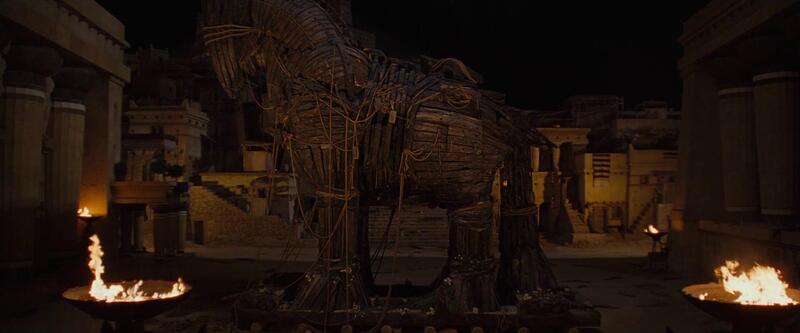
The Gods and Monsters Stay Silent Here
Read Time:10 Minute, 40 Second
MOVIE REVIEW
Troy [Limited Edition]
 –
– 

Genre: Action, Adventure, Drama
Year Released: 2004, 2026 Arrow Video 4K
Runtime: 2h 43m
Director: Wolfgang Petersen
Writer: David Benioff
Cast: Brad Pitt, Eric Bana, Orlando Bloom, Diane Kruger, Brian Cox, Brendan Gleeson, Sean Bean, Rose Byrne, Peter O’Toole
Where to Watch: available August 18, 2026, pre-order your copy here: www.arrowvideo.com, www.mvdshop.com, or www.amazon.com
RAVING REVIEW: Hector knows what war costs before the ships reach the Trojan shore. He understands that courage won’t protect his family, honor won’t restrain an ambitious king, and victory might only delay the destruction waiting outside the city walls. TROY surrounds him with men who speak eagerly about glory, destiny, and the names history will remember. Hector is the one man asking who will be alive when that begins.
That perspective gives Wolfgang Petersen’s production a human foundation beneath the armies, fortifications, and thousands of ships. Eric Bana plays Hector as a warrior whose strength comes from responsibility rather than appetite. He fights because Troy requires it, not because killing makes him feel immortal. Bana carries a deepened exhaustion into nearly every scene, allowing Hector to love his country while recognizing the terrible decisions being made in its name.
Achilles approaches mortality from the opposite direction. He knows death is unavoidable and wants to leave behind a name strong enough to outlive his body. Brad Pitt gives him the physicality expected of a legendary warrior, moving through combat with speed, precision, and an almost insulting lack of concern for whoever stands across from him. Achilles doesn’t simply believe he’s superior to other soldiers. He treats that superiority as an observable fact.
Pitt’s performance was reduced to hair, armor, and a carefully sculpted body when TROY arrived in 2004. Time has been kinder to what he’s doing beneath the imposing appearance. Achilles carries himself like a man trapped by the reputation he worked to create, unable to walk away because life can no longer satisfy him. Pitt occasionally sounds too contemporary for the surroundings, though his restraint becomes more persuasive as victory no longer provides the fulfillment Achilles expected.
David Benioff’s screenplay removes the active presence of the Greek gods and turns the Trojan War into a conflict driven entirely by pride, politics, revenge, and desire. The choice makes the story easier to approach as a grounded war drama, particularly for viewers unfamiliar with Homer’s THE ILIAD. Agamemnon doesn’t need divine guidance to attack Troy. Helen’s departure gives him the public justification he needs to pursue power he already wanted. (Such an interesting parallel to 2026’s THE ODYSSEY, a film that happily leans into gods and monsters.)
Removing the gods also changes the nature of the tragedy. Characters who were once caught between desire and divine interference now bear full responsibility for their choices. The story becomes less mysterious and less mythic, but its cruelty feels more forefronted. Every death results from a king’s ambition, a prince’s recklessness, a warrior’s wounded pride, or another man’s inability to stop events he can see moving toward disaster.
Brian Cox relishes Agamemnon’s hunger for control without turning him into a figure sitting safely behind his army. His contempt makes it clear that Menelaus’s humiliation is merely an opportunity. Brendan Gleeson plays Menelaus as angry and savage rather than heartbroken. At the same time, Sean Bean gives Odysseus the awareness of a man who understands both the absurdity of the war and his inability to avoid it. Their competing motives make the Greek alliance feel temporary even when the soldiers move as one enormous force.
Peter O’Toole’s Priam stands on the other side. He loves his sons, believes deeply in Troy, and trusts traditions that can no longer guarantee safety. O’Toole doesn’t need a battlefield to establish authority. His voice and posture convey a lifetime of leadership, while his moments of uncertainty expose an older man watching his family pay for decisions he can’t take back.
The scale surrounding these performances remains impressive more than two decades later (although again, compared to THE ODYSSEY, the cracks show). Petersen gives the armies a feeling of depth and impact, filling the beaches and plains with bodies that feel like something is there, rather than simply occupying the background. The first Greek assault establishes the speed and confidence of Achilles and his Myrmidons. The later battles become increasingly chaotic as formations collapse and individual soldiers disappear inside the violence.
TROY doesn’t treat combat as an uninterrupted celebration. Victories arrive with funeral fires, damaged alliances, and families waiting for men who won’t return. Petersen allows the spectacle to remain exciting without completely separating that excitement from consequence. The camera pulls back far enough to display the size of the armies, then returns to the ground where shields break, soldiers panic, and bravery becomes difficult to distinguish from desperation.
Nothing in the larger battles matches the confrontation between Hector and Achilles. The sequence works because both men enter it carrying different burdens. Achilles wants revenge, and Hector understands that refusing the challenge would merely move the danger closer to his family. Their duel is swift, brutal, and remarkably easy to follow, built around the fighters’ contrasting styles rather than frantic editing.
Bana and Pitt reportedly performed the duel without stunt doubles, and that commitment is visible in the speed and force of their movements. Achilles attacks with the confidence of someone who has never encountered an equal. Hector adjusts, searches for openings, and survives longer than anyone expects. The outcome may be known, but Petersen creates tension by making every blow feel capable of altering what has already been written.
Orlando Bloom plays Paris as impulsive, frightened, and painfully unaware of how many people will suffer for his decisions. That characterization is intentional, especially when placed beside Hector, though Paris remains difficult to invest in once the war expands beyond his romance. His willingness to let others fight and die for a love he describes as unavoidable makes him one of the story’s most frustrating figures. Diane Kruger brings sadness and guilt to Helen, but the screenplay gives her limited room to exist beyond being desired, defended, and blamed. Her relationship with Paris begins the war without becoming convincing enough to carry its consequences. The movie repeatedly tells us that their love is worth risking everything, while their scenes together rarely explain why either person believed that risk was justified.
The women throughout TROY are asked to absorb the damage created by men. Rose Byrne gives Briseis conviction and intelligence, although her storyline becomes tied too quickly to Achilles. Saffron Burrows has several affecting scenes as Andromache, especially when Hector attempts to prepare her for the possibility of Troy falling. Their marriage has a tenderness missing from the movie’s younger romance, making Hector’s departure from his wife and child far more painful than the affair that started the war.
The treatment of Achilles and Patroclus also reflects the limitations of a major production made in 2004. TROY identifies Patroclus as Achilles’ young cousin and leaves no room for the emotional or romantic interpretations that have followed the characters for centuries. That decision narrows Achilles’ grief by making the relationship “safer and easier to explain.” Garrett Hedlund communicates Patroclus’s admiration, but the screenplay rushes through a bond that motivates one of its most consequential acts of revenge.
TROY reaches its emotional peak after the majority of the fighting has ended. Priam’s secret journey into the Greek camp strips away the armies, royal titles, and declarations of glory, leaving two grieving men in the same room. O’Toole is extraordinary as Priam asks Achilles to think of his own father and return Hector’s body. Pitt responds by letting Achilles’ confidence briefly disappear, revealing the frightened mortal beneath the warrior everyone believes can’t be defeated. The scene accomplishes what the film’s louder moments sometimes struggle to express. No victory can restore the dead, and no reputation can protect a man from grief. Achilles finally recognizes something familiar in an enemy, while Priam preserves his dignity without pretending forgiveness has erased what happened. Their exchange gives the chaos surrounding it a reason to matter.
The theatrical cut runs nearly three hours, yet some relationships remain underdeveloped because the movie is carrying an enormous amount of story. The ten-year conflict has been compressed into a short campaign, and political shifts occasionally happen with little room to settle. The 196-minute Director’s Cut restores character depth in some ways, expands the violence, and gives portions of the story additional breathing room, though it can’t completely repair the thinner romantic writing.
Arrow Video’s Limited Edition presents both versions in 4K with Dolby Vision and lossless audio. Each cut receives its own 4K disc, while a third Blu-ray brings together archival featurettes, production material, galleries, the trailer, and an introduction by Petersen. The new remasters were created from the original 35mm camera negative, giving the film’s large-scale photography a physical-media release suited to its size.
TROY takes substantial liberties with Homer, abandons the gods, simplifies important relationships, and occasionally allows grandeur to overpower intimacy. Its adaptation may frustrate anyone seeking a close translation of THE ILIAD, but Petersen understands the tragedy behind the legend. Kingdoms fall because powerful men mistake desire for destiny, and soldiers become immortal only after losing the lives they were so eager to risk. Hector leaves the strongest impression because he never needs history to call him great. He protects his family, stands beside his people, and walks toward a fight he knows he may not survive. Achilles gets the eternal name he wanted, but Hector gives TROY its soul.
Bonus Materials:
4K ULTRA HD LIMITED EDITION CONTENTS
Brand new 4K remasters of both the Director’s Cut and Theatrical Cut of the film from the original 35mm camera negative by Arrow Films
Collectors’ booklet featuring new writing on the film by Priscilla Page and Laurie Maguire and an excerpt from the original production notes
Reversible sleeve featuring original and newly commissioned artwork by Peter Strain
DISC 1: THEATRICAL CUT (4K ULTRA HD)
4K (2160p) Ultra HD Blu-ray presentation in Dolby Vision (HDR10 compatible) of the Theatrical Cut
Original lossless DTS-HD MA 5.1 surround audio plus stereo audio
Optional English subtitles for the deaf and hard of hearing
DISC 2: DIRECTOR’S CUT (4K ULTRA HD)
4K (2160p) Ultra HD Blu-ray presentation in Dolby Vision (HDR10 compatible) of the Director’s Cut
Original lossless DTS-HD MA 5.1 surround audio plus stereo audio
Optional English subtitles for the deaf and hard of hearing
Troy Revisited, an archival introduction by director Wolfgang Petersen
DISC 3: EXTRAS (BLU-RAY)
In Movie Experience, an archive picture-in-picture commentary of the film
Troy in Focus, a series of archival behind-the-scenes featurettes
In the Thick of Battle, an archival behind-the-scenes featurette
From Ruins to Reality, an archival behind-the-scenes featurette
Troy: An Effects Odyssey, an archival behind-the-scenes featurette
Attacking Troy, an archival behind-the-scenes featurette
Gallery of the Gods, an archival introduction to the Greek Gods
Easter egg
Trailer
Image galleries
Please visit https://linktr.ee/overlyhonestr for more reviews.
You can follow me on Letterboxd, Instagram, Twitter, and YouTube. You can also find my social media accounts on most platforms by searching for 'Overly Honest Reviews'.
I’m always happy to hear from my readers; please don't hesitate to say hello or send me any questions about movies.
[photo courtesy of ARROW VIDEO, MVD ENTERTAINMENT]
DISCLAIMER:
At Overly Honest Movie Reviews, we value honesty and transparency. Occasionally, we receive complimentary items for review, including DVDs, Blu-rays, CDs, Vinyl Records, Books, and more. We assure you that these arrangements do not influence our reviews, as we are committed to providing unbiased and sincere evaluations. We aim to help you make informed entertainment choices regardless of our relationship with distributors or producers.
Amazon Affiliate Links:
Additionally, this site contains Amazon affiliate links. If you purchase through these links, we may receive a commission. This affiliate arrangement does not affect our commitment to honest reviews and helps support our site. We appreciate your trust and support as you navigate these links.


Happy
0 %

Sad
0 %

Excited
100 %

Sleepy
0 %

Angry
0 %

Surprise
0 %
 1
1
 0
0


Average Rating