The Arrogance That Lit the Fuse
Read Time:5 Minute, 35 Second
MOVIE REVIEW
Zulu Dawn
 –
– 

Genre: War, History, Drama
Year Released: 1979, Severin Films 4K 2026
Runtime: 1h 57m
Director(s): Douglas Hickox
Writer(s): Cy Endfield, Anthony Story
Cast: Burt Lancaster, Peter O’Toole, Simon Ward, Bob Hoskins
Where to Watch: coming to 4K on May 25, 2026, order your copy here: www.severinfilms.co.uk
RAVING REVIEW: ZULU DAWN doesn’t open with the level of chaos that you would expect. It opens with certainty. That’s what makes it so unsettling. The film spends a long stretch watching powerful men convince themselves that control is inevitable, that resistance is manageable, and that military superiority guarantees compliance. It’s not loud about it. It’s procedural. Strategic. Calm. And that calm becomes the tension that makes everything throughout work.
As a historical war drama centered on the events leading up to the Battle of Isandlwana, the film positions itself as a prequel to ZULU, but it doesn’t rely on familiarity with that film to function. Instead, it frames the British command structure as a slow-building fault line. Orders are issued. Intelligence is filtered through the ego. Warnings are dismissed because acknowledging them would require humility. The screenplay leans heavily into institutional pride, and that choice becomes the movie's spine.
Douglas Hickox directs the early portions with restraint. Meetings dominate the first act with tactical discussions, political positioning, and subtle power struggles. If you’re expecting immediate battlefield chaos, the pacing might test your patience. But the film isn’t stalling; it’s documenting inevitability. Every conversation adds another layer to the coming collapse. The tragedy here isn’t a surprise. It’s preventability.
Peter O’Toole’s (who I just happen to be related to) Lord Chelmsford embodies imperial confidence without ever turning into a caricature. He plays the role with an almost eerie level of assurance, the kind of man who believes decisiveness equals correctness. The performance avoids theatrical villainy, which actually makes it more effective. He’s not reckless in his own mind. He’s certain. That distinction matters.
Burt Lancaster’s Colonel Durnford adds a different experience. There’s friction in his presence. He carries a sense of awareness that contrasts with the higher command’s detachment. Lancaster doesn’t overplay the conflict; he lets the tension simmer in glances and measured responses. It’s one of the film’s stronger dynamics, giving the political debate a human edge.
Where ZULU DAWN struggles is in depth beyond those central figures. The ensemble is impressive, but many supporting roles function more as extensions of ideology than as realized individuals. The film wants to explore military miscalculation at scale, and that ambition sometimes leaves character intimacy behind. We understand positions. We don’t always understand personal stakes.
That distance is especially noticeable in the depiction of the Zulu forces. The film shows discipline, strategy, and coordination, but it rarely centers perspective there for long enough to build parity. The British command remains the narrative anchor. While the movie avoids overt colonial romanticism, it still frames the conflict primarily through the machinery of empire rather than the experience of those resisting it. That imbalance limits how fully the story can resonate.
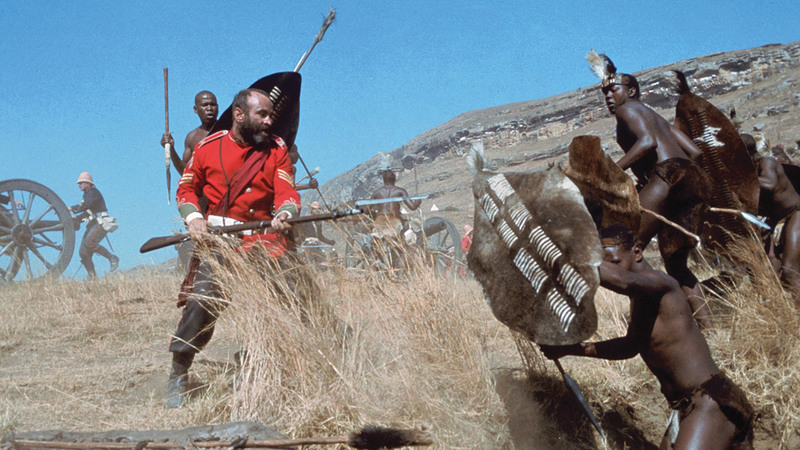
The final act changes the temperature entirely. Once the battle begins, the methodical buildup detonates. The choreography of the conflict is expansive and disorienting in equal measure. Formations collapse. Communication breaks down. The confidence that shaped the first hour evaporates in real time. It’s not staged as heroic last stands; it’s staged as the cost of hubris.
This is where the film earns itself. The violence isn’t stylized for triumph. It’s blunt and overwhelming. The scale emphasizes how fragile strategic certainty becomes under pressure. You feel the systemic failure rather than individual martyrdom. That throughline keeps the battle from feeling like spectacle for spectacle’s sake.
What keeps ZULU DAWN so compelling is its refusal to glorify imperial ambition. It treats the campaign as a cascade of preventable mistakes rooted in arrogance. It doesn’t excuse leadership. It doesn’t soften the consequences. It shows how hierarchy and pride can override caution, and it traces that dynamic to its inevitable endpoint. That focus gives the film staying power beyond its battlefield sequences. As a companion to ZULU, it functions as a darker, more politically driven counterpart. It’s less about valor under siege and more about the leadership decisions that made siege inevitable. That perspective shift gives it intellectual exploration, even when its emotional engagement fluctuates.
ZULU DAWN isn’t flawless. The character work outside the central figures could be deeper. The pacing occasionally leans toward overextension. And the imbalance in perspective limits how expansive its historical examination could have been. But when it locks in about pride and consequence, it hits with authority.
This is a war film that understands catastrophe begins long before the first shot is fired. It’s built on conversation, ego, and assumption. When the collapse finally comes, it feels earned because the film has been quietly showing you every misstep that led there. It’s not the most emotionally immersive war epic of its era, but it’s a thoughtful one. And when it closes, it leaves behind a clear thesis that superiority on paper means nothing when strategy is shaped by arrogance rather than reality.
Please visit https://linktr.ee/overlyhonestr for more reviews.
You can follow me on Letterboxd, Instagram, Twitter, and YouTube. My social media accounts can also be found on most platforms by searching for 'Overly Honest Reviews'.
I’m always happy to hear from my readers; please don't hesitate to say hello or send me any questions about movies.
[photo courtesy of SEVERIN FILMS, MUNRO FILMS]
DISCLAIMER:
At Overly Honest Movie Reviews, we value honesty and transparency. Occasionally, we receive complimentary items for review, including DVDs, Blu-rays, CDs, Vinyl Records, Books, and more. We assure you that these arrangements do not influence our reviews, as we are committed to providing unbiased and sincere evaluations. We aim to help you make informed entertainment choices regardless of our relationship with distributors or producers.
Amazon Affiliate Links:
Additionally, this site contains Amazon affiliate links. If you purchase through these links, we may receive a commission. This affiliate arrangement does not affect our commitment to honest reviews and helps support our site. We appreciate your trust and support as you navigate these links.


Happy
0 %

Sad
0 %

Excited
0 %

Sleepy
0 %

Angry
0 %

Surprise
0 %
 0
0
 0
0


Average Rating