Kink, Chaos, and Questionable Judgment
Read Time:7 Minute, 47 Second
MOVIE REVIEW
I Want Your Sex
 –
– 


Genre: Comedy, Romance, Thriller
Year Released: 2026
Runtime: 1h 30m
Director(s): Gregg Araki
Writer(s): Gregg Araki, Karley Sciortino
Cast: Olivia Wilde, Cooper Hoffman, Mason Gooding, Chase Sui Wonders, Johnny Knoxville, Margaret Cho, Roxane Mesquida, Charli XCX, Daveed Diggs
Where to Watch: opens nationwide July 31, 2026
RAVING REVIEW: Sex has become so scarce, or in some cases even taboo, in mainstream movies that showing adults openly wanting it now feels strangely confrontational. Gregg Araki responds to that with I WANT YOUR SEX. This loud, latex-covered comedy treats desire as funny, dangerous, embarrassing, liberating, and occasionally capable of ruining everyone’s week. Ultimately, I do think there could have been a more edgy version of this film somewhere; it played with that line, but never quite jumped to the other side as much as it could have.
The result is unmistakably a Gregg Araki film, right down to the aggressive colors, beautiful people making awful choices, sudden tonal changes, and emotional sincerity hiding behind ridiculous behavior. I WANT YOUR SEX may look like a prolonged provocation, but its interest in desire goes beyond how many restraints, toys, and latex outfits can fit into 90 minutes.
Elliot is a twentysomething whose ambition hasn’t developed much beyond finding somewhere to be. A job assisting Erika Tracy, a famous artist with no interest in ordinary professional boundaries, gives him direction and places him near someone whose confidence seems almost supernatural. Erika quickly identifies the mixture of curiosity, inexperience, and eagerness he hasn’t learned to hide.
She doesn’t just hire him. Erika turns Elliot into her sexual muse and submissive (sometimes willing), introducing him to an arrangement that makes his previous relationship with his more conservative girlfriend, Minerva, look even more emotionally vacant. What begins as an intimidating fantasy becomes a contest involving control, attachment, jealousy, artistic ego, and the increasingly unreliable difference between choosing something and understanding its consequences.
Araki and co-writer Karley Sciortino don’t pretend the employer-subordinate relationship is harmless because Elliot finds it exciting. Consent may be there in the beginning with the arrangement. But that doesn’t erase the enormous imbalance between a powerful artist and an inexperienced employee who can barely explain what he wants. The film lets that discomfort remain throughout, at times amplifying it to an eleven.
That refusal to take a clear moral position gives the comedy some bite. Erika can be liberating and selfish during the same encounter. Elliot can enjoy surrendering control, only to become angry when he realizes the person holding it may not care about him the way he imagined. Their choices don’t become meaningless simply because both entered the relationship willingly.
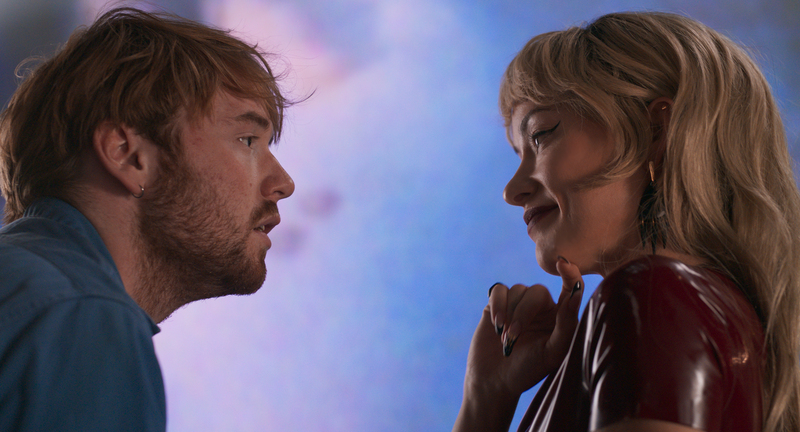
Olivia Wilde understands that Erika has to be seductive, ludicrous, exhausting, and slightly frightening at once. She enters scenes with the confidence of someone who has spent years making others wait for her approval, then allows small flashes of insecurity to surface whenever that authority is threatened. Erika has built her identity around being impossible to embarrass, which makes every moment of emotional exposure feel dangerous. Wilde commits to Araki’s heightened world without turning the performance into a joke. Her posture, wardrobe, and deliberately controlled tone suggest that Erika has designed herself as carefully as one of her art installations. She wants to be desired, feared, studied, and obeyed, although being known is another matter.
Cooper Hoffman takes a less obvious route with Elliot. Rather than trying to match Erika’s presence, he plays him as someone whose fantasy life has outpaced his emotional vocabulary. Elliot can participate in elaborate sexual situations and remain incapable of answering a straightforward question about what any of it means to him. Hoffman’s nervousness becomes one of the film’s best ideas. Elliot is frequently aroused, confused, alarmed, or all three at the same time, and his inability to project confidence makes Erika’s interest in him both funnier and more revealing. Their chemistry isn’t built around two equally assured people meeting in the middle; it comes from the attraction between someone who believes she controls everything and someone who discovers how much power submission can hold.
Mason Gooding’s portrayal of Zap, one of the people entrenched in Erika’s artistic empire, delivers some of the film’s funniest reactions without making the character seem unaware of the absurdity surrounding him. He knows what kind of workplace this is, which makes him far less shocked than Elliot and considerably better prepared to survive it.
Chase Sui Wonders brings the perfect emotional friction as Apple, Elliot’s roommate and closest friend. Apple can recognize the danger in his obsession long before he does, though her concern is tangled with feelings she hasn’t addressed. Wonders prevents the character from becoming a sensible observer placed outside the madness, allowing Apple to make her own messy decisions once desire and resentment become impossible to separate. It breaks my heart though, because the world wants/needs more Apple and I wanted the film to give her a deeper story!
Charli XCX plays Minerva with an amusingly dry distance that suits the film’s satire. Her disinterest in Elliot becomes funny because she treats their relationship like an administrative obligation neither of them remembers agreeing to maintain. The character remains more one-dimensional than the others, occasionally feeling designed to prove Erika’s argument about sexually disengaged young adults rather than exist beyond it.
The mystery in the film supplies momentum, although it’s less compelling than the shifting relationships. The investigation occasionally feels attached to the story because Araki wants another excuse to rearrange loyalties and expose secrets. It produces laughs and gives the supporting cast room to play, but the emotional fallout between Elliot, Erika, and Apple carries far greater weight than the question of criminal responsibility.
The generational commentary can also become unnecessarily direct. Erika repeatedly describes younger adults as frightened, sexually inactive, and trapped behind carefully managed identities. Some of that land is because Elliot and his friends embody genuine contradictions, but the screenplay occasionally has her explain its argument after the characters have already demonstrated it. Treating Gen Z as a single anxious group creates easy targets that aren’t always convincing. The film is perceptive when examining how fear of making mistakes can prevent honest communication, though it becomes less interesting when sexual caution is treated as little more than prudishness. Hesitation may come from repression, but it can also come from experience, self-awareness, or a reasonable distrust of powerful people announcing themselves as liberators.
The costumes extend Erika’s authority before a line of dialogue in her scenes. Latex, exaggerated accessories, and carefully exposed skin turn clothing into another instrument of control. Elliot’s relative blandness makes him appear as though he wandered into someone else’s fantasy and only gradually realized he was expected to perform.
I WANT YOUR SEX doesn’t argue that every boundary exists to be crossed. It argues that desire becomes harder to understand when people are too frightened, ashamed, distracted, or dishonest to discuss it. Erika mistakes experience for wisdom, Elliot confuses intensity with intimacy, and nearly everyone discovers that sexual freedom doesn’t remove emotional responsibility.
In the end, the thing keeping the film from being as good as it could have been was its unwillingness to go further, not necessarily with the encounters, but with the idea of it all. It’s too excited to focus on the irony of it all, swapping the traditional gender roles, and just trying to push too hard in the wrong way. That doesn’t ruin the film; it just stops it short of being as thoughtful as it could have been. After years of movies treating sex as something that happens offscreen between conversations, I WANT YOUR SEX puts it back inside the argument. The result is messy, colorful, knowingly ridiculous, and alive in ways respectable entertainment often forgets how to be.
Please visit https://linktr.ee/overlyhonestr for more reviews.
You can follow me on Letterboxd, Instagram, Twitter, and YouTube. You can also find my social media accounts on most platforms by searching for 'Overly Honest Reviews'.
I’m always happy to hear from my readers; please don't hesitate to say hello or send me any questions about movies.
[photo courtesy of DESPERATE PICTURES, BLACK BEAR, MAGNOLIA PICTURES]
DISCLAIMER:
At Overly Honest Movie Reviews, we value honesty and transparency. Occasionally, we receive complimentary items for review, including DVDs, Blu-rays, CDs, Vinyl Records, Books, and more. We assure you that these arrangements do not influence our reviews, as we are committed to providing unbiased and sincere evaluations. We aim to help you make informed entertainment choices regardless of our relationship with distributors or producers.
Amazon Affiliate Links:
Additionally, this site contains Amazon affiliate links. If you purchase through these links, we may receive a commission. This affiliate arrangement does not affect our commitment to honest reviews and helps support our site. We appreciate your trust and support as you navigate these links.


Happy
0 %

Sad
0 %

Excited
0 %

Sleepy
0 %

Angry
0 %

Surprise
0 %
 0
0
 0
0


Average Rating