The Frontier Looks Different From Here
Read Time:9 Minute, 52 Second
MOVIE REVIEWS
Eastern Trails: The Western at DEFA
 –
– 

Genre: Western, Adventure, Drama
Years Released: 1967, 1969, 1973, 1975
Runtime: 6h 6m
Directors: Richard Groschopp, Konrad Petzold, Gottfried Kolditz, Werner W. Wallroth
Writers: Wolfgang Ebeling, Richard Groschopp, Günter Karl, Rolf Römer, Gottfried Kolditz, Gojko Mitić, Werner W. Wallroth, Dean Reed
Cast: Gojko Mitić, Dean Reed, Armin Mueller-Stahl, Rolf Römer, Andrea Drahota, Milan Beli, Annekathrin Bürger
Where to Watch: available now; order your copy here: www.eurekavideo.co.uk
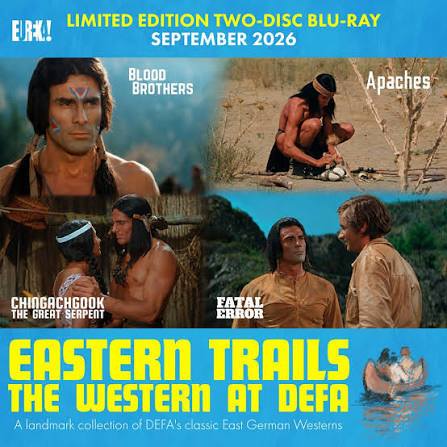
RAVING REVIEW: Westerns have never been the easiest sell for me, so putting four of them into one six-hour box set sounds more like an assignment than an invitation. EASTERN TRAILS: THE WESTERN AT DEFA, however, comes with an angle strange enough to make the familiar landscapes worth another look immediately. These aren't American westerns or even the Italian variations that reshaped the genre during the same period. They're East German productions made by the state-operated DEFA studio, looking across the Atlantic at the mythology of America's frontier and deciding that the people traditionally pushed to the edges of those stories should be standing in the middle instead.
Eureka's latest Masters of Cinema collection brings together CHINGACHGOOK THE GREAT SERPENT, FATAL ERROR, APACHES and BLOOD BROTHERS, spanning 1967 through 1975. All four star Gojko Mitić, the Yugoslav actor who became an enormous star throughout East Germany and much of Eastern Europe through these so-called Indianerfilme. The name is dated, as are plenty of things about the movies themselves, but their place in Western history is fascinating.
These films emerged alongside the Spaghetti Western yet approach many of the same genre conventions from another direction. Settlers, soldiers, prospectors, and businesspeople who would've occupied heroic positions in plenty of American productions are often the threat here, while Native characters take the traditional Western hero's role. Land theft, broken agreements, exploitation, and massacres aren't unfortunate background events occurring while cowboys have adventures. They're usually the reason the adventure is happening at all.
CHINGACHGOOK THE GREAT SERPENT is probably the easiest entry point. Based on James Fenimore Cooper's THE DEERSLAYER, Richard Groschopp's film puts Mitić as Chingachgook, who sets out with Deerslayer (Rolf Römer) to rescue his kidnapped bride-to-be, Wahtawa (Andrea Drahota). The basic construction remains recognizable enough that anyone familiar with older adventure westerns can settle in quickly, even as the perspective begins shifting away from what Hollywood audiences of the period would've expected.
Mitić immediately explains why DEFA kept bringing him back. He's an extremely physical performer, and the movies frequently build around his athleticism rather than asking him to carry everything through dialogue. Running, horseback riding, climbing, and combat give Chingachgook an almost mythic quality, while Mitić has enough screen presence to survive some of the more rigid dramatic material surrounding him.
The film also makes the contradictions of the entire collection obvious. Putting a Native protagonist at the center and treating colonial expansion critically was a meaningful departure from countless westerns that had reduced Indigenous people to anonymous threats. That doesn't suddenly make an East German production starring a Yugoslav actor an authentic representation of Native American cultures, though, and much of the costuming, dialogue, and characterization still relies on broad ideas filtered through Europeans looking at America from thousands of miles away.
FATAL ERROR moves away from the adventure structure and gives the politics considerably less room to hide. Oil discovered on reservation land should theoretically provide opportunity for the Shoshone people living there. Still, the Wyoming Oil Company has little interest in allowing the people who own the land to benefit from what's underneath it. Mitić's Shave Head and his half-brother Chris Howard, played by Armin Mueller-Stahl, gradually uncover a system built around corruption and violence.
Of these four films, FATAL ERROR may be the clearest example of DEFA turning western mythology into an ideological argument. Capitalism isn't merely somewhere in the background; exploitation becomes the villain. The movie can be so direct that characters occasionally seem to represent positions before they function as people, and subtlety certainly isn't one of the collection's defining qualities.
Still, Mueller-Stahl gives this entry another level of dramatic credibility, while the murder-mystery elements keep the political message attached to an actual story. It's also interesting to see an early major performance from an actor who would eventually become familiar to audiences far beyond East Germany. The film doesn't escape the stiffness that occasionally surfaces throughout these productions, but its anger gives it a sharper personality than a generic frontier adventure would've provided.
APACHES is considerably harsher. Gottfried Kolditz's film follows Ulzana (Mitić), one of the survivors of a massacre carried out against the Mimbreno Apache people after American interests begin coveting valuable resources on their land. Revenge naturally follows, but there's significantly less romantic adventure surrounding the violence this time.
The massacre gives APACHES an immediacy the earlier films sometimes lack. Kolditz isn't particularly interested in making frontier expansion look noble, and the brutality inflicted on Ulzana's people pushes the movie toward something closer to a revenge film. Mitić fits that shift well, especially because his physicality lets Ulzana's anger come through movement rather than endless explanation.
At the same time, APACHES shows one of its biggest weaknesses, which builds across the set. The moral divisions can become extremely clean. American expansionists are frequently greedy, violent, or deceitful. At the same time, Indigenous characters are positioned as victims or righteous resistance fighters, and flipping the traditional Western's morality doesn't automatically create more complicated characters.
Understanding why East German filmmakers approached the material this way has historical value, especially during the Cold War. These westerns weren't being produced in an ideological vacuum any more than Hollywood westerns were. They're challenging one national mythology while constructing another interpretation that served the values of the society producing them.
BLOOD BROTHERS makes another interesting adjustment by bringing American singer and actor Dean Reed into the story. Reed, sometimes called the "Red Elvis," plays Harmonika, an American soldier who rejects the violence being committed against the Cheyenne and eventually finds himself living among them. His relationship with Mitić's Hard Rock provides the title and gives the fourth film a somewhat different emotional foundation.
Reed and Mitić are an unusual pairing, but that helps BLOOD BROTHERS distinguish itself after several hours of similar landscapes and conflicts. Harmonika essentially becomes the white character who can recognize the lies supporting expansion, which isn't exactly a new device. Yet, the movie uses his shifting loyalties to explore the cost of rejecting the group that once defined him.
By the fourth movie, repetition has inevitably become an issue. Corrupt white men, threatened Native communities, broken promises, massacres, and Mitić standing against injustice have appeared in enough combinations that the overall pattern becomes difficult to ignore. Watching these four productions together makes their historical importance clearer, but it also exposes how closely many of their ideas and dramatic structures overlap.
That's where EASTERN TRAILS works better for me as a piece of film history than as six straight hours of entertainment. Individual entries have exciting action, impressive location photography and a charismatic star. Still, the collection becomes far more compelling once you begin asking why these films existed and who they were made for. The American West became a surprisingly useful canvas for East Germany to project its own political worldview.
There's an irony in that process that's impossible to ignore. DEFA was challenging Hollywood for presenting American expansion largely from the settler's perspective, yet East German filmmakers were still creating stories about Native Americans without actually being Native Americans themselves. These movies can feel progressive and dated at the same time, sometimes within the same scene.
That tension makes the supplemental material especially valuable. Eureka includes a new commentary on APACHES from film historian Michael Brooke, while Western scholar Jenny Barrett's video essay examines how these productions depicted American history. An interview with Dean Reed adds useful context to BLOOD BROTHERS, and the archival Reed performance offers another glimpse into how unusual his cultural position became.
The limited-edition book also begins an extended examination of DEFA's Indianerfilme by Lee Broughton, which feels particularly appropriate for a release where understanding the background changes the experience considerably—watching them as four obscure westerns misses much of what makes them noteworthy. Knowing how successful the films became throughout Central and Eastern Europe, and how Mitić emerged as a major star through them, turns the collection into something much stranger and more interesting.
All four features arrive in 1080p, restored by the DEFA Foundation, with original German audio and newly translated English subtitles. The set is Region B and limited to 2,000 copies, with Eureka placing it firmly within Masters of Cinema rather than treating the films as curiosities tucked into a novelty collection.
None of that means the movies suddenly overcome every problem of their period. Performances can be rigid, the political messaging occasionally becomes too obvious, cultural representation requires plenty of historical context, and watching all four reveals a formula that was easier to overlook one film at a time. The action and landscapes often remain impressive, but there are stretches where the historical importance is carrying more weight than the drama.
That's also why EASTERN TRAILS: THE WESTERN AT DEFA earns a 3/5 rather than becoming something I'd recommend indiscriminately. Western fans interested in corners of the genre Hollywood rarely exposes will find far more here than someone simply looking for four great movies. These films aren't forgotten masterpieces waiting to replace the American classics, but they don't need to be.
Their value comes from seeing one of America's most recognizable genres leave America, pass through the political and cultural machinery of East Germany, and return looking strangely familiar while arguing something very different. I wouldn't suddenly call myself converted to westerns after six hours with Gojko Mitić, but EASTERN TRAILS gave me a reason to look at the genre from a direction I hadn't spent much time considering. For a collection built around traveling west by looking east, that's enough to make the trip worthwhile.
Please visit https://linktr.ee/overlyhonestr for more reviews.
You can follow me on Letterboxd, Instagram, Twitter, and YouTube. You can also find my social media accounts on most platforms by searching for 'Overly Honest Reviews'.
I’m always happy to hear from my readers; please don't hesitate to say hello or send me any questions about movies.
[photo courtesy of EUREKA ENTERTAINMENT]
DISCLAIMER:
At Overly Honest Movie Reviews, we value honesty and transparency. Occasionally, we receive complimentary items for review, including DVDs, Blu-rays, CDs, Vinyl Records, Books, and more. We assure you these arrangements do not influence our reviews, as we are committed to unbiased, sincere evaluations. We aim to help you make informed entertainment choices regardless of our relationship with distributors or producers.
Amazon Affiliate Links:
This site also contains Amazon affiliate links. If you purchase through these links, we may receive a commission. This affiliate arrangement does not affect our commitment to honest reviews and helps support our site. We appreciate your trust and support as you navigate these links.


Happy
0 %

Sad
0 %

Excited
0 %

Sleepy
0 %

Angry
0 %

Surprise
0 %
 0
0
 0
0


Average Rating