The Horror Hiding Behind Every Version
Read Time:6 Minute, 56 Second
MOVIE REVIEWS
Burning (Ot)
 –
– 


Genre: Horror, Mystery, Psychological Thriller, World Cinema
Year Released: 2024, 2026
Runtime: 1h 41m
Director(s): Radik Eshimov
Writer(s): Aizada Amangeldy, Dastan Madalbekov
Cast: Aysanat Edigeeva, Ömürbek Izrailov, Kalicha Seydalieva, Zhanilai Isakova, Askar Kachkynbaev, Ruslan Orozakunov, Meerim Kasabolotova
Where to Watch: streaming exclusively on IndiePix Unlimited on Amazon Prime Video, beginning September 4, 2026
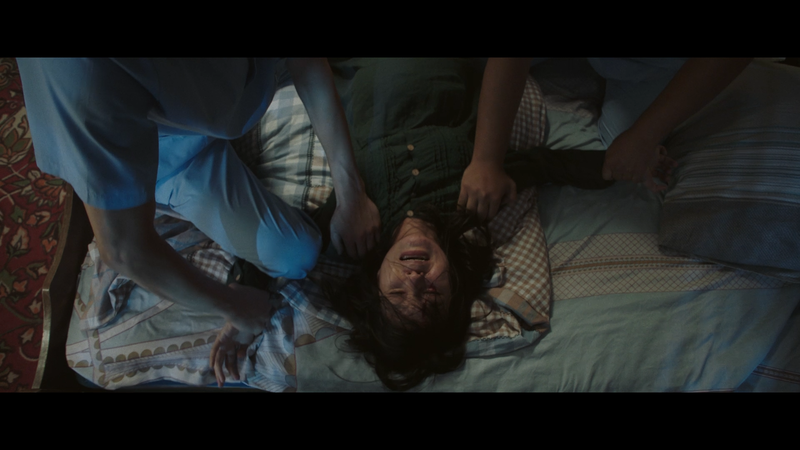
RAVING REVIEW: Aysanat Edigeeva spends the majority of BURNING being observed rather than understood. As Asel, a young mother grieving the death of her firstborn, she has the guarded existence of someone living in a place where every motion can be interpreted by somebody else. Neighbors notice her behavior, her mother-in-law’s rituals, her husband’s frustration, and the family’s isolation, then fill the gaps with whatever explanation makes the most sense to them. Director Radik Eshimov lets that casual observation shape the horror. The people watching aren’t short on confidence, even when what they actually know is remarkably limited.
That confidence drives the film’s fractured structure. A house burns down during a storm, and neighbors gathered at a local shop begin gossiping about what might have caused the fire. One account casts Farida (Kalicha Seydalieva), Asel’s imposing mother-in-law, as the source of something supernatural. Another places suspicion on Asel herself. Marat (Ömürbek Izrailov), Asel’s husband, takes on different personalities depending on who remembers him. The comparisons to RASHOMON are unavoidable, and BURNING openly accepts that tradition, but Aizada Amangeldy and Dastan Madalbekov’s screenplay isn’t using conflicting testimony merely to stage the unknown here. Each version exposes the assumptions of the person telling it.
Repetition is where the movie occasionally strains. The same moments return with altered versions, and the first half spends a little too long making sure the audience recognizes what changed. The structure requires overlap, but not every repeated idea earns the time it’s given. Eshimov becomes more economical as the film progresses, trusting subtler shifts in behavior, framing, and performance to convey information that earlier sections spell out. The score can be similarly forceful, pushing certain scenes toward menace when the discomfort already exists without much assistance. BURNING is more effective when the house is quiet, and the people inside it are left to make us uneasy on their own. Although, in the end, so much of this is about personal taste and what those moments ultimately bring to you. I felt justified in understanding the story's progression without that added context, but I could also see why that additional context might help fill things in for some viewers.
Seydalieva benefits from that uneasiness. Farida enters the family home carrying herbs, beliefs, and an authority that makes her difficult to read. In one version she can seem almost otherworldly; in another, the same actions feel far less like evidence of danger than as behavior filtered through somebody else’s fear. Seydalieva never overplays the uncertainty. Izrailov faces a different challenge with Marat, whose temperament shifts depending on the storyteller. A look of exhaustion can become resentment, and a moment that appears passive can acquire a much uglier meaning when the surrounding details change. The performances have to remain recognizable while supporting contradictory interpretations, and all three leads manage that balance incredibly well.
Edigeeva has the hardest task here, because Asel is the person most frequently reduced to somebody else’s explanation. Grief makes her vulnerable. Her silence can be treated as instability, her fear as irrationality, and her attempts to navigate the household as proof for theories that have already been formed about her. Edigeeva gives those scenes an emotional consistency that the storytelling intentionally withholds elsewhere. Even when the movie is asking us to reconsider what we’ve seen, Asel never feels like something placed there to make the next twist possible. There’s a person underneath all that speculation, and the gradual recognition of how little the people around her have bothered to understand her becomes more disturbing than the question of whether the house carries a curse.
The film’s treatment of domestic violence gives those competing stories a purpose beyond determining who is telling the truth. Supernatural potential, gossip, family expectations, and talk of madness offer convenient explanations for trouble that people can observe from a safe distance. Distress is visible, yet everyone interprets it according to assumptions about marriage, motherhood, masculinity, and reputation. Eshimov is especially good at showing how concern can become entertainment once a private tragedy turns into the story everybody in town wants to discuss. The people talking about their own theories don’t necessarily see themselves as cruel. That makes their certainty more uncomfortable.
Kerim Kasymaliev’s cinematography supports all of this without making the film visually overwhelming. The wide framing often leaves enough room around the characters that the house itself feels exposed, as though privacy barely exists even behind closed doors. Exterior scenes have a damp, muted quality that makes the fire especially violent against its surroundings. Inside, ordinary spaces become uncomfortable through placement and distance rather than elaborate production design. Eshimov allows a few more overt horror images into the film as a witness’s imagination begins to influence what we see, but the most unsettling parts remain recognizable. BURNING can flirt with possession, curses, and ritual while keeping its attention on behavior that needs no supernatural explanation.
Its success feels appropriate for a movie that relies much more on perspective and performance than spectacle. Eshimov doesn’t simply borrow the ideas of RASHOMON and leave them untouched. He applies that structure to a community where rumor, tradition, grief, and gender influence which version of a woman’s life other people are willing to accept. The culture and settings give the story its personality without making its behavior seem remote. Gossip operates pretty much the same everywhere. People see fragments, fill in whatever they miss, and eventually become certain enough of their conclusions to repeat them as facts.
BURNING doesn’t handle every moment with the same restraint. A few underline ideas that have already landed, and the music occasionally competes with scenes that would be stronger left alone. Those limitations keep the film from hitting quite as hard as its best parts, but honestly, that’s nitpicking; that’s trying to find reasons to think about what could have improved the film, not necessarily reasons why the film didn’t work. They don’t undo the precision of its structure or the strength of Edigeeva, Izrailov, and Seydalieva, whose evolving performances make the recurring scenes worthwhile. By the final stretch, the origin of the fire is only part of what needs to be explained. What stayed with me is how thoroughly Asel can be talked about, judged, feared, and pitied by people who never really know what is happening inside her home. The different versions matter, but so does the willingness of everyone outside that house to believe the one that asks the least of them.
Please visit https://linktr.ee/overlyhonestr for more reviews.
You can follow me on Letterboxd, Instagram, Twitter, and YouTube. My social media accounts can also be found on most platforms by searching for 'Overly Honest Reviews'.
I’m always happy to hear from my readers; please don't hesitate to say hello or send me any questions about movies.
[photo courtesy of INDIE PIX FILMS]
DISCLAIMER:
At Overly Honest Movie Reviews, we value honesty and transparency. Occasionally, we receive complimentary items for review, including DVDs, Blu-rays, CDs, Vinyl Records, Books, and more. We assure you that these arrangements do not influence our reviews, as we are committed to providing unbiased and sincere evaluations. We aim to help you make informed entertainment choices regardless of our relationship with distributors or producers.
Amazon Affiliate Links:
Additionally, this site contains Amazon affiliate links. If you purchase through these links, we may receive a commission. This affiliate arrangement does not affect our commitment to honest reviews and helps support our site. We appreciate your trust and support as you navigate these links.


Happy
0 %

Sad
0 %

Excited
0 %

Sleepy
0 %

Angry
0 %

Surprise
0 %
 0
0
 0
0


Average Rating