The Myth of the Ordinary Man
Read Time:8 Minute, 41 Second
MOVIE REVIEW
Falling Down (Limited Edition)
 –
– 

Genre: Drama, Crime, Thriller
Year Released: 1993, 2026 4K
Runtime: 1h 53m
Director(s): Joel Schumacher
Writer(s): Ebbe Roe Smith
Cast: Michael Douglas, Robert Duvall, Barbara Hershey, Rachel Ticotin, Tuesday Weld, Frederic Forrest, Lois Smith, Michael Paul Chan, Steve Park, D.W. Moffett, Raymond J. Barry, Dedee Pfeiffer, Vondie Curtis-Hall
Where to Watch: available now, order your copy here: www.arrowvideo.com, www.mvdshop.com, or www.amazon.com
RAVING REVIEW: The uncomfortable thing about FALLING DOWN is that its starting point doesn’t feel that far from reality. Not the violence, not the cruelty, not the choices William Foster makes once he starts crossing lines, but the exhaustion underneath that first step out of the car. Everyone has had some version of that day. The traffic won’t move. The prices make no sense. The rule you’re asked to follow is stupid. The person in front of you doesn’t care. The system has an answer for everything except relief. Joel Schumacher’s film understands that with alarming clarity, then follows it into the place most people know not to go.
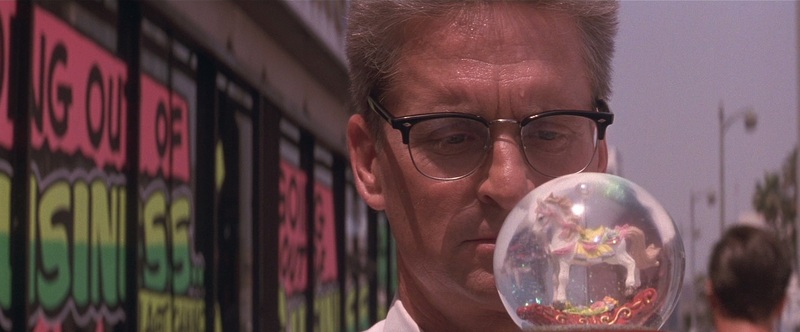
Michael Douglas plays Foster, nicknamed D-Fens, a man already beaten down by life before the movie begins. He’s unemployed, divorced, estranged from his daughter, trapped in the unrelenting heat of Los Angeles, and clinging to an idea of himself the world no longer recognizes. He doesn’t walk away from his car because one inconvenience breaks him. He walks away because one inconvenience lands on top of years of others. That’s the part of the film that has only become more relevant over the last 30 years. The world hasn’t gotten easier. It’s found new ways to squeeze regular people until even basic stability feels like a privilege.
That doesn’t make D-Fens a hero or even an antihero. It makes him recognizable, which is far more unsettling. I understand the anger of being pushed, charged, ignored, lied to, and told to keep smiling while everything gets more expensive, more hostile, and more rigged against you. I understand why a person reaches a point where the next shove feels like the one that finally does it. I would obviously never go to the lengths Foster goes to, and the film never gives him the moral permission to do so. The power of FALLING DOWN is that it lets you understand the pressure without excusing what he turns into.
That distinction matters more now than it may have in 1993. People have been looking for relief anywhere they can find it, and far too many listened when a con man told them their pain had a simple enemy. Instead of real help, they were handed a grievance. Instead of a way out, they were sold someone to hate. That choice put us in an even worse spot by returning a horrid man to the presidency, and it makes FALLING DOWN feel less like a relic and more like a warning that kept getting ignored. Foster’s tragedy isn’t only that he snaps. It’s that he decides his suffering entitles him to choose targets.
Douglas walks that line with a performance that remains one of his most unnerving. He doesn’t begin with the over-the-top madness. He begins with control, politeness, and the posture of someone who believes rules still apply as long as they apply in his favor. That’s what makes the performance sting. D-Fens is constantly presenting himself as reasonable while becoming more dangerous by the minute. He complains like a man trying to make a point, but the point keeps changing shape until all that’s left is entitlement with a weapon.
Los Angeles doesn’t look glamorous here. It looks hot, crowded, loud, and indifferent. Andrzej Bartkowiak’s cinematography turns daylight into pressure, filling the frame with concrete, traffic, storefronts, construction, fast-food counters, fences, and streets where everyone seems one insult away from boiling over. The film doesn’t need darkness to feel dangerous. D-Fens comes apart in public, in places where people are just trying to get through their own day.
Certain side characters are written more as symbols than people, and the racial and cultural shorthand can be blunt in ways that flatten parts of the world Schumacher is trying to capture. The movie is sharpest when it studies Foster’s self-mythology; it’s less precise when it turns strangers into checkpoints on his collapse. Those limitations are real, but they don’t cancel the film’s impact. If anything, they make the discomfort more complicated because the movie itself is wrestling with anger, fear, prejudice, and social fracture in a way that isn’t always tidy.
Robert Duvall’s Prendergast gives FALLING DOWN the counterweight it needs. He’s also tired. He’s also dismissed. He’s also living with pressure that other people don’t truly see. The difference is that he doesn’t treat pain as a license. Duvall plays him with decency rather than flashy heroism. His last day before retirement could’ve been a cliché, but Duvall turns it into something human. A man who still chooses responsibility when it would be easier to look away. Barbara Hershey is just as important as Foster’s ex-wife Beth because she punctures his fantasy of “going home.” To him, home is something he’s owed. To her, it’s a place he has made unsafe. Hershey gives the film its emotional reality. The movie needs Beth because she reminds us that every story has people trapped on the other side.
The military-surplus-store sequence remains one of the film’s most focused moments. Foster is confronted by someone who thinks they’re on the same side, who says the quiet part out loud, and assumes that shared hatred means a shared purpose. Foster recoils, but the moment doesn’t absolve him. It exposes how dangerous it is to build an identity around resentment while insisting you’re nothing like the worst people who share it. He wants to believe his anger is okay because it's different. The film knows better.
The modern world has created endless pressure points while offering fewer healthy outlets for pain. Wages lag, prices continue to climb, institutions fail, healthcare terrifies people, politics turns suffering into branding, and media ecosystems feed people a steady diet of blame. Foster’s path is extreme, but the emotion around him is suffocating. People feel cornered, and cornered people are easy to manipulate when someone tells them their rage is righteousness. I'd like to see what a film like this would look like today.
Arrow Video’s 4K release gives the film a fitting return because FALLING DOWN is built as much on texture as on plot. The glare of the pavement, the sweat, the cramped interiors, the faded signs, the hard edges of the city, and the strange brightness of its violence all matter.
Schumacher’s film endures because it refuses to let a bad day stay as just that one moment. It starts with a man pushed to the edge, then asks what happens when the last shove lands on someone who has mistaken frustration for truth. D-Fens wants to believe he’s waking up from a lie, but he’s really falling deeper into one. He thinks he sees the world because he’s angry. That may be the most relevant part of all.
FALLING DOWN is still shocking, still dark and funny, still uneven in places, and still all too alive. It understands the fantasy of finally saying no to a world that keeps taking, but it also understands the danger of letting that fantasy choose your enemies for you. Thirty years later, the world hasn’t stepped back from the edge. It has moved the edge closer to everyone and handed microphones to the people willing to shove.
Bonus Materials:
4K ULTRA HD LIMITED EDITION CONTENTS
Brand new 4K restoration by Arrow Films, approved by cinematographer Andrzej Bartkowiak
4K UHD (2160p) Blu-ray presentation in Dolby Vision (HDR10 compatible)
Newly restored original lossless stereo 2.0 and DTS-HD MA 4.0 surround audio
Optional English subtitles for the deaf and hard of hearing
Archival audio commentary by director Joel Schumacher, editor Paul Hirsch, screenwriter Ebbe Roe Smith, LA Times writer Shawn Hubler, and actors Michael Douglas, Michael Paul Chan, Vondie Curtis-Hall, and Frederic Forrest
Man on the Edge, a brand new interview with screenwriter Ebbe Roe Smith
At War with the World, a brand new interview with composer James Newton Howard
Going Home, a brand new location featurette revisiting the real-life Los Angeles sites used in Falling Down
Deconstructing D-Fens, an archival interview with Michael Douglas
Original trailer
Image gallery
Collectors’ booklet featuring new writing on the film by film critics Alexandra Heller-Nicholas and Simon Ward
Please visit https://linktr.ee/overlyhonestr for more reviews.
You can follow me on Letterboxd, Instagram, Twitter, and YouTube. My social media accounts can also be found on most platforms by searching for 'Overly Honest Reviews'.
I’m always happy to hear from my readers; please don't hesitate to say hello or send me any questions about movies.
[photo courtesy of ARROW VIDEO, MVD ENTERTAINMENT]
DISCLAIMER:
At Overly Honest Movie Reviews, we value honesty and transparency. Occasionally, we receive complimentary items for review, including DVDs, Blu-rays, CDs, Vinyl Records, Books, and more. We assure you that these arrangements do not influence our reviews, as we are committed to providing unbiased and sincere evaluations. We aim to help you make informed entertainment choices regardless of our relationship with distributors or producers.
Amazon Affiliate Links:
Additionally, this site contains Amazon affiliate links. If you purchase through these links, we may receive a commission. This affiliate arrangement does not affect our commitment to honest reviews and helps support our site. We appreciate your trust and support as you navigate these links.


Happy
0 %

Sad
0 %

Excited
100 %

Sleepy
0 %

Angry
0 %

Surprise
0 %
 1
1
 0
0


Average Rating