Two Ninja Movies Vibing on Pure Delirium
Read Time:7 Minute, 37 Second
MOVIE REVIEW
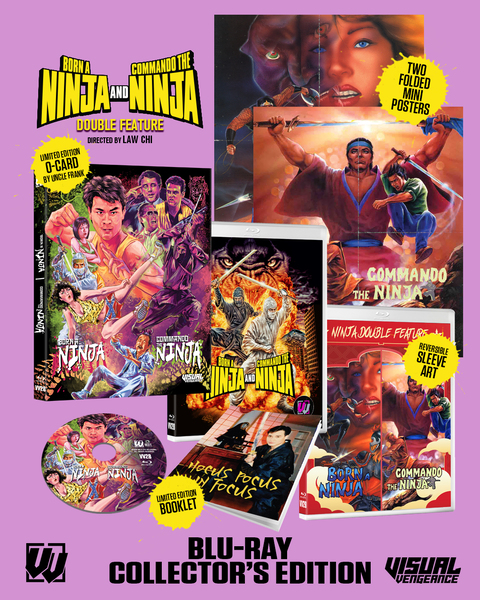
Born A Ninja / Commando The Ninja Double Feature [Visual Vengeance Collector's Edition]
 –
– 

Genre: Martial Arts, Action, Comedy
Year Released: 1988 / 1988, 2026 Visual Vengeance Blu-ray
Runtime: 1h 25m / 1h 26m
Director(s): Joseph Lai / Law Chi
Writer(s): Joseph Lai / Stephen So, AAV Creative Unit, Godfrey Ho
Cast: Patrick Largent, Daniel Garfield, Man Fei, Martin Chan, Hung Kuan, Yolanda Kuk, Laura Yang
Where to Watch: available now, order your copy here: www.mvdshop.com or www.amazon.com
RAVING REVIEW: BORN A NINJA and COMMANDO THE NINJA feel like somebody recorded a fever dream onto a stack of damaged VHS tapes, duplicated them fifty times, then accidentally created cult cinema gold in the process. Within minutes, ninjas are vanishing into smoke, people are screaming about stolen germ-warfare formulas, and a martial-arts style called “Hocus Pocus” is being taken seriously. None of it should work. Most of it barely makes sense. Yet both films attack the screen with such relentless, low-budget conviction that resisting their charm eventually becomes impossible. Logic stops mattering. Structure becomes optional. Dialogue sounds like it was translated through six different versions of Google Translate before arriving at the dubbing booth. Yet somehow, against every reasonable instinct, the experience becomes hypnotic. These aren’t high-end martial arts classics or forgotten gems waiting to be rediscovered as misunderstood masterpieces. They’re messy, ridiculous, aggressively low-budget fragments of 80s ninja exploitation operating entirely on raw enthusiasm, and that enthusiasm becomes impossible to resist.
What makes this Visual Vengeance double feature work so well is that both films understand chaos on the most primal VHS-era level imaginable. Every few minutes, something insane has to happen. A ninja disappears. Someone throws fireballs. A dramatic zoom crashes into someone’s face for absolutely no reason. Characters scream the name “Tanaka” like the fate of civilization depends on it. The movies move with the energy of filmmakers terrified that the audience might get bored if more than 30 seconds pass without another fight scene, an over-the-top stunt, or a bizarre editing decision interrupting the frame. And honestly, thank goodness for that.
The shot-on-video aesthetic gives these films a texture that would probably be impossible to recreate intentionally today. They look cheap because they are cheap. The lighting blows out constantly, the sound mix feels held together by a prayer, and the dubbing rarely even attempts to sync with the actors onscreen. Yet that becomes part of the identity. There’s no ironic self-awareness, trying to manufacture cult appeal. This is genuine exploitation filmmaking made during an era when you could seemingly stitch together unfinished footage, wild concepts, ninja iconography, and random espionage plots into something resembling a movie. Or, in this case, two movies that barely resemble reality itself.
BORN A NINJA feels slightly more deranged, which somehow works in its favor. The film bounces between germ-warfare conspiracies, ninja assassins, martial-arts duels, and the supernatural with the confidence of a production convinced the audience will absolutely keep up. They won’t, but that confusion becomes part of the fun. The pacing is relentless in the strangest possible way. Scenes don’t build naturally toward one another so much as violently collide together. Entire conversations feel like they begin halfway through and end before the point is made. Characters appear and disappear without reason. At one point, the film almost seems bored with its own plot and simply starts throwing more ninjas at the screen.
COMMANDO THE NINJA, meanwhile, feels marginally more coherent, though only marginally. The action lands a little harder, the momentum flows more naturally, and the film leans further into pure absurdity. The fashion, hilariously serious performances, and bizarre “international espionage” atmosphere create the sensation of watching somebody’s heavily damaged memory of an action movie rather than the action movie itself.
What’s surprising is how watchable both films remain despite every obvious flaw. A lot of bad cinema becomes exhausting because it collapses under incompetence without compensating for entertainment value. These movies never stop compensating. Even when scenes drag, something completely insane eventually comes around the corner to wake things back up.
Daniel Garfield’s Larry becomes central to why these films remain memorable. The “Hocus Pocus Master” concept is already absurd in basically every way, but Garfield's commitment to the material somehow stabilizes the insanity around him. Patrick Largent’s Ninja Master David operates on the same wavelength. Neither performance is traditionally “good” by any metric, but both actors understand the assignment. In movies this bizarre, hesitation would kill everything. Commitment is the only thing keeping them alive.
That same commitment extends to the fight choreography. Some of the action is clumsy, some of it is surprisingly energetic, and almost all of it feels built through pure force of will. Yet there’s an undeniable charm to watching productions this resourceful trying to stage large-scale ninja warfare on microscopic budgets. Zip lines, smoke bombs, crash zooms, random battles, and endless ambushes keep the films moving. They may not always make sense, but they rarely feel lifeless.
The restoration and presentation work from Visual Vengeance deserves serious credit, too. Releases like this matter because they preserve a very specific lane of exploitation history that major studios would happily let disappear forever. Shot-on-video martial arts cinema was never built for prestige. These were movies designed for rental store shelves, bootleg circulation, and late-night cable. Seeing them treated with genuine care rather than dismissal gives the release added value beyond nostalgia. The bonus features help contextualize the strange ecosystem these films came from. The included essays and interviews deepen appreciation for just how bizarre and prolific the production pipeline of Godfrey Ho and Joseph Lai really was.
And honestly, one of the biggest highlights of the entire set ends up being the commentary tracks. Hearing Justin Decloux and Will Sloane from The Important Cinema Club tackle COMMANDO THE NINJA feels like listening to two people perfectly equipped for this exact kind of chaos. Their enthusiasm for exploitation and knowledge of cult film history make the experience even more entertaining. Decloux’s solo commentary on BORN A NINJA works just as well because he understands the balance required for movies like these. He’s not mocking them from a distance or trying to elevate them into something they’re not. He understands why this kind of trash cinema becomes lovable to the right audience. As someone who’s become a huge fan of The Important Cinema Club, I found that hearing them engage with material this unhinged added an entirely different layer of enjoyment to the release.
That’s really what this double feature ultimately captures, the joy of discovery. Not a perfected studio filmmaking. Discovery. The feeling of stumbling across some impossibly strange relic at two in the morning and wondering how something this insane ever got completed, distributed, and remembered decades later. These movies feel like artifacts from an alternate dimension where ninja films never stopped. And somehow, against every reasonable critical instinct, that makes them incredibly fun to watch.
Bonus Materials:
SD masters from original tape elements
Commando the Ninja commentary with Justin Decloux and Will Sloane of The Important Cinema Club
Born A Ninja with commentary by Justin Decloux of The Important Cinema Club
The Essential Godfrey Ho – Video Essay
The Law Chi Touch – Video Essay
Actor Kwan Chung interview
Image Gallery
Original Trailers
Visual Vengeance Trailers
Optional English subtitles
Two-fold mini-posters with original VHS art
Reversible sleeve featuring original VHS art
‘Stick Your Own’ VHS sticker set – FIRST PRESSING ONLY
Limited Edition O-Card by Uncle Frank – FIRST PRESSING ONLY
Booklet with essay by ninja movie expert C.J. Lines
Blu-ray sleeve featuring art by The Dude
Please visit https://linktr.ee/overlyhonestr for more reviews.
You can follow me on Letterboxd, Instagram, Twitter, and YouTube. My social media accounts can also be found on most platforms by searching for 'Overly Honest Reviews'.
I’m always happy to hear from my readers; please don't hesitate to say hello or send me any questions about movies.
[photo courtesy of VISUAL VENGEANCE, MVD ENTERTAINMENT]
DISCLAIMER:
At Overly Honest Movie Reviews, we value honesty and transparency. Occasionally, we receive complimentary items for review, including DVDs, Blu-rays, CDs, Vinyl Records, Books, and more. We assure you that these arrangements do not influence our reviews, as we are committed to providing unbiased and sincere evaluations. We aim to help you make informed entertainment choices regardless of our relationship with distributors or producers.
Amazon Affiliate Links:
Additionally, this site contains Amazon affiliate links. If you purchase through these links, we may receive a commission. This affiliate arrangement does not affect our commitment to honest reviews and helps support our site. We appreciate your trust and support as you navigate these links.


Happy
0 %

Sad
0 %

Excited
0 %

Sleepy
0 %

Angry
0 %

Surprise
0 %
 0
0
 0
0

Average Rating