Survival Comes With Complications
Read Time:8 Minute, 12 Second
MOVIE REVIEW
Portraits Of The Apocalypse (Retratos del apocalipsis)
 –
– 

Genre: Horror
Year Released: 2024, 2026 Cleopatra Entertainment DVD
Runtime: 1h 15m
Director(s): Nicanor Loreti, Fabián Forte, Luca Castello
Writer(s): Nicanor Loreti, Fabián Forte, Luca Castello
Cast: Demián Salomón, Lorena Vega, Ezequiel Rodríguez, Paula Manzone, Natalia Santiago, Paula Rubinsztein
Where to Watch: available now, order your copy here: www.cleorecs.com, www.mvdshop.com, or www.amazon.com
RAVING REVIEW: A missing cat receives more attention than the collapse of civilization. That imbalance makes perfect sense in PORTRAITS OF THE APOCALYPSE, where people remain preoccupied with private lives, family struggles, and unresolved grief even after the dead begin walking through Buenos Aires. The world may be ending, but someone still wants to finish an argument, conceal an error, or get a few hours of sleep.
Nicanor Loreti, Fabián Forte, and Luca Castello divide the outbreak into four interconnected stories. Each captures a different stage of the disaster, moving from the first signs of infection toward a reality where survival has become routine. The chapters share a world without trying to make it all one continuous plot, allowing the directors to approach familiar zombie tropes through police noir, domestic comedy, found footage, religious horror, and intimate tragedy.
That range is also the source of the film’s unevenness. Certain chapters feel complete within their brief running times, while others resemble promising introductions to stories that end just as their larger possibilities really take hold. The connections between them are satisfying without being especially intricate. Rather than fitting together like pieces of a mystery, they operate as reports from separate corners of the same emergency.
Loreti opens with MURDER AT THE SCENE OF THE CRIME, following police officer Muriel Sosa as she attempts to manage a disastrous situation inside a house containing several bodies. Her greatest problem initially appears to be professional rather than supernatural. She’s made a serious mistake and begins arguing about how to cover it up. Paula Manzone handles that internal conflict with a tense comic edge. Muriel’s conscience becomes a second participant in the scene, criticizing her decisions while also offering increasingly questionable advice. This externalizes the panic of someone who knows that any honest account of what happened will destroy her career. By the time the corpses begin creating issues, she has already demonstrated how quickly fear can turn judgment into self-preservation.
The chapter’s dark humor comes from watching a person worry about the wrong catastrophe. Muriel remains consumed by the consequences of her own actions while an unprecedented threat develops around her. Loreti doesn’t need a crowded street or large-scale attack to establish the outbreak. One compromised person in one room is enough to show how badly institutions will handle what is coming.
RATS, directed by Forte, shrinks the crisis further by placing it inside an apartment. An older woman is convinced that large rats have taken her cat, while her exhausted son-in-law wants everyone to leave him alone. Her daughter is caught between concern and irritation, trying to settle a household disturbance that becomes increasingly difficult to explain. The segment earns its stripes by allowing family tension to continue after the danger has become visible. Nobody wants to treat the mother’s fears seriously because she has apparently made odd assumptions before. The son-in-law’s condition is dismissed because his attitude isn’t unusual enough to trigger alarm. Each person has an established role in the family, and those roles prevent them from recognizing when the situation has fundamentally changed.
Forte uses irritation as effectively as fear. The characters snap at one another, make assumptions, and delay because acknowledging the truth would require far more effort than continuing the argument. The humor doesn’t reduce the threat. It reveals how easily people can explain away warning signs when the alternative is admitting that their home is no longer safe.
The first two chapters give PORTRAITS OF THE APOCALYPSE a solid intro. Both understand that panic often begins with denial, embarrassment, or inconvenience rather than heroism. They also benefit from compact settings that keep the production’s limitations from becoming distracting. The makeup and physical effects are used selectively, giving each enough impact without requiring armies of infected extras.
The tone shifts sharply with RUBÍ, directed by all three filmmakers. Lorena Vega plays a pregnant woman recording messages for her unborn daughter from an isolated home. She and her partner have survived beyond the first wave, though their safety has grown increasingly fragile. Her video diary becomes an attempt to preserve a relationship that may never have the chance to exist. The image isn’t presented as evidence recovered for an audience. It feels like something created for one person, carrying instructions, affection, fear, and an incomplete history. Vega’s character understands that hope may require preparing for an outcome she can barely bear to consider.
Ezequiel Rodríguez brings a harsher take to the chapter. His character regards the recordings as a distraction from the practical decisions keeping them alive. Neither perspective is treated as entirely unreasonable. Food, shelter, and security matter, but survival without the memory can become another form of disappearance. Their disagreement gives the segment an emotional conflict that doesn’t depend on the infected entering the house.
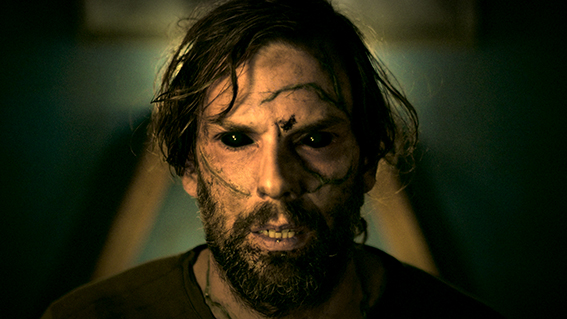
Castello closes the anthology with THE KING OF THE DAMNED, the most ambitious and unsettling of the four stories. Demián Salomón plays a father who has captured the zombie responsible for his son’s death. He believes the creature may provide a means of reaching the child again, turning his home into a place where grief, imprisonment, and ritual have become inseparable. This chapter expands the outbreak beyond infection and suggests that something spiritual or demonic may be involved. The idea could have weakened the “realism” established earlier, but Castello treats it as an expression of desperation rather than an explanation delivered through exposition. The father doesn’t need proof that his plan will work. He needs the possibility to be real because accepting his son’s absence would leave him with nothing to pursue.
The restrained creature effects benefit the final chapter. The zombie isn’t merely an attacker waiting to escape its restraints. It becomes an object onto which the father projects guilt, anger, and desperate belief. That relationship brings PORTRAITS OF THE APOCALYPSE closer to occult horror, separating the ending from the expected military barricades or desperate escape routes of many outbreak movies.
The shift also leaves several ideas underexplored. A demonic source for the catastrophe opens a much larger mythology than the film has time to examine, and the closing chapter feels capable of sustaining its own feature. Instead, the story introduces a disturbing possibility, follows it to one brutal consequence, and ends before the wider implications can take shape.
Demián Salomón and Ezequiel Rodríguez reunite after WHEN EVIL LURKS, though PORTRAITS OF THE APOCALYPSE uses them in separate stories rather than building the film around that association. Their presence strengthens the ensemble without overwhelming performers in the quieter chapters. Manzone and Vega leave equally strong impressions, each grounding extraordinary circumstances in recognizable fear.
Anyone expecting relentless attacks and citywide chaos will find a much smaller production. The directors are less interested in depicting the scale of destruction than in watching people fail to understand what it means. That focus produces four worthwhile ideas rather than four equally satisfying stories. The first chapter is sharp and anxious, the second mixes family frustration with a dread and creeping horror, the third reaches for emotional weight, and the fourth introduces the collection’s most original concept. None overstays its welcome, although two end before their strongest ideas have been fully explored.
PORTRAITS OF THE APOCALYPSE doesn’t reinvent the zombie, and its episodic structure can’t completely hide the gaps created by limited time and resources. Its best choice is refusing to measure the end of the world by the number of bodies filling the streets. People make selfish decisions, cling to routines, underestimate those around them, and search for impossible ways to recover what has been lost. The dead may be reclaiming Buenos Aires, but the living remain trapped by concerns that existed before the first body rose. Civilization doesn’t collapse all at once. It disappears behind closed doors, one frightened decision at a time.
Bonus Materials:
Bonus Trailers, Slide Show & more!
Please visit https://linktr.ee/overlyhonestr for more reviews.
You can follow me on Letterboxd, Instagram, Twitter, and YouTube. You can also find my social media accounts on most platforms by searching for 'Overly Honest Reviews'.
I’m always happy to hear from my readers; please don't hesitate to say hello or send me any questions about movies.
[photo courtesy of CLEOPATRA ENTERTAINMENT, MVD ENTERTAINMENT]
DISCLAIMER:
At Overly Honest Movie Reviews, we value honesty and transparency. Occasionally, we receive complimentary items for review, including DVDs, Blu-rays, CDs, Vinyl Records, Books, and more. We assure you that these arrangements do not influence our reviews, as we are committed to providing unbiased and sincere evaluations. We aim to help you make informed entertainment choices regardless of our relationship with distributors or producers.
Amazon Affiliate Links:
Additionally, this site contains Amazon affiliate links. If you purchase through these links, we may receive a commission. This affiliate arrangement does not affect our commitment to honest reviews and helps support our site. We appreciate your trust and support as you navigate these links.


Happy
0 %

Sad
0 %

Excited
0 %

Sleepy
0 %

Angry
0 %

Surprise
100 %
 1
1
 0
0

Average Rating